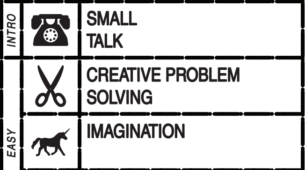
My team is prototyping a collaborative story-building, roleplaying, analog tabletop game referred to as Playwright for 4-10 people ages 8+, where each player’s assigned “Role” modifies their storytelling style. The Narrator each turn builds on the story in the Role-specified style, then players have 30 seconds to jot down a “Plot Point” continuation of the story. The next Narrator decides which Plot Point they’d like to incorporate on their storytelling turn. For our Competitive Analysis Critical Play, Ananya, Clara and I played Wing It: a fellow analog tabletop story-building game created by Molly Zeff and Jon Cannon, for 4-7 players ages 12+—its two types of cards are shown below. Each turn, given a blue “Situation” card, players have to invent and story-tell a resolution of the Situation using 3 of 5 red “Resource” cards in their hand, then the turn’s judge decides who gets the point. Both games encourage creativity—but Wing It more strongly incites Competition through modular Situations and storytelling-dependent points, while Playwright better evokes the aesthetic of Fantasy through Roles, and also allows more freedom of Expression and replayability with story-specific Plot Points.

At a high level, Playwright and Wing It are both games that provide Narrative fun, relying on players’ creativity to be played and enjoyed. For both, the “Starting Prompt” or Situation mechanic saves players from starting from a blank slate, like how a Dungeons and Dragons game begins in a unique universe that sets the context for all player actions. In Playwright, the narrative throughline is built solely by the players, both in their turn as the Narrator and as writers of the next Plot Point. Wing It operates with shorter rounds of “Call-and-Answer”: given the Situation, the players connect three nonsensical, unrelated Resources in an absurd story. The video below demonstrates how players weave in random Resources in their narration, resulting in engaging dynamics of setting the card down during the story that elevates Narrative fun, and of dramatic storytelling that invokes Sense Pleasure in the listeners. Both Wing It and Playwright involve verbal storytelling and benefit from the creative output of their players—the more they lean into unpredictable storylines and dynamic narrations, the more enjoyable the game.
Beyond these similarities, Wing It leans further into the double-edged fun of Competition than Playwright. Wing It has the mechanic of discrete rounds separated by each Situation card, where players “reset” and tell their absurd stories anew. When playing, this caused me to hyperfixate on how three of five Resources in my hand—in the image below—could solve the Situation in a hilarious way Clara would like. Because my story was completely disparate from Ananya’s, who I was competing against, and was not correlated to any of the previous rounds, I felt pressured to speak more dramatically than I was comfortable with in order to win. I feel that the winning mechanic of this game is biased against players who are not practiced in telling stories engagingly to others. Not all players enjoy Competition—a variation for them would be for everyone to collaboratively come up with a solution that creatively incorporates the Resource cards under a time limit. However, in Playwright, all verbal storytelling is free from the pressure of judgment and is not the only mechanic that the points depend on. Although Wing It gives rise to Competition fun, it can be uncomfortable for some players to fully engage in its only mechanic that allows players to win.

Another difference between Wing It and Playwright is the ability for players to experience the aesthetic of Fantasy, to step into a new role they do not usually play. In Wing It, every story is spoken from the perspective of who the player is in real life, albeit with some additional dramatic flairs; completely Narrative-reliant points and the lack of roleplaying in storytelling attribute success to one’s ability to just be a funny, engaging person. Wing It may be biased against introverts, which I believe Playwright remedies with its Role mechanic: it changes the players’ narrative voice with clear behavior cues such as “Go into detail about something irrelevant” or “Fall in love with everything”. Especially when backed by points that incentivize playing your Role correctly—a mechanic we are prototyping—players want to follow these cues to win, but also simply because it is fun to speak under a set of rules that change one’s usual, day-to-day voice.
In addition to a stronger sense of Fantasy fun than Wing It through Roles, Playwright also allows for more freedom of Expression and replayability. Wing It, like the prompt and answer cards in Cards Against Humanity, has finitely many Situation (329) and Resource (89) cards. The game increases replayability with 8 blank Resource cards and numerous different permutations, and its pre-written cards reduce player cognitive load—but scrambling to relate random objects can get repetitive and tiresome after many iterations. Playwright asks the players for a little more creativity, as the current prototype does not provide pre-written Plot Points. However, the mechanic of player-written Plot Points encourages players to write story-specific points that are funny and understandable only to the people at the table, which contributes greatly to the aesthetic of Expression—each game truly is something unique and irreplicable.
Wing It and Playwright are both games of creatively weaving stories together. Each round of Wing It is a competition of who can tell the best story given pre-written, potentially repetitive Situations and Resources. Though similar, Playwright introduces roleplaying and collaborative, continuous story-building that kindle the aesthetics of Fellowship, Fantasy, and Expression, where each play can never be the same.