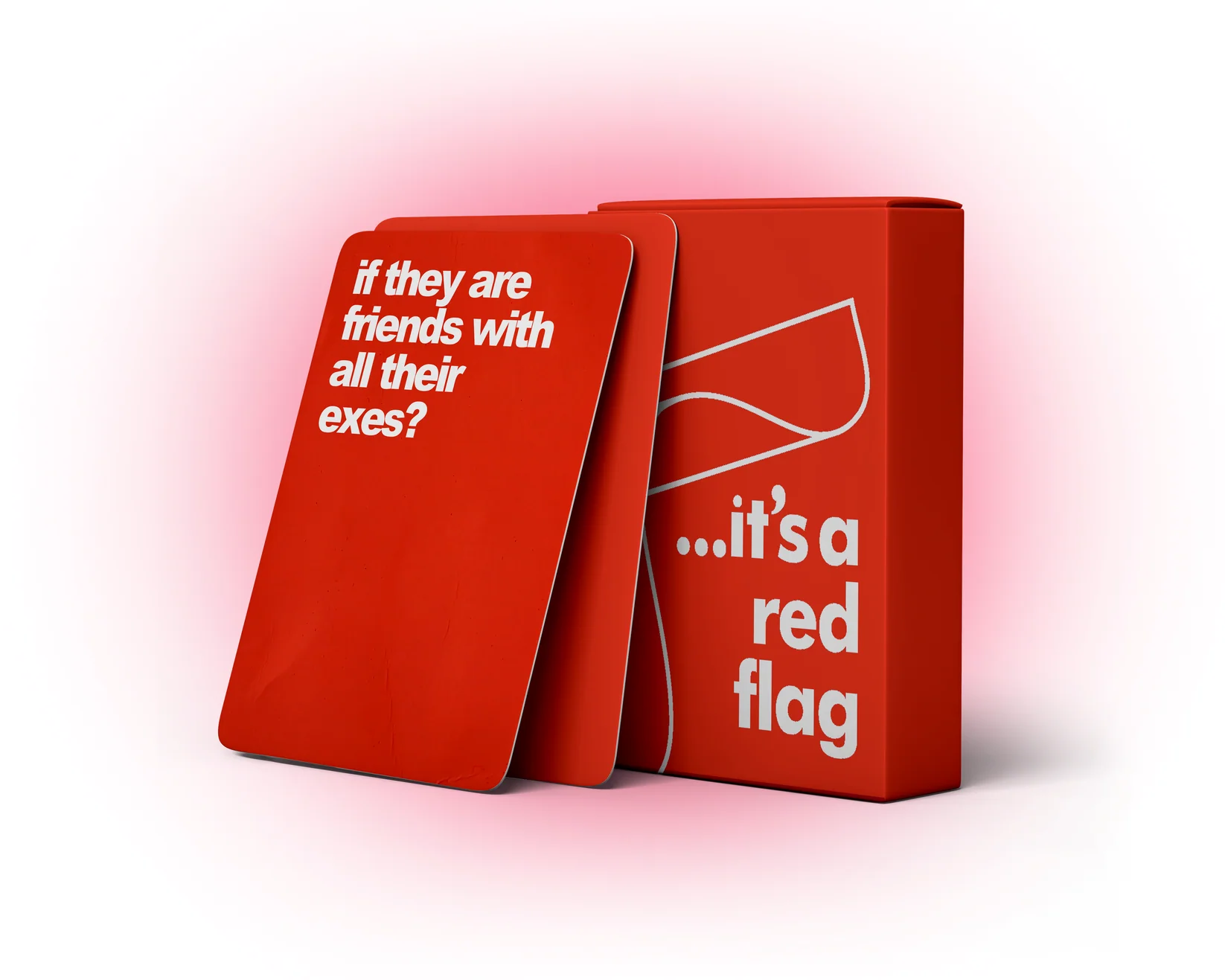
Red Flags is a social party card game created by Jack Dire that’s usually played in person in groups of 3-10 players (ages 17+) with physical cards (though I played the digital version). The game targets people who enjoy improvisation and social interaction play. On first glance, Red Flags and my team’s game, Dealbreakers, appear very similar: they both evaluate traits in the context of relationships and aim to spark conversation from all sides. However, the main difference is that Red Flags focuses on persuasion and performance but Dealbreakers focuses on understanding and modeling another person’s internal values. This distinction leads to fundamentally different player experiences, social dynamics, and opportunities for building friendships.
In Red Flags, the mechanic of combining two “perk” cards to construct an ideal partner, followed by the sabotage mechanic of adding a “red flag,” leads to a dynamic of competitive storytelling and argumentation. Players have to defend their constructed character by improvising narratives and persuade the “Single” to choose their candidate. This produces an aesthetic of narrative. For example, when I played with my friends Yazmin, Chinyoung, and Julieta, one of my favorite moments was watching players fully embody their characters based on perk cards. We were empowered to confidently sell our perks, and then become embarrassed when forced to justify the red flag attached to them, showing how we thought through awkward traits. That moment of mixing humor and social discomfort is a particularly effective design choice.
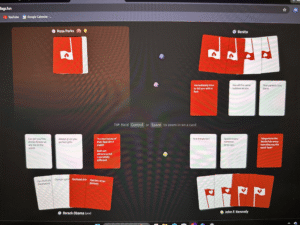
Another strong mechanic is the visible sabotage system. Players assign red flags to the person on their left, which creates a dynamic of indirect competition and targeted interference, where players are aware of who is undermining whom. This produces an aesthetic of challenge. Additionally, the argument phase allows players to appeal directly to the “Single,” creating a dynamic of persuasion and strategic communication. These mechanics collectively support creativity and engagement, but they also privilege extroversion and improvisational skill. Players who are less comfortable speaking up or performing might feel less involved.
In contrast, Dealbreakers shifts the focus toward interpretation. The core mechanic of the game is ranking dealbreaker traits from most to least unacceptable, combined with the guessing mechanic where other players attempt to reconstruct that ranking. This leads to a dynamic of perspective-taking and group reasoning. Players aren’t convincing others of their own ideas, but trying to understand the internal logic of the Ranker. The resulting aesthetic is one of discovery and fellowship. When the group debates their guesses, they reveal assumptions about each other’s values.
The addition of the “cutoff line” mechanic in round two furthers this structure. It forces the Ranker to distinguish between tolerable and completely unacceptable traits. This creates a dynamic of boundary-setting, which produces an aesthetic of expression. In Red Flags, humor often diffuses tension but Dealbreakers holds space for that tension to be discussed.
Red Flags primarily supports proximity and similarity. Players are physically together, engaging in shared humor, which fosters bonding through co-experience. The game also highlights similarity when players align on what makes a “good” or “bad” partner, but this is often secondary to the performance aspect. Dealbreakers, on the other hand, more directly engages reciprocity and disclosure, which are stronger drivers of deep social connection. The act of ranking dealbreakers requires players to disclose their personal values, even if indirectly. When others attempt to guess those rankings, reciprocity is shown trying to meet the Ranker’s perspective and validate their thinking. This back-and-forth creates a deeper level of interpersonal understanding.
Observing the ups and downs, Red Flags is fun right away. The energy is high, and people are laughing, but after a while the jokes start to feel the same. The loudest or funniest person usually wins. One way to fix this would be to add a hidden preference card for the Single each round (i.e. “values loyalty” or “hates embarrassment”). If a player’s date actually matches that hidden value, they get bonus points. This would reward players who pay attention and understand the Single, not just those who perform the best.
Dealbreakers sometimes drags, or the answers feel too obvious. The cards matter a lot. If they are too extreme, there is nothing to debate. If they are too mild, no one cares. One idea is to label each dealbreaker with a “severity range” (1-5) and force each hand to include a mix (e.g., one 5, two 3s, two 1-2s). This guarantees tension without making the answer obvious.
On the ethical layer, Red Flags leans on exaggeration. It’s funny, but can slip into stereotypes without people noticing. Dealbreakers is riskier in that it asks players to show what they actually believe. It’s exposing but is also where things become meaningful. People are pushed to reflect on their values and see how different they are from others.
Red Flags connects people through laughter and performance while Dealbreakers connects people through reciprocity and understanding. I would play both again.