Game: Among Us
Creator: Innersloth
Platforms: Mobile, PC, Nintendo Switch, PlayStation, Xbox, VR
Target audience: Casual players (roughly teens and up) who enjoy playing in a group with friends or with strangers
Playing Among Us years after it blew up during the pandemic felt strange and I definitely got a sense of deja vu. I had watched so much when I was stuck at home, but had never played it myself. I remembered the broad mechanics of the game, but I had forgotten the depth that can go into making the game interesting. For example, I forgot that a strategy could be faking tasks as the imposter . This gap in my strategy understanding impacted my experience while also highlighting how I communicate under pressure and make decisions without information.
MDA revealing communication style and decision making
Among Us has formal elements similar to mafia, where imposters (mafia) kill crewmates, while crewmates (townsfolk) try to complete tasks. However, there is only a debate and voting system after a body is reported. This leads to the dynamics of accusing other players, forming alliances, and last-second votes. These form the aesthetics of fantasy (occurs in space/imagined worlds) and fellowship.
The lack of knowledge about some strategies and how to keep track of all the information showed how I changed my communication style when under pressure as I defaulted to questioning and deflection rather than being able to evidence-based arguments. By asking questions like “where was the body found” and “who were you with” became common as a way for me to speak without drawing too much attention to myself. My decision-making followed a similar pattern. I think I acted more emotionally than analytically. I voted with the majority and just tried to complete my tasks. In hindsight, I think that this makes sense and probably aligns with what I do in group settings anyways. I am more introverted so I mostly listen in unfamiliar, large group settings and am comfortable going with the flow most of the time.
Templates and role in a group setting
I also noticed a lot of new features that had been added since I watched in 2020/2021. Specifically for communication, there were new quick chat templates with pre-written phrases like “Where?” or “Who did [task]?”. This definitely was added to streamline communication, especially for mobile players or younger players, so that they did not have to type long questions in short discussions. This design choice emphasizes one of the game’s tensions: the gap between what players know and what they can communicate to each other in a limited timeframe.
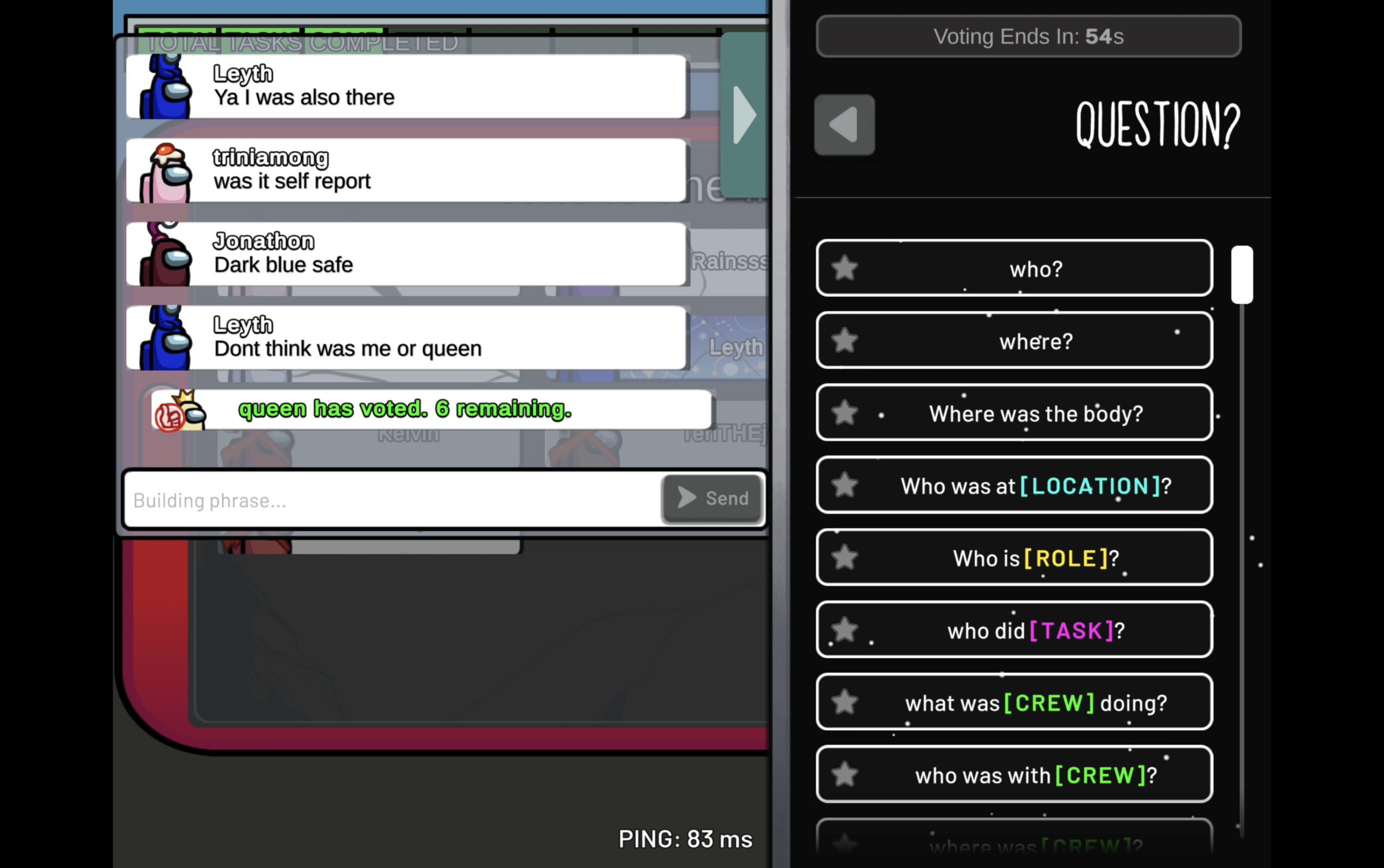
Compared to other, in person games, which can have extended discussion phases, Among Us has a strict time frame that compresses debate into about 2 minute windows where the reporter has to relay information about location and actions, while others try to do the same thing. It is hard when all players are talking in-person or through Discord, but it is even harder with just typing. The templates aim to solve this. They also revealed something about my specific role in groups. I’m someone that overthinks and processes to make sure that I am saying the right thing at the right time. The templates felt very constraining, while typing was not faster. I was still thinking through what everyone was saying about what happened and had less time to say my piece. Other players thrived though. They quickly typed questions and alibis, while I lagged behind, still composing my thoughts while they had already moved to who to vote.
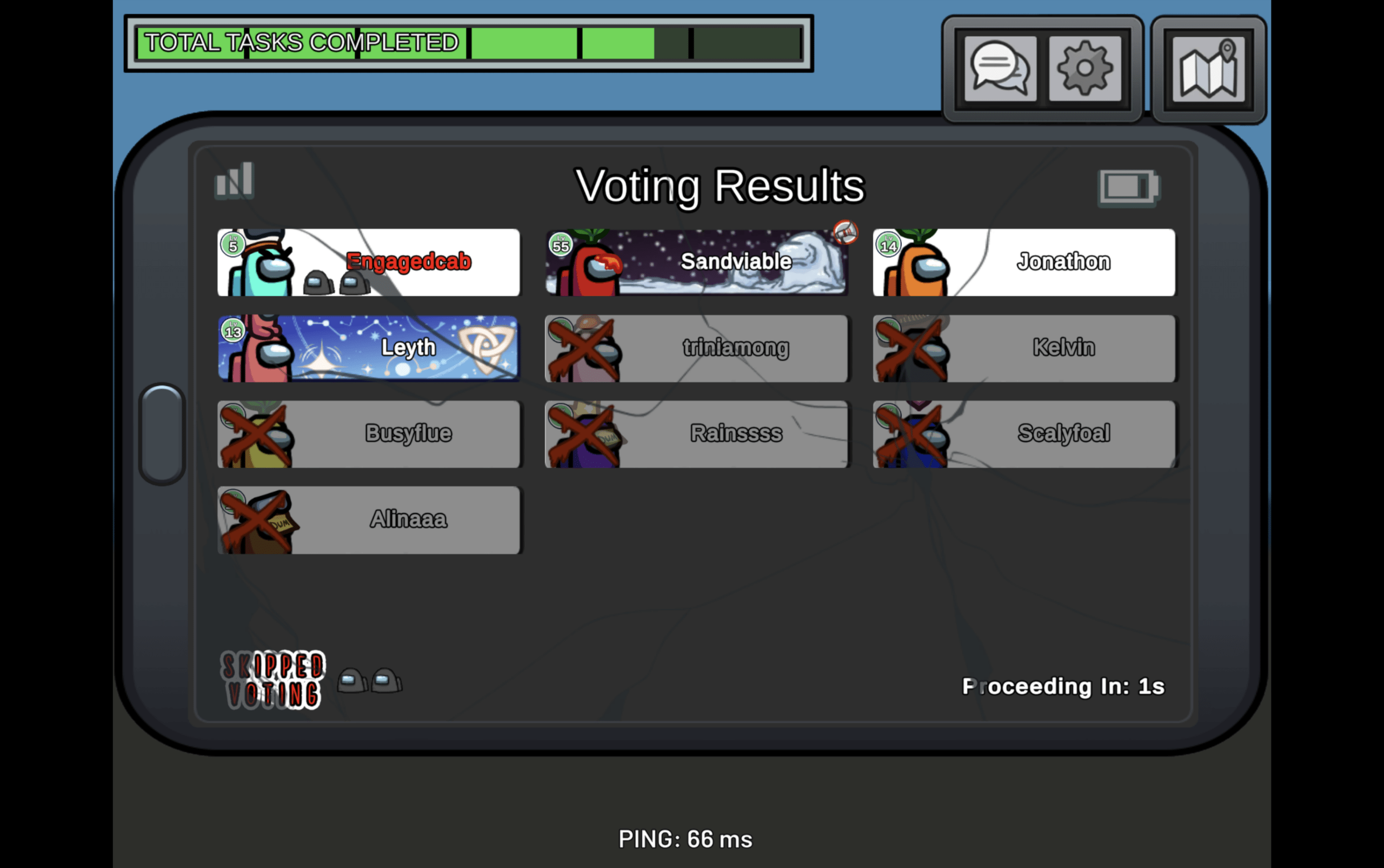
This became more obvious to me when I was the imposter and was not able to come up with a defense fast enough to clear my name. This led to me being voted out and eventually losing the round.
Ethics of Deception in Games
Among Us asks us to lie to friends and others enthusiastically, as part of a core mechanic, and then laugh about it afterward. This raises a tension of if lying is generally socially and morally wrong, why does it feel permissible here?
I believe the magic circle we enter in games provides the answer, but not a free pass. In Among Us, players enter the magic circle where deception is expected and even celebrated when done well. This lie does not feel real because of the context. The harm that makes everyday lying wrong does not apply because trust outside the game (usually) remains intact due to the magic circle. However, this only works if the boundaries stay clear and lying remains about the game information. Games like Among Us do not permit us to lie to others regularly, but they do permit us to pretend together, and that difference matters.