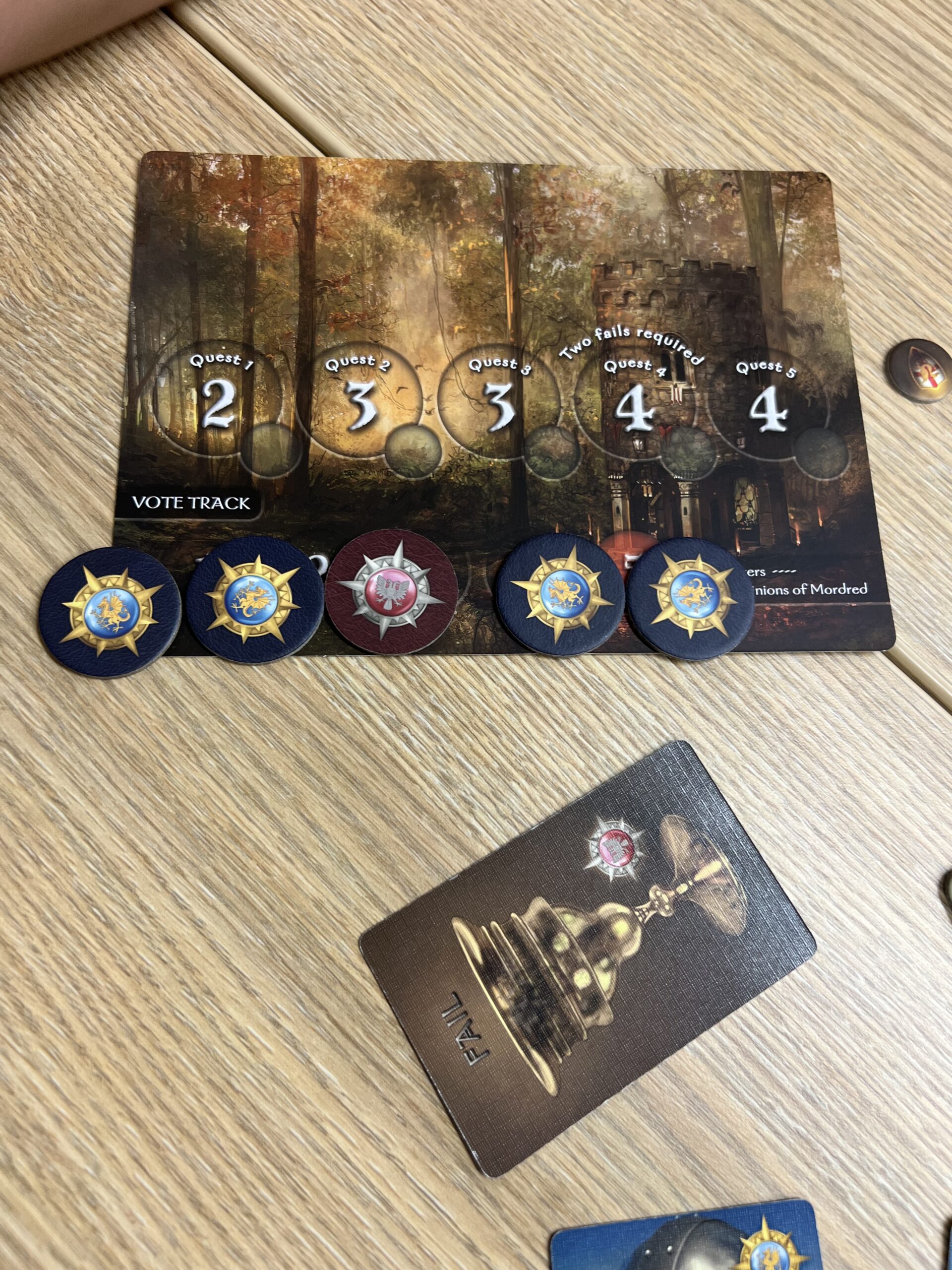
Game: The Resistance: Avalon
Creator: Don Eskridge (published by Indie Boards & Cards)
Platform: Tabletop (physical card game)
Target Audience: 6-10 players, ages 13+. People who enjoy social deduction, bluffing, and party games.
“In what ways did your experience playing this game highlight aspects of your own communication style, decision-making, or role within a group? Reflect on how the game’s mechanics and structure influenced or brought out these behaviors.”
Avalon taught me that I am a comically terrible Merlin. I knew exactly who ⅔ of the bad guys were. Still lost. Why? Because I was too loud, too wrapped up in the moment, and too blind to see that my Percival was sitting right across from me. The game punishes Merlin not for lacking information, but for lacking self-awareness, and I think that’s the cleverest thing about it. The game punishes/rewards different positions for different play styles.
I was Merlin, which meant I knew who the two minions of Mordred were. But I couldn’t say so. If the evil team identified me at the end, they could assassinate me and win. My job was to subtly guide the good team without revealing myself. My Percival—whose role is to confirm who Merlin is—sat directly across from me. I did not notice quick enough. Instead, I noticed Butch who was vocal, who agreed with me. When the two minions voted no on an expedition, I saw it. I knew what it meant. But instead of staying quiet, I kept talking. I dominated the table. I threw suspicion at Ryan and Lily—not because they were guaranteed to both be bad, but because I got wrapped up in the confusion and needed someone to blame and identify as Mordred.
Ryan had decided his strategy, across multiple games of Avalon, was to state, repeatedly and with great sincerity, that he is a “beacon of light.” He said this whether good or evil. So when it came time to actually judge whether Ryan was good? Difficult… Similarly, Jeffery in the first game announced he was evil. He wasn’t. Then in subsequent rounds, he announced at the start of each round (for fairness) that he was, of course, evil. If I recall correctly, he was evil in none of those rounds. But the damage was done. Once someone tells you they’re evil enough times, you stop being able to tell with great conviction when they’re joking. These aren’t bugs. They’re features. The game doesn’t punish Ryan or Jeffery for their chaos. It punishes me for not being able to filter it out (because once again I played too much like a soloist and not a team player).
There were a couple of my traits that did not work in my favor. I have a horrific short term memory, very easily exploited. I trust loud people and suspect quiet ones. Butch talked and agreed with me, so I trusted him. He was Mordred! Comically bad turn of events for Merlin. I didn’t think of myself as a pawn. I revealed my suspicions too early, and the evil team didn’t need to kill me, they just needed me to keep talking. And I get wrapped up in the current round. I react. I don’t stop to ask who might be playing me. My Percival was weighing my words carefully. That should have been GLARINGLY obvious but the shiny loud conversation, not unlike beating me over the head with an obvious trap, was to familair. Percival followed my leads even when those leads were bad. But I assumed my Percival had trusted me, not as Percival but as a Knight, because I was loud—because that’s how I assign trust. I didn’t stop to consider that Mordred (who I mistook as Percival) might be very vocally and actively participating to secure their win. Ryan, by the way, had Butch’s card punched from early on. He knew something was off. But we hadn’t cleared Ryan fast enough—because how could we? The boy who cries “beacon of light” didn’t get believed in the final hour. A weird vote breakdown in the final round made the wrong choice too easy. We put the wrong people on the last expedition. We lost. Consequences of one person, me in this case, contribute to the failure of many.

Avalon punishes individualism. In MDA terms, the game’s primary aesthetic is Fellowship, it’s a social framework. But I played it like a Challenge game, trying to solve the puzzle alone. That’s by design. The game also rewards reputation management. Ryan’s “beacon of light” schtick works across multiple playthroughs but becomes useless precisely when you need it most. Jeffery’s false announcements do the same. They’re not optimal play. They’re human play, and Avalon is smart enough to let humans be messy; messy makes for more entertaining and bonding gameplay.
Unlike Mafia, Avalon has no player elimination. When you’re wrong, you don’t sit out. You keep playing. Merlin’s mistakes don’t remove you, they compound. I didn’t die. I just kept making the wrong choices because I never stopped to ask: who is playing me? Where is my team? Is that really my team? Avalon didn’t make me a better liar. It made me realize I’m a loud, easily manipulated Merlin who trusts the wrong people and cannot distinguish a sincere “beacon of light” from a sarcastic one. Next time, I’ll shut up. I’ll watch the quiet players. And I’ll remember: just because someone agrees with you doesn’t mean they’re on your side.
“Does lying as a part of a game constitute a wrong action? If not, what is so special about games that they permit us to lie to our friends?”
No, because games create a magic circle where ordinary rules are suspended by mutual consent.
From a developmental psychology perspective, trust is the first thing we learn to need. As a baby, you trust your provider will return. You trust they’ll feed you. When that trust is violated, it’s visceral. It hurts and it spells real world consequences for violating trust. But Avalon begins with murky relationships. At the start, I don’t trust anyone. The game tells me: these people may be lying. That frame changes everything. When Butch “lied” to me—agreed with me, voted with me, played the game to establish trust—he wasn’t betraying me. He was playing the role the game assigned him. The lie was inside the magic circle.
 What makes it permissible is consent. I sat down at the table knowing I would be lied to. I agreed to that. Outside the game, lying violates an implicit contract. Inside the game, lying is the contract. That said, Avalon challenged my perspective because the lies felt real. When I realized I’d been played, I felt a little silly, maybe a little bashful—not betrayed—but not the visceral discomfort that breaking real-world trust our development instills and would evoke in us. The game doesn’t harm trust between players (I still like everyone). If anything it positively harms (read challenges) our relationship towards trust allotment and social discernment. And if play serves an evolutionary purpose maybe that’s the point.