Coup, designed by Rikki Tahta, is a fast-paced 2-6 player tabletop card game built around bluffing and social deduction. In the game, you assume two roles at once, but you have the freedom to play as any role you’d like…until someone calls your bluff. I found this game to be a fun take on a bluffing game, as it doesn’t require as much self-advocacy and arguing. Other games in this category, such as mafia, revolve much more around defending yourself and blaming others, while the strategy in Coup seems to be to maintain your poker face and stick by your actions. This made the deception more structured and tied to the gameplay systems rather than pure social reasoning. The game overall is quite simple mechanically, but the social dynamics it produces are much more complex.
The Early Game
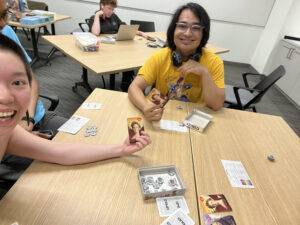

As soon as we started playing, almost everyone’s strategy was to claim the duke and get 3 coins, quickly progressing towards the 7 needed to coup. Multiple people did this right away, even without having the card. This led to a bunch of early challenges, and several players lost their first card within the first couple of minutes.
This phase of the game felt quite chaotic and aggressive, as people were willing to take risks because the cost of being wrong was not that high yet. Communication was more assertive, and people challenged each other quickly. I quickly realized that I am someone who prefers to take on a more low-risk and honest role, as I didn’t want to become a target so early on in the game. A couple players cemented themselves as ‘challengers’, or people who were willing to put themselves at risk to expose others. At this point in the game, I experienced fun as a challenge, both from trying to assess the strategies of the other players and coming up with my own ideas of how to survive the uncertain landscape ahead.
The Late Game
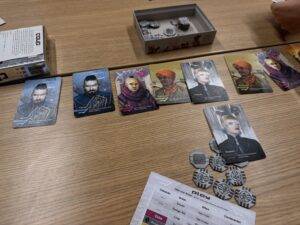
Once players were down to one card, the strategy seemed to shift. People took far fewer risks, bluffed less, and became much more cautious. They began to stick with the actions they had done before, as if they didn’t want to stray from their patterns and risk exposing themselves. Even though the mechanics of the game were the same, people became much more wary since they were only one wrong call away from being eliminated. I felt more comfortable in this part of the game, as it allowed me to stick by my strategy from the early game in confidence. However, I felt myself getting more stressed as people collected more coins since I had essentially revealed my card to the rest of the players. By sticking with an honest strategy, it was obvious which card I had, which put a target on my back since it was a card that wouldn’t help me defend myself.
Our House Rule

One of the most interesting parts of our gameplay ended up coming from a misunderstanding. We misinterpreted the blocking rule as that an ambassador/captain could block stealing from any player, when they actually could only block someone stealing from them. This small misunderstanding led to a completely different dynamic and gameplay. Players started forming ‘alliances’, protecting each other from being stolen from in exchange for reassurance that they wouldn’t be the target of a coup. It added a layer of cooperation to a game that is usually more individualistic, incorporating fellowship as a layer of fun. I no longer only thought of myself as an individual in the game, as my relationships with others could determine how far I was able to go. This situation made me consider how sometimes unclear rules aren’t always flaws, as they have the potential to create interesting opportunities for new game strategies.
My Major Mistake…

At one point during our game, I confidently claimed I had the captain card, got challenged, and proudly flipped my card over…only to realize it was actually the assassin. I had apparently glanced at it earlier, saw that it was blue, and just assumed it was the captain. I even had enough coins to assassinate multiple people, but I was so sure I had the captain and never glanced at my card again, so I never ended up assassinating anyone. That moment was funny, but it also exposed what I would consider an area for improvement in the design of the game aesthetics. All of the other cards have colors and designs that are drastically different from each other; however, both the Captain and Assassin cards are a similar shade of blue. I wonder why the designer chose these visuals instead of sticking with the visual contrast present across the rest of the deck. I would suggest maintaining the contrast between the cards to avoid another moment of confusion like this one!
Ethical Reflection
In Coup, lying is a central part of the game. If there was certainty that everyone was telling the truth, there would be no game at all; it would just be a game of chance based on what card you drew at the beginning. What makes lying acceptable here is the magic circle in which the game exists; everyone agrees to the rules, including the fact that lying is allowed and expected. This creates a bounded space where new norms are set allowing us to assume a new persona. However, the emotional reactions when being lied to are still real despite the social acceptance of lying. I still felt surprised, frustrated, and even betrayed when I was deceived in the game. However, my feelings were reframed by the game’s environment as an emotional journey rather than a personal attack. Rather than feeling morally bad for lying or being lied to, I viewed it as a strategic tool for this particular situation. In bluffing games like Coup, lying becomes context-dependent and assumes a critical role in the game, meaning it is no longer seen as unacceptable.