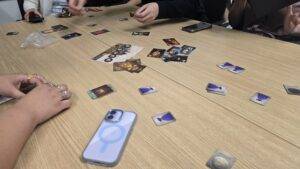
I had a blast playing Avalon during Monday’s board game night. Avalon is a hidden-role social deduction board game designed by Don Eskridge for 5 ~ 10 players. Our group played it in person using the physical card set. I played two rounds – the first as a civilian, and the second as Percival. Both rounds were epic – in the first round, Percival acted as if he weren’t familiar with the rules and accidentally let slip who Merlin was, which fooled the villains into guessing the wrong person. In the second round, we correctly identified two of the villains, but Mordred (Butch) managed to make it onto the final quest and cost us the game.

The game revealed many interesting aspects about myself. In terms of communication style, I found myself staying quiet for most of both rounds. Rather than speaking up, I tended to accumulate as much information as possible and speak up only when absolutely necessary. I think this is partly because in Avalon, good players want to join as many quests as possible, but people who talked too much seemed to draw suspicion. In the second round, playing as Percival made me even more careful since I was the only one who knew Merlin’s identity. I tried especially hard not to expose any potential clues about who Merlin was.
Another thing the game revealed was my decision-making process. I noticed that I’m more heavily influenced by other people under uncertainty even though I try not to. In the first round as a civilian I hardly understood what was going on, so I found myself just following the group’s consensus. In the second round as Percival, I felt more confident — I was able to identify Morgana quickly, and I pieced together the other villains by reading Merlin’s reactions to different players. However, I over-trusted Merlin – she mistook Mordred for a civilian (Butch was a really good actor) and I blindly trusted her. As a result, Mordred made it to the final quest and we lost. Looking back, I think the reason I trusted Merlin so much was because I thought that she was the most reliable source – but I failed to realize that even she had a blind spot.
Now for the ethics question – is lying a morally wrong action even within a game, and if not, why? In Avalon, lying clearly wasn’t a wrong action. If it weren’t for Mordred’s bluffing, the game would have been far less interesting. Lying makes bluffing / social deduction games like these much more compelling because it significantly increases the number of possible states of the game, amplifying the Challenge and Fellowship types of fun.
So what is it about games that permits us to lie to our friends? I think there are two reasons that answer this question. The first reason is that games are a “magic circle” – they’re essentially a low-stakes environment not connected to the real world. Whatever happens inside doesn’t lead to consequences on the outside world, and that separation creates a special experience for us. Since games are a separate space, it enables people to try out various actions – such as lying – which wouldn’t be allowed in the real world.
The other reason is that lying acts as a benefactor for everyone in the game. As I described above, Mordred’s acting is what made our second round genuinely thrilling. However, even for games, lying is only acceptable if it benefits the gameplay experience. For example, consider cooperation games like Codenames, where a spymaster gives clues to help teammates guess words. If the spymaster lies to their own team, it would frustrate everyone and undermine the whole point of playing. The difference is that in Avalon, deception is the mechanic that creates challenge and excitement for all players; in Codenames, it would just be sabotage. Therefore, lying in games isn’t blindly permitted — it’s allowed when it makes the game better for everyone involved.