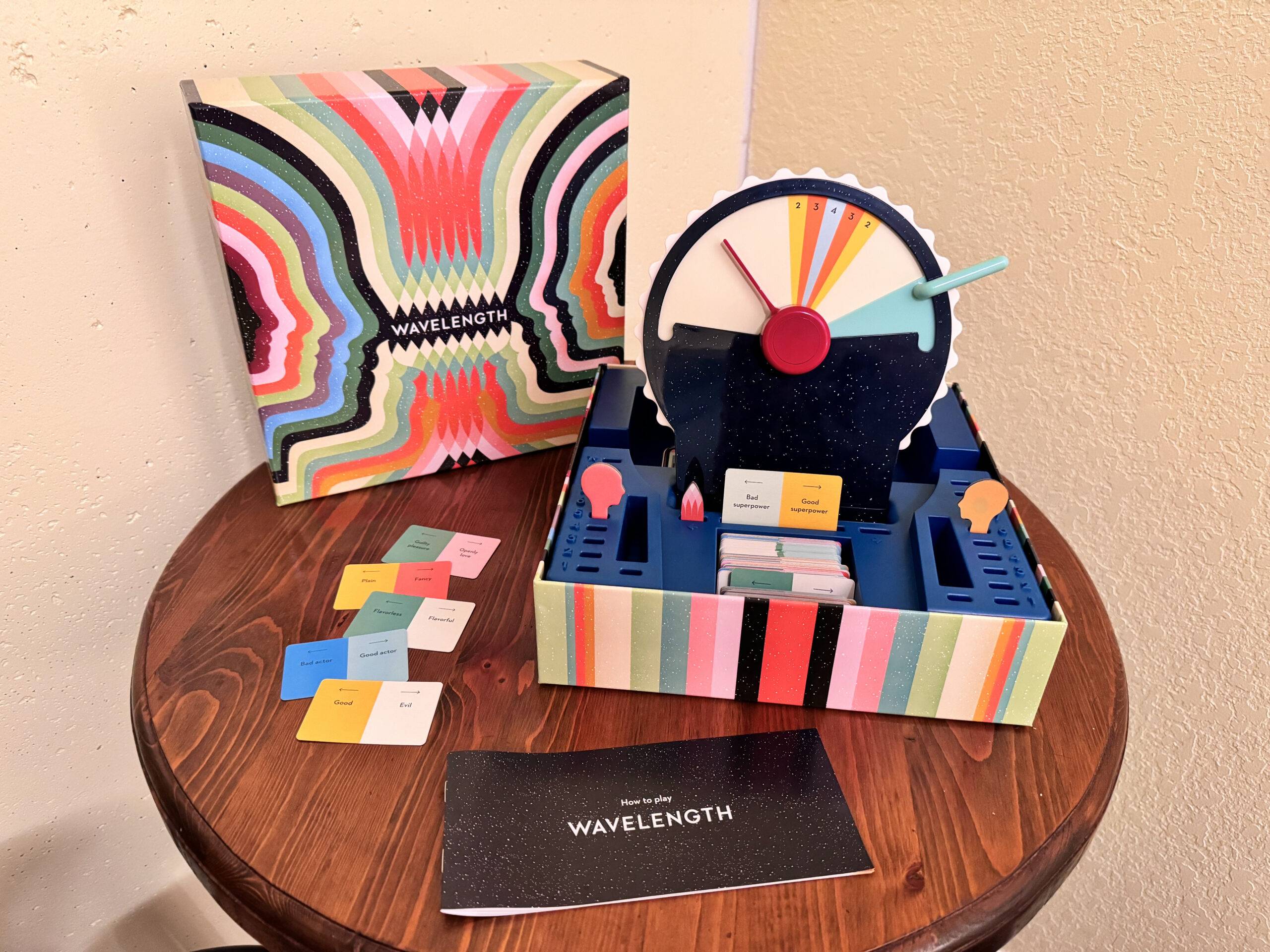
Last night I played Wavelength for the first time with my girlfriend here at Stanford. Wavelength is a social guessing game designed by Alex Hague, Justin Vickers, and Wolfgang Warsch, published in 2019. The game targets casual players but is advertised as being fun for anyone. It’s meant for players ages 14 and up and for groups of two to 12 people. I played the physical board game version but it is also available to play for free at longwave.web.app.
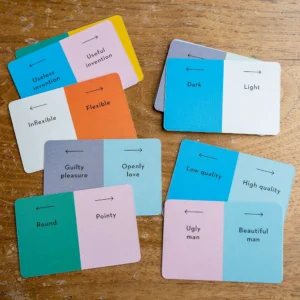 A photo showing some of the spectrum cards from the game
The premise is simple: one player is the ‘psychic’ who sees where a hidden target sits on a spectrum between two opposites like Hot <-> Cold or Overrated <-> Underrated and must give a single clue word to guide their partner in turning a dial to the right spot. The closer to the center of the target, the more points you score. No clarification, no second guesses, and no funny looks, just one word and a whole lot of trust and intuition.
 A photo showing the contents of the box
My girlfriend and I got through our session pretty smoothly overall and we were able to understand each other well as we racked up a pretty high score. One thing that stood out wasn’t the wins but rather the moments right before I gave a clue, when I’d go quiet, visibly freeze up a little and overthink what should have been gut instinct. I’d land on a word immediately, then talk myself out of it in favor of something I thought was more “precise” or “defensible.” My girlfriend noticed. She’d watch me hesitate and say something like, “just say it” and almost every time my gut reaction would have been the better response.
That pattern surprised me. I tend to think of myself as a fairly decisive person, but Wavelength exposed a specific kind of overthinking. My impulse was to optimize communication even when the mechanic and aesthetic is explicitly asking you to trust it. The game’s constraint of a single clue word striped away my usual tendency to over explain or hedge my bets.
Meanwhile, my girlfriend gave her clues quickly and intuitively just like an engineer should. She leaned into those gut feelings and went with her instincts which often led to higher scores. Her clues were harder for me to dial in on at first, but once I recalibrated to her wavelength (hehe sorry), they made a lot of sense. We think differently, but we got there.
Using the MDA framework, Wavelength’s primary aesthetic is clearly fellowship or the game as a social framework, but it also works as expression, a kind of self-discovery. The mechanic (hidden target, single clue) creates a dynamic where you have to externalize your internal logic, briefly and completely. You can’t revise. That dynamic is what made our different reasoning styles so visible.
Compared to other games in the ‘getting-to-know-you’ genre, Wavelength is unusually indirect. A game like ‘We’re Not Really Strangers’ asks explicit personal questions and it’s designed to generate vulnerability on purpose whereas Wavelength sneaks it in. You can finish a whole session having learned something real about a person without either of you having disclosed a single personal fact. That indirect-ness is what makes it feel lower-stakes, more replayable, and honestly more revealing in some ways.
That said, the two-player format does lose something. The published rules assume a team that debates the dial position out loud before locking in and that negotiation is itself a meaningful part of the social experience. With just two people, there’s no team deliberation, just one guess. A dedicated two-player variant with a back-and-forth clue structure, or modified scoring, would go a long way.
Ethics
Wavelength is built on the assumption that you and the people you’re playing with share enough common ground in terms of cultural, experiential, and conceptual knowledge. That assumption is itself a social norm, and it’s worth naming. The game works best when players have overlapping reference points. For groups with very different backgrounds I’d imagine it can quietly surface who’s in the know and who might not be.
The open-ended, opinion-based spectra are a smart design choice but they don’t fully escape the problem of assumed shared context. Players who find themselves consistently misaligned might feel like they’re watching others play fluently rather than playing themselves. Designers could help by being more intentional about the range of spectrum cards included, and players can help by swapping out cards that don’t feel accessible to everyone at the table. There were a few cards that were more culturally loaded than others but this is an easy thing to fix with the addition of some home rules.