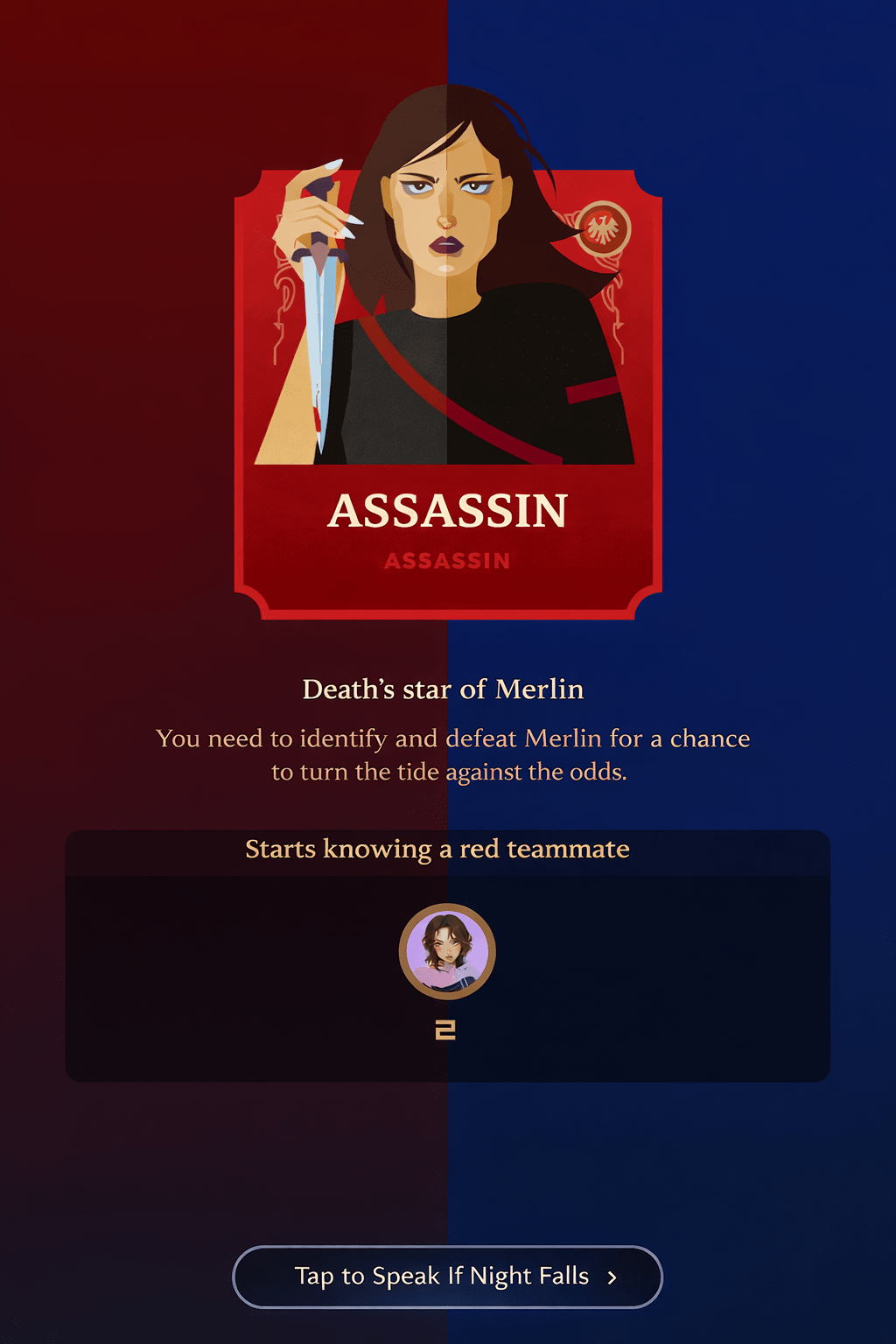
The game I chose is Avalon, designed by Don Eskridge. It is a social deduction board game for 6–10 players. The target audience is people who like reasoning, social, and psychological games. It is mainly a board game, but it can also be played digitally. Players are divided into good and evil. Good wins by succeeding three quests; Evil wins by sabotaging three quests or assassinating Merlin at the end.
Playing Avalon made me realize that my communication style is cautious and reactive, and sometimes I create chaos by saying unexpected things. My decision-making seems logical, but I actually rely a lot on social reading because of hidden roles. I also noticed that I easily trust others, and my thoughts can be easily overwritten during discussion. During the game, I didn’t speak much initially, especially when I had no strong information. If I got a normal, good role, I tended to stay quiet. This made it harder for others to reason about my role, but also made it harder for my team to win.
One moment was when I suspected a player early, but later they gave a long explanation. After that, I started doubting myself and changed my decision. It felt like my earlier thoughts were overwritten. Sometimes I switch ideas after hearing others, then later forget why I switched and go back again. Later on, I developed a strategy. I made my role in the group, which is kind of an outlier. I don’t fully lead or follow. I say random ideas to create confusion, like, I’m Morgana, I think XXX is Merlin, I’m going to the quest with my Merlin. At this time, I’m the real Merlin, and the person I point out is the evil person I saw during the night. I’m not sure if she’s Morgana or Assassin, but I know I have a 50% of chance pointing to the true Morgana. This behavior makes everyone confused, but I know Percival will know I’m Merlin, if the person I point out is the real Morgana. Then I play randomly and speak like an outlier, to make others more confused.
The mechanics of Avalon are hidden roles, voting, and limited information about each person. It shapes a suspicious and persuasive dynamic to let other people believe you, and the aesthetics is the tension between the players, and the fun of seeing others being fooled, or the sense of accomplishment of revealing an evil person.
Because of hidden roles, I had to rely more on how people talk instead of pure logic. This pushed me to use social judgment more than I expected. Compared to games like Werewolf or Mafia, Avalon is more engaging because players are never eliminated early. In those games, if you die in the first round, you just sit and watch, which is boring. In Avalon, I can always participate and influence the game. However, the game has some issues. If a player is introverted and has no information, they may stay quiet, which hurts their team. I also think the balance is a bit unfair. Evil players know each other, but good players don’t. Merlin has a lot of information but cannot speak too clearly because of the Assassin. This makes good players very dependent on communication, which is hard.
One idea I had is adding a vote to disable the Assassin’s power. Players can vote once, and if they hit the Assassin, the Assassin loses the ability. If not, nothing happens. This gives good players more counterplay. And the person who gets voted as an assassin doesn’t reveal their real identity; only they know if they lose their ability or not, which won’t disrupt the game’s flow.
I think lying in Avalon is not morally wrong. The game is designed so that evil players must lie, and everyone agrees to this before playing. Lying becomes an expected behavior inside the game. However, some players are still uncomfortable lying. They may become quiet or act differently, making them easy to detect. This shows that even though lying is allowed in the game, it can still feel unnatural.
Avalon has clear formal elements: rules define hidden roles and voting, the objective is to outwit others, and the outcome is zero-sum (either good or evil wins). The game creates a boundary where lying is allowed, which changes how players behave.
In one round, I suspected a player but changed my mind after their explanation, which led to a failed mission. In another moment, I stayed quiet and observed others’ behavior because I was an assassin and trying to guess who Merlin was. These moments show how my communication and decision-making affected the game.
Overall, Avalon’s mechanics force players to rely on social interaction, making the experience both challenging and insightful.