


[Sketchnote of Fullerton’s Working with System Dynamics & Cook’s Loops & Arcs.]
HD Version: https://drive.google.com/file/d/1IqFYicQigHDE8nmSXcvqQzOXhExUiMnH/view?usp=drive_link
Overview
For this Read & Play, I decided to play Shapez.io, which is a factory building game created by Tobias Springer, available on Steam and demo on browser. In this game, players design and optimize factories to produce different shapes. I think the target audience of this game is players who enjoy problem-solving and find satisfaction in solving puzzles and optimizing a system.
In terms of genre, the game seems like a mix of factory simulation and sandbox game. There’s no narrative or “win” state, but there’s a sense of progress that comes from achieving greater efficiency. For example, with every level there is a counter that tracks how close you are to the goal (such as 20 pieces out of 50) and the speed at which it ticks up essentially helps you understand how efficient your factory is.
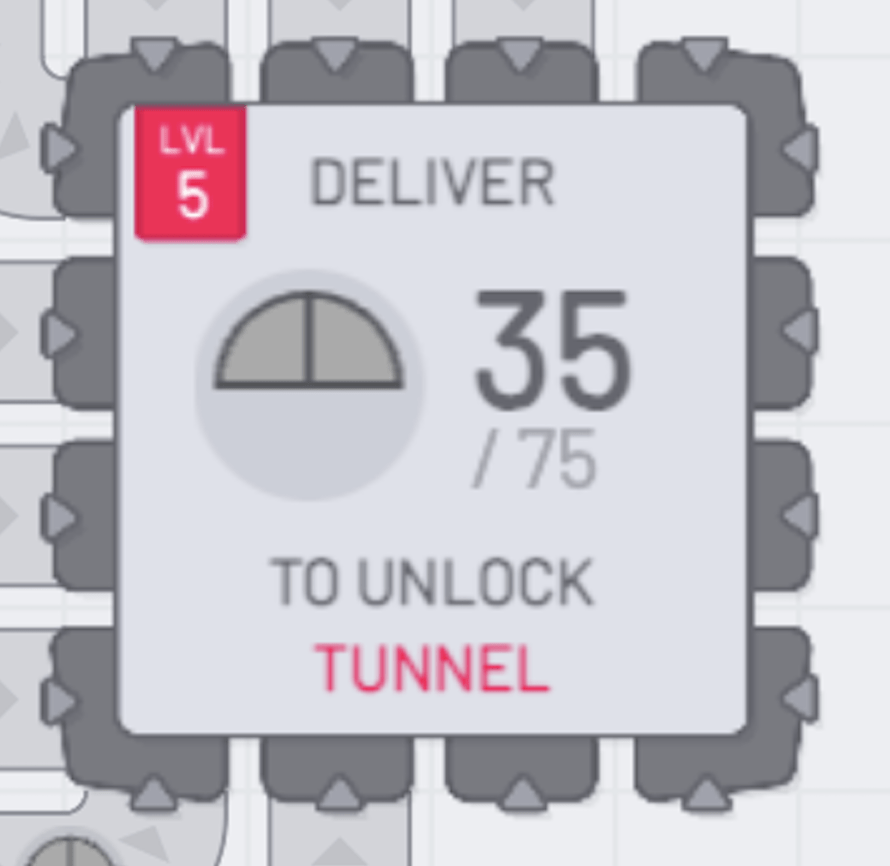
[Image of the inventory goal in the center of the factory.]
I think the game emphasizes the values of optimization and continuous improvement. You’re not necessarily fighting anything here like a base-building game, but the “enemy” is inefficiency. This is made clear at the very beginning where there is a prompt that says “THIS IS NOT AN IDLE GAME.” After reading this I started to feel some urgency to get better and fix my lines as if I was going to be replaced by a robot if I was inefficient.
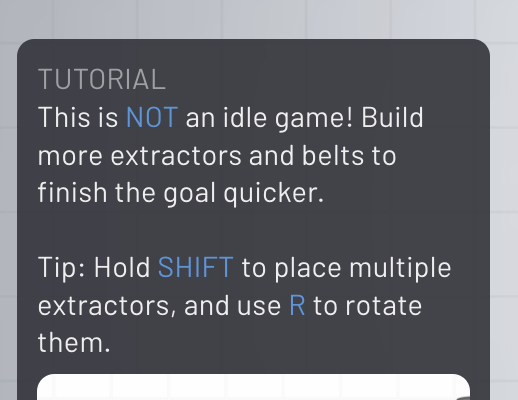
[Image of the opening tutorial.]
While the concept of this game sort of touches on resource management, ultimately since there were unlimited resources like shapes and machines to use (unlike a real factory), this didn’t seem to be the focal point of the game or the core value it was trying to achieve. I’d be interested to see how the game would change if it introduced real-world constraints, similar to how Mini Metro limits the number of tracks and trains. I think some kind of restriction could strengthen its procedural rhetoric, making the commentary on automation and optimization feel more reflective of real systems.
Shapez.io as a System
Thinking about this game in terms of the elements of a system, the objects are the shapes, conveyors and different machines/hubs that make up the production line. Each object has different properties: shapes have types and colors; conveyors have direction and speed; machines have processing times. These properties change as you level up and new mechanics like cutting and coloring come in. Every new mechanic that gets introduced forces players to rethink their factory layout and refine feedback loops.
The behaviors of these objects form the game’s system, where extractors endlessly produce resources, conveyors transport them, and then machines transform them. There are also points where delays machines can get clogged or cut off. The relationships between these elements are defined by continuous loops of input, processing, and output, reinforced by the interventions of the player.
In terms of loops and arcs, Shapez.io operates with a lot of interaction loops that teach the player how to build, give them a chance to act on that information, and then give feedback on how they did. With these loops where the player gets increasingly better at the game, it helps to build mastery before moving onto harder levels.
I also experienced a clear skill chain since each new mechanic built directly on what I had already learned. For example, I first used simple extractors and connecting conveyors to move shapes. Once I met that goal, the game layered in tools like cutters and rotators that required me to combine those earlier skills in new ways. Eventually, I was managing complex systems with trash and painting, where each of these new machines depended on my understanding of flow and efficiency from earlier stages.
Overall, the game does function as a formal system, with a closed set of interacting elements governed by predictable rules. After playing for a little over half an hour, I started getting more comfortable with the controls, and the game felt less like solving a puzzle and more like optimizing a system, which relates to the idea of micro to macro system dynamics. For example, my attention moved away from finding ways to fit together the individual pieces and toward minimizing conveyor belt paths and trying to build tunnels to optimize the extractor paths.
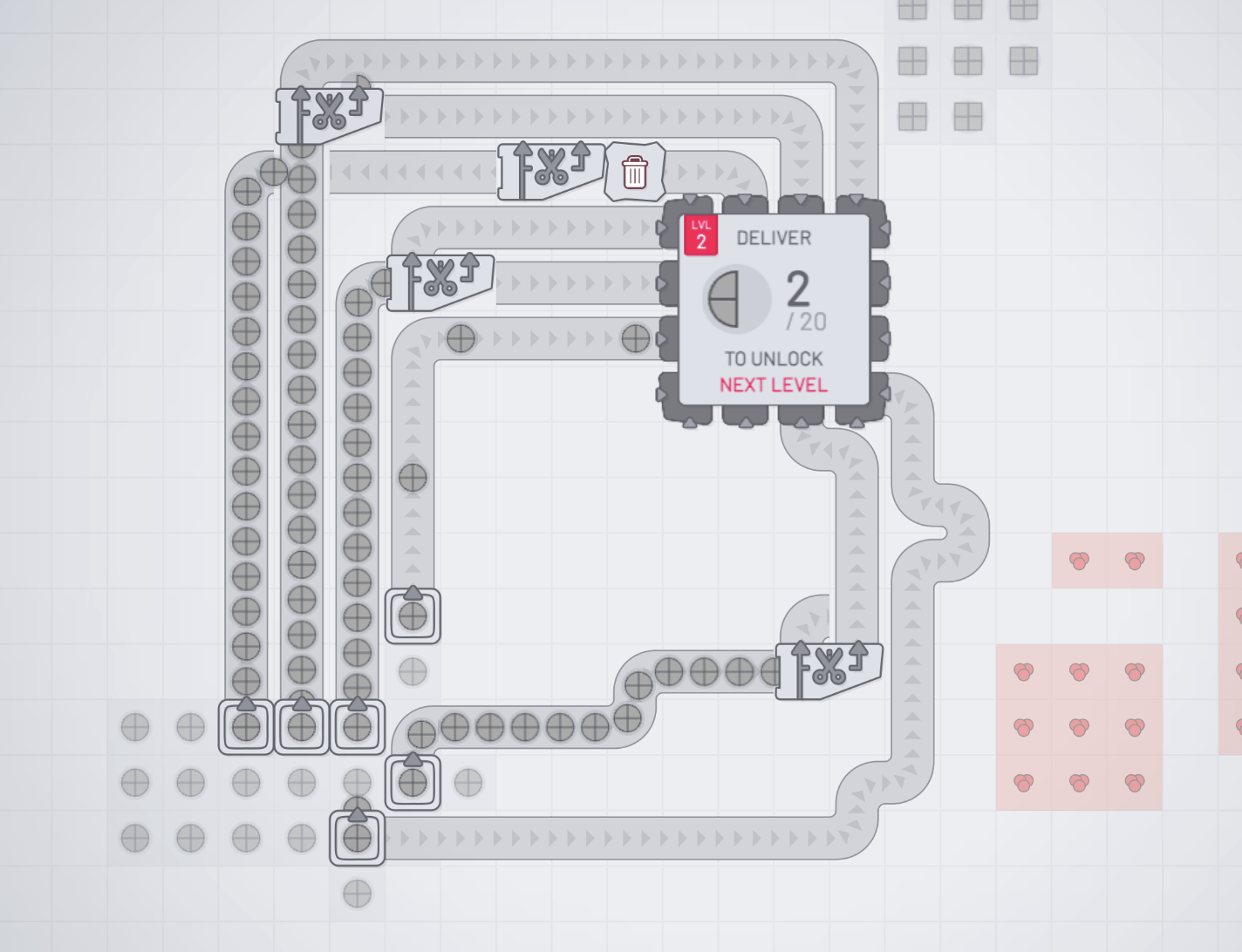
[Image of my first attempt at figuring out how to get the objects to fit together.]
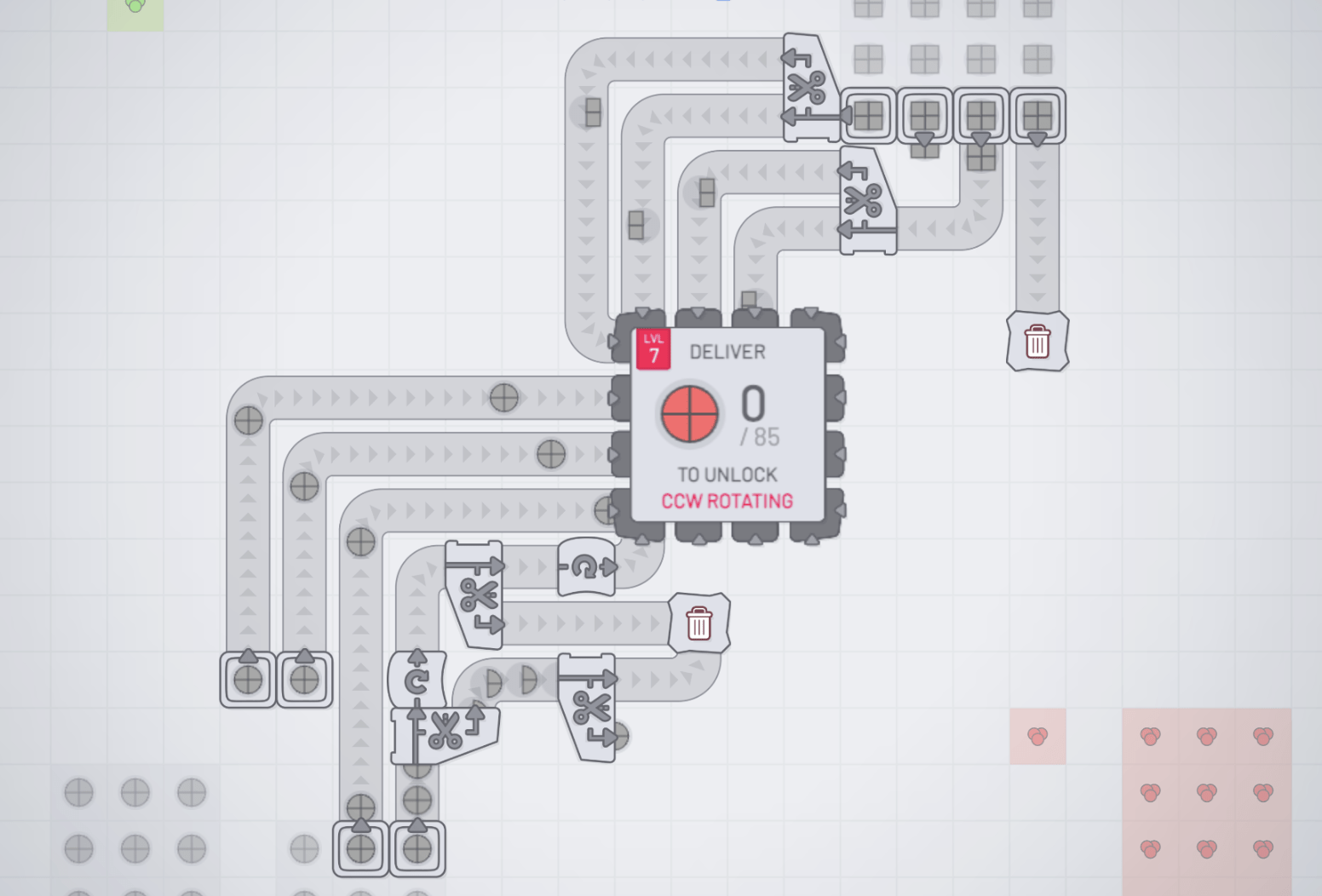
[versus. image of my final factory where I’ve cleaned up a lot of the paths to increase efficiency.]
Design Takeaways
One of the strongest points of Shapez.io that motivated me to continue playing and improving was the visible feedback of my growth. For example, as the factory leveled up, the goals became larger and more complex and you can always see how well you’re working towards them. There are also some points where the counter stops because there is a clog in the system, so even failure can be observed in real time. This direct feedback helps players intuitively grasp cause-and-effect loops without needing to give extra explanation.
I also really appreciate the gradual complexity of the game. Rather than starting the user with all the different machines and risk overwhelming the, the game’s onboarding really reflects the concept of reinforcing arcs, where each new element builds on prior understanding. This helps the player build their wisdom and finds a good balance of challenge that is difficult but achievable.
