

NOTE:
Players can press return to dismiss dialogue, I didn’t have time to change the text finished icon before submitting 🙁
Overview
In this game, we control a Player Character living in a small town. I want to give a quick trigger warning for the deaths of characters, and also wanted to say that no dogs will die during the duration of this game. I would recommend you play the game before reading past this part of the overview though.
https://leythtstanford.itch.io/empathy-machine
The idea behind this game came to me after seeing images of the flattened cities in Palestine and Ukraine. My initial idea was that I wanted a game where the player would play through a normal day or two, completing items on their todo list, when suddenly one morning, they awake to their whole town being destroyed in an attack. My goal was to somehow express the feeling of the world someone knows being destroyed, and the feelings someone might have if they never thought it would happen to them. Because this kind of destruction is so tied to physical space, it was important to me that this game have an actual map for the player to traverse, which is why it’s a top down game.
Branching Choice Map
The overall narrative unfolds the same way every time, there’s no way for the player to avert the tragedy of wandering aimlessly through their destroyed town.
There are however, a few optional threads for players to follow through the different days. By talking to characters on different days, they can learn more about the characters and the world around them.
If the player finds the secret bunker at the top left of the town square on day 1, they will find the path blocked by a soldier on day 2.
If the player speaks to the barista on day 1, they will have a new dialogue line on day 2 that tells the player more about the world.
If the player does not speak to the balloon guy on day 2, the balloon guy will die in the attack.
On day 3 there is a protest where the player can learn more about the world around them.
When in doubt! Explore! Talk to everyone you can find in order to have the full experience.
The end of this game leaves the player wandering aimlessly in the town square no matter what, until they give up and close the game.
Version History + Playtesting Notes:
Version 1
Here’s a picture of the first ever version of the game I playtested:
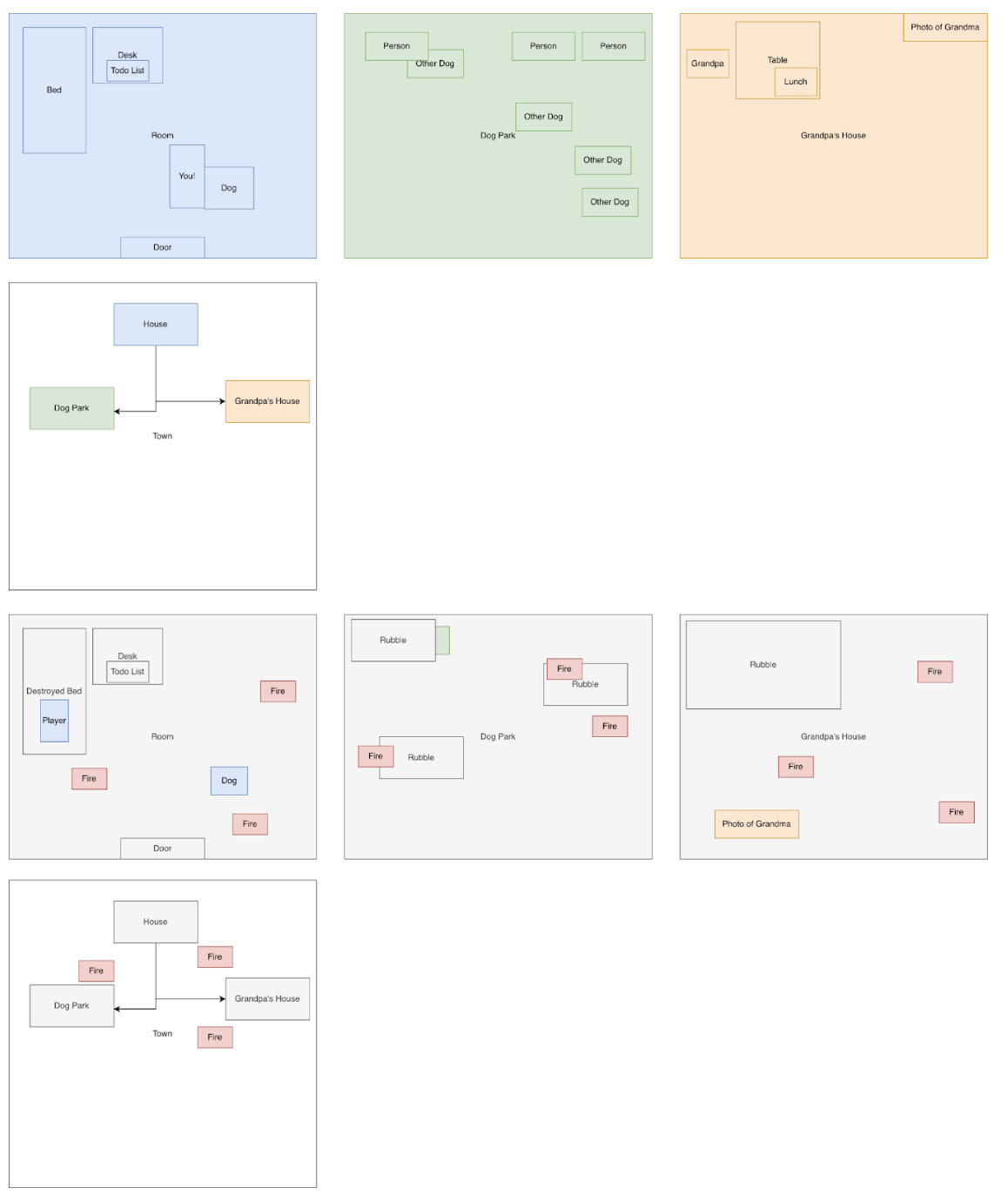
My first playtester for this game was a fellow CS Coterm (who actually playtested through it a couple of times).
In this initial playtest I moved components around the screen and narrated the world while the player gave directions on what she wanted to do. It functioned kind of like a game of dungeons and dragons.
The premise of this early version of the game was that the player was presented with a Todo list with 2 (or maybe more) items, the original two were to take our dog to the dog park, and to visit our grandpa. However, they only had time to do one task per day. Upon going to sleep, they hear lots of loud crashing and destruction, and when they get up they see that their town has been destroyed. The idea was that the town had been destroyed in some kind of war/attack, but this wasn’t explicitly stated in the game at this time.
This first playtest is what solidified my concept of the game for a few reasons, the first was that the player, despite having no information about the game, sort of saw the twist coming, and yet, was still surprised when the world was destroyed. She also liked the dog quite a bit, and said that she genuinely felt bad that our grandfather and the other, green dog died. She also liked the sad little details, things like the grandmother’s photo really sold the reality of the world. Her biggest idea, which I really loved and intended on implementing, but just never had quite enough time to actually build, was to have the order of events matter especially after the destruction occurs. The idea was that you can save either the dog or the grandpa and not both. The other was to have more days of normalcy before the disaster, this one I was able to implement, but not for a while. This idea really gets to my core idea of the game, but sadly I just didn’t have enough time to build out the paths (more on that a bit later). The tester also mentioned that actually being able to properly control the character was important, and that it was hard to empathize with a bunch of rectangles (Fair enough!!)
Version 2
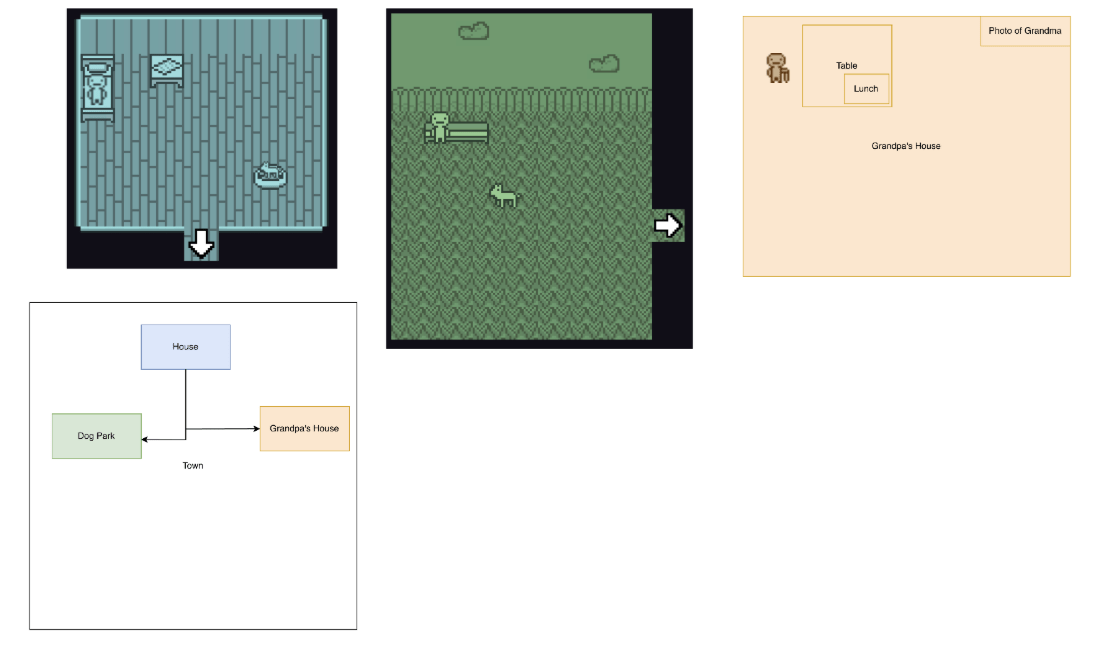

My second playtest was with the same CS Coterm, and was pretty similar from the one that came before.
Namely, some of the assets were improved, and I had a more refined structure to the actual story ironed out. Overall though the narrative was the same as before though. This time around, the player tried to break certain aspects of the game, since they knew how it worked this time around. This wasn’t really an issue since I was manually controlling everything, but I realized that the digital implementation of the story would need to be relatively robust to handle this kind of play. The player also told me that the improved assets helped her feel more connected to the characters (especially the dog), but that ultimately, it didn’t do enough to differentiate the experience. This was pretty expected, but was still good to note. The biggest take away of this playtest though, was that, despite knowing the twist up front, she still felt the weight of it, and that knowing what was going to happen made the starting segment more impactful. This really convinced me of this idea, because at the time I was worried that the game’s narrative only existed in order to serve the twist to the player, but knowing that the narrative could have weight even when the twist wasn’t a twist was great to see.
After the play test concluded, I showed the tester a blank scene in RPG Maker (My original engine choice for the assignment), and asked her to try moving around. She really disliked the way the movement worked, and said it felt very clunky. It was after this that I made probably the worst decision of the whole project, I made the switch to Unity as my engine. The reason I made this swap is that I wanted more control over the player’s experience. I didn’t want to restrict my target audience to only people familiar with RPG style controls (click to move etc), and I haven’t used it since like middle school, and don’t really remember how it works at all. Unity on the other hand, I’ve used a bunch of times before, and, for the last two summers, I’ve been a Unity client engineer for Pokémon Go. On top of this, I had an old project for a top down game with a dialogue system from a summer camp I did right before coming to Stanford. In other words, I was FULL of unearned confidence, and decided to swap to Unity. My main focus at this point was to make the game interactable.
Version 3
The next version of the game was built in Unity, on top of my other game from years ago. It had basic movement (That kind of worked), but no real dialogue or anything yet. I somehow only have the “bad day” version of the project backed up but here’s how that looked. (These tiles are all in color, but have a black and white filter applied to them at the moment.)
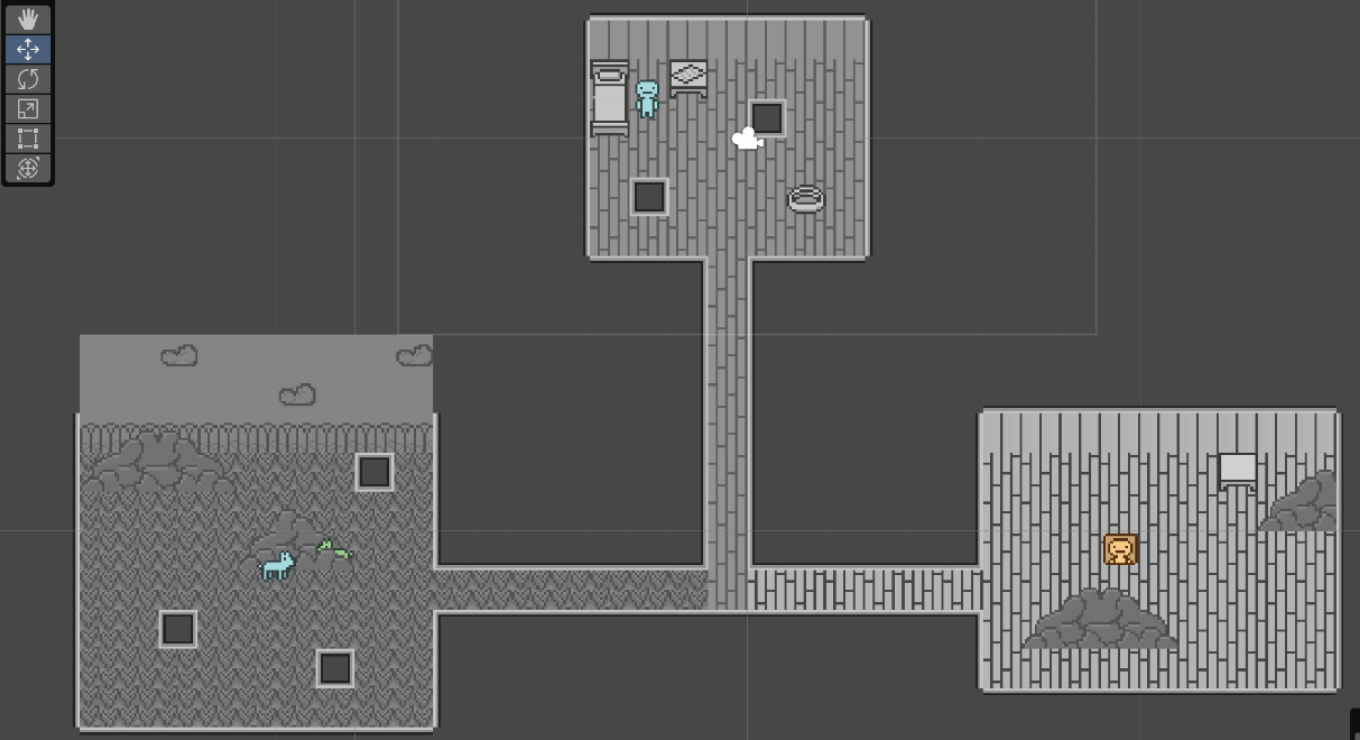
In creating this version of the game, I realized that my unity skills in 2021 were… lacking to say the least, and so the dialogue, interactable, and inventory functionality were all effectively unusable, meaning I had to rebuild it all from scratch. I had spent much of the time leading up to the version creating the assets and tiles to be used, since having more immersive art was a big piece of feedback I got in my playtests before. At this point I was still narrating the story and interactions to the players.
My playtester was Christina (Hi Christina! (And Hi Butch (Since you’re grading all of them 🙂 )!)). One issue that came up during the playtest was that the colliders for the player didn’t work properly, and the hallways were unable to be navigated through. Christina did like some of the overall direction, but also said it was kind of too early to tell what the game actually was at this point. Her biggest feedback to me was that I needed to sit down and start actually writing the dialogue for the game, so I could understand the trajectory of my own story. Christina also made me promise not to kill any of the dogs, that decision actually did lead to some shifts of the narrative. Specifically, instead of having the emotional moment on the dog park path being the death of the other dog, it shifted to being the death of the dog’s owner, adding another important character to the narrative.
Version 4
This version was probably what I would define as an inflection point for the game. In this version, I fully implemented a simple dialogue system, that allows for players to interact with objects they are close to, to get dialogue from characters. I also started the creation of the town square (though it was pretty rudimentary)

At this point there were still only the two plot lines, where you talk to the todo list, go to one of the rooms, then go home, then the attack (which was still not mentioned in game at all) happens, then you can go to the dog park and grandpa’s house, talk to grandpa as he refuses to leave his house, and talk to the dog owner who got crushed by rocks as he passes away.
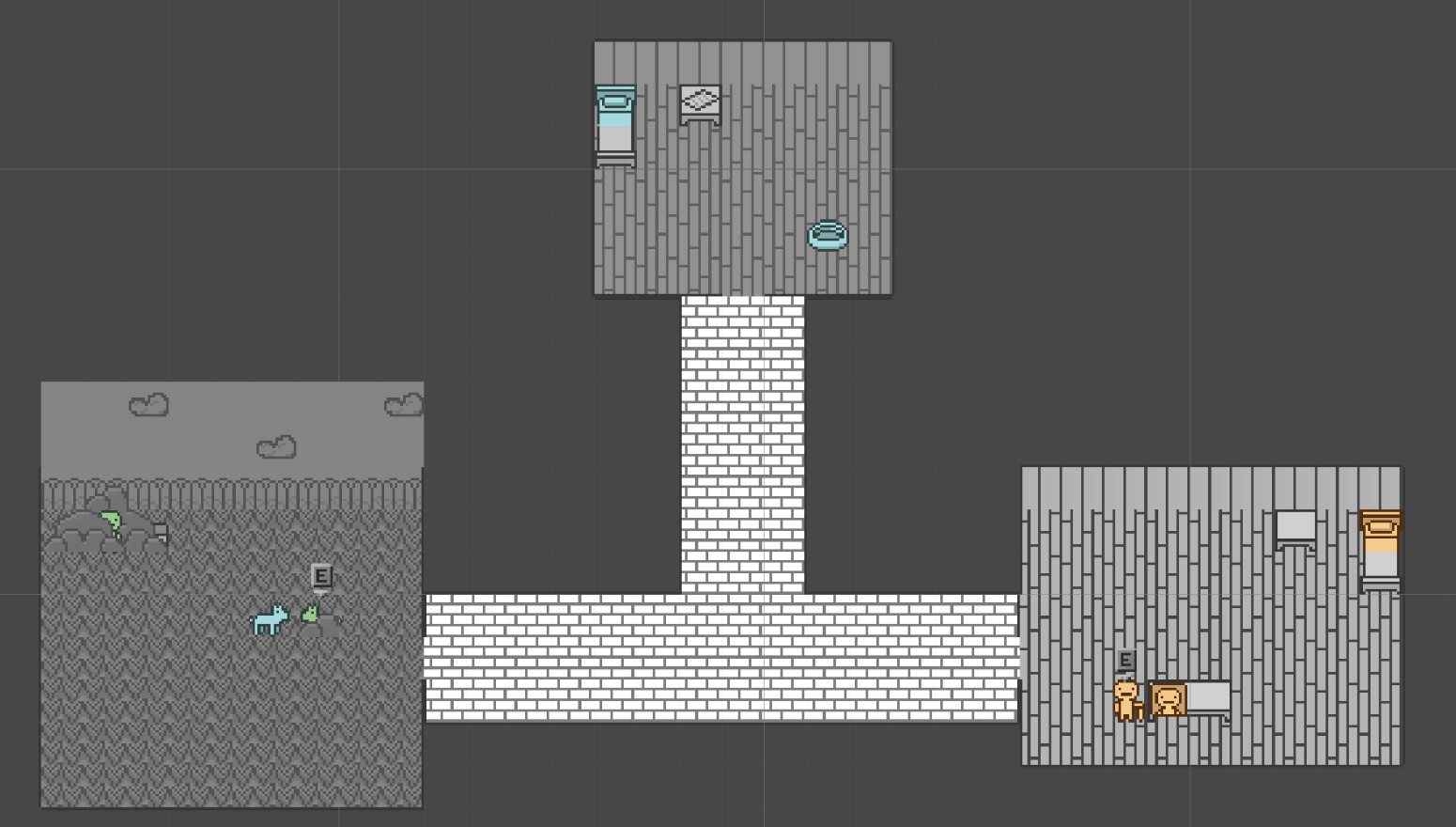
I had the same CS coterm playtest again, along with another Coterm who didn’t know about the game at all. Our returning playtester liked that they could finally play the game independently (with the exception of me manually swapping the scene), and they thought the dialogue vs the narration was more immersive. Both playtesters had one major piece of feedback in common though, that the world felt too static. Things weren’t changing a ton, and at the moment it more felt like a snapshot of time where you can walk around and talk to people, but the world doesn’t change at all as you do. Just talking to Grandpa as the world crumbles, and then having nothing happen bad, and antithetical to the narrative I was trying to build. After this playtest, I went ahead and created a cause and effect system, where interacting with dialogue could make changes to the world/dialogue themselves.
Version 5
The big change in Version 5 was the event system. This included changes like enforcing the fact that you could only do one of the Todo items on the normal day, actually having the transition between the days exist in the game without my intervention, making it so that when characters die their sprites turn grey, and making it so that fire spreads through Grandpa’s house after the player leaves, leading to his death. Visually the game looked basically the same as before, so you can see the above screenshots for an idea.
My playtester for this version was the man, the myth, the legend, Butch himself. Butch overall said that with some of the bugs ironed out, that it was a good start, and I simply needed more. Granted, this was on Quite frankly he was completely right. The first big decision I made was to change the flow of the game to include two normal days, so that both tasks could be done. I retained player agency in the fact that the player can still choose which to do each day, but overall, the game would now be longer. I wanted to add more to-do tasks, but since it was Monday at this point, and the deadline was Friday, I knew I didn’t have time to do a ton.
Version 6
Version 6, the version of more. I hadn’t yet had time to build the new two days structure, but instead focused on trying to flesh out the town more. In this version of the game I finally built out the town square, and ended up making a bunch of new assets to make the town square feel more built out.
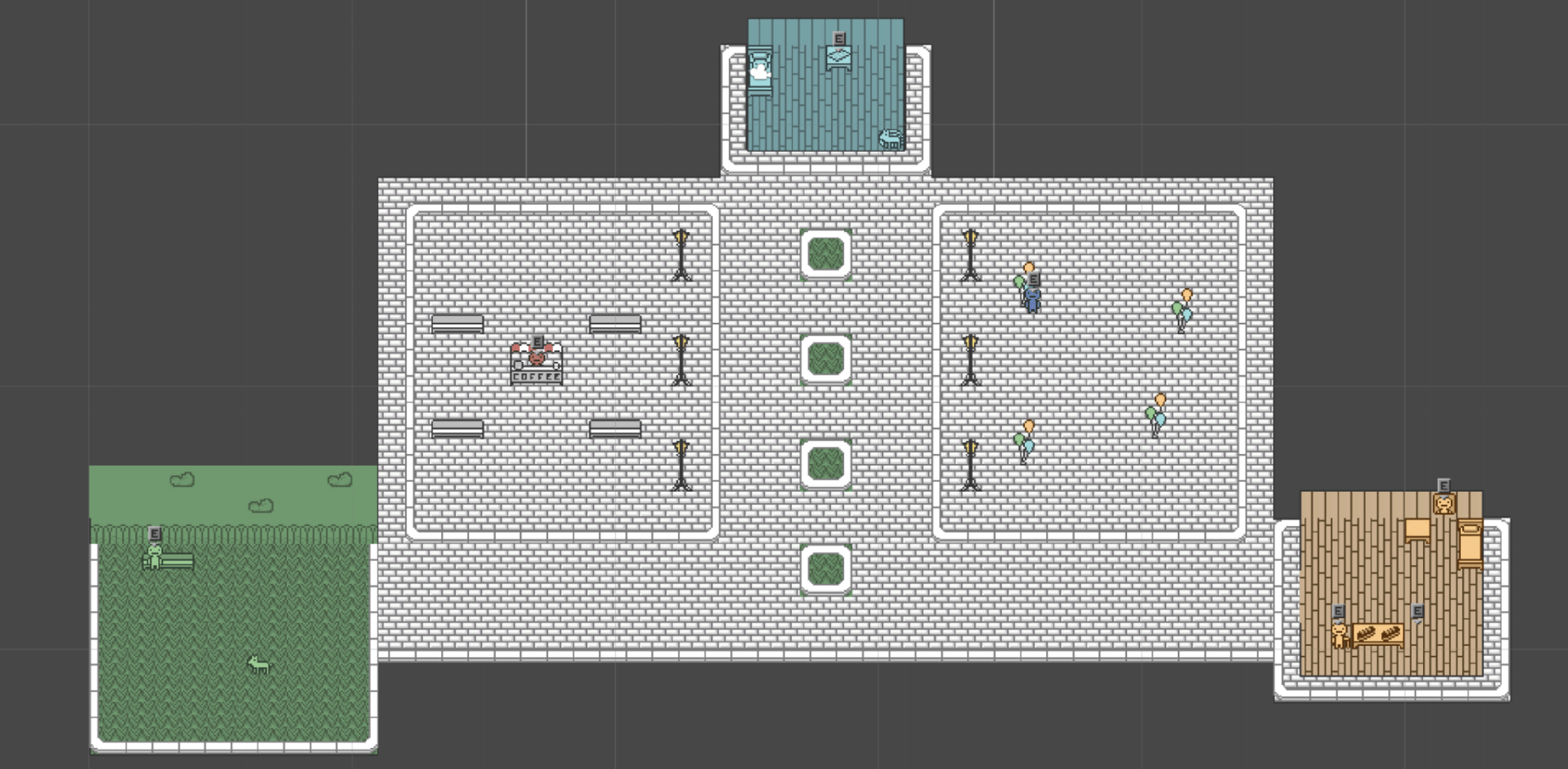
I also added two new interactions to the town square, in an attempt to better flesh out the lore of the world. At this point I had finally done most of the technical implementation work, and was able to put (almost) all of my energy into the narrative and the map. These two new additions were a barista, and BALLOON GUY. The idea behind the barista was to have another character who could give hints about the lore of this town. The barista mentions that they’ve considered leaving town, and further highlights the fact that the player’s family has left town. There’s no explicit mention of the war, but it starts to add inklings that something may be amiss. The only other previous hint was from the park goer mentioning that they moved to this town because it was safer far from the capital, so I wanted to add a little more hinting towards the truth. Balloon guy was the result of an exercise where I wanted to add something to the world that had nothing to do with the narrative, in order to help create the narrative that there was more to the world than just the todo list and the destruction.
Christina ended up being the playtester for this version and she enjoyed Balloon guy quite a bit, which I was excited about, and commented on some specific assets like the bent lightposts after the destruction. Despite the fact that I had added more, it was very horizontal, and didn’t do a lot to add depth to the narrative, and she reminded me as much. I also asked Christina for advice on the ending, and she told me I should drive home my message. Specifically, she told me that if I was trying to create empathy for the victims of natural disasters, I should have the red cross or someone come in at the end. However, as I mentioned previously, the intent of this game was for it to be about war. In this moment I realized that the weird hint hint nudge nudge story telling I was trying to do was not effective in actually getting my point across. I decided that I needed to make things like the Player Character’s motivation more explicitly represented in the game itself. This was also one of the first playtests where the mechanical feedback I was getting (things like better controls/more clear interactions) were pretty minor, and instead the main focus was on the narrative.
Version 8
For version 8 I had figured out the technical implementation behind having the two days of normalcy where the player does both tasks, and added more change across the two normal days. The coffee guy now has a new line for the second day, this one specifically and explicitly discusses the war, and the reasons why the player’s family left town. This plot point was one that existed in my canon for this world, but it was now represented in the game. I wanted this to feel dynamic though, so, the barista will only say this line if the player talked to them on the first day, otherwise they will only say their original line. I also changed the Balloon guy so that he would only appear on the second day, this led to having a bit of mystery of the balloons scattered around the town the first day, that pays off the second. I also made it so that if the player doesn’t interact with Balloon Guy, and he never flies away on the balloons, that he winds up dead after the attack. The biggest addition for Version 8 was a secret area accessible from the top left corner of the town square. This area leads to you a grassy field with a mysterious bunker in the center of it. If the player finds this structure the first day, on the second day there will be a soldier blocking off the route back to the bunker, who has an additional line about the war. I also better showed the player’s attitude of separation from the war and its consequences through these lines.
On Thursday (10/30) night, I playtested Version 8 with some gaming friends of mine on our Destiny 2 discord server. Both of these friends are very into story based video games, and I thought they’d have a unique perspective.

(The above playtester has an ultra wide screen monitor so the game appears very stretched).
This is also the playtest where I realized I hadn’t taken photos of the other playtests, so that one is on me.
These playtesters had really great ideas on the narrative of the game. First and foremost, they said that the sort of mystery that unfolded over the war was really interesting, and that gathering sort of clues about what was going on kept them invested in the narrative. They suggested that I expand on the bunker a bit, because they felt like it could be very relevant in any sort of proper ending I added. They also suggested that some kind of time skip between the normal days could help to establish normalcy better than just the two days. They also really liked the interactions with the barista, because they added a lot of context to the world, without feeling like it was just pure exposition. They also suggested things like a fade to black between nights, and having the game get darker once it was time to go back to sleep. These playtests wrapped up at around 12:30 am on Friday October 31st (the due date), so I knew that despite wanting to explore a lot of these suggestions, that I would not be able to implement everything they suggested.
Version 9: Final Submission
I may have gotten a little bit too ambitious in my plans for version 9, but the key feature of version 9 was a third day in the normal world, in which an anti-war protest happens in the town square. I ended up deciding to add this day, because I really liked the idea of getting to better understand the change in the Player character’s attitude towards the war over time. On this day, the player speaks to some protestors about the war, and the player character really highlights his view that his town is far away from the societal hubs/cities, and should be perfectly safe. The extra day also meant I could give an additional interaction with every single character in the game (besides Balloon Guy that is). I think this last day really strengthened the narrative beyond anything I could have done with just the original two days. The player gets to have a variety of conversations with all the characters, all of whom have different perspectives, and we get to see the player interact with all of them before the attack. In this version I also added a time of day cycle to the normal days, so that the player can actually see that it’s gotten later, after they’ve finished their tasks for the day.
The downside of creating this whole extra day of content is that I actually never had time to give the story a satisfying conclusion. I had something planned regarding the bunker, but ultimately just didn’t have time to make it. I don’t really regret it though, during one of my discord playtests, one of the players was just sort of aimlessly wandering around the destroyed world as we debriefed, and it honestly really captured the dismal, unsatisfying end well enough that I went ahead with day 3 instead.
I was never able to playtest this version of the game, since I stopped working on it just before finishing up the writeup for submission, and it has some quirks (bugs), but ultimately I felt good about the work I was able to do in response to the last couple playtests.
Reflection
I was honestly kind of sad, because getting this very valuable narrative feedback from the final playtest was really amazing, and I wish I had been able to get it earlier. Overall, I regret choosing Unity as my engine for this project, it took so many hours to even get the game in a state where the narrative was the thing people were commenting on. I spent so many hours making assets and functionality, and I think given a couple more days, I could have really expanded on the narrative (and honestly! I still might!). I really am bummed I didn’t get to finish a more satisfying ending, no matter how fitting the current ending may be. Also little things like having the screen fade between nights would have been nice. After putting this reflection together though, I’m really proud of the work I was able to do once I finally had the software implementation finished. I just wish I could have enjoyed the full tool kit for a bit longer, so I could have done better justice to the story I was trying to tell.


Hi Leyth! This was incredible! I really enjoyed being able to move the character around and walk through the setting. I think it’s incredible that you used Unity and made a full landscape plus avatars and house assets and movement and everything, with a cohesive plotline to boot! The values you chose for your game—which I’m assuming are anti-war sentiment or more specifically, a critique of complacency about war—were made clear through your plotline and your ending. The game effectively captures how the tragedy of war begins gradually and then strikes all at once. I think your implementation of dialogue, character death, and abrupt destruction hone in on the values you want to impart to the players. If you continue this for P4, I think you should focus on building out the middle part of the game. The beginning and ending are done well, but the meat and potatoes of your narrative is in the exploration of slice-of-life moments where you connect with other characters and your town overall, with snippets of background war events. I think expanding on that would give the narrative that emotional impact you mentioned missing out on in your reflection. Thanks for the great play!