Premise
Player Role
The player is a lab-grown rabbit that is transferred from its farm to a laboratory for clinical testing. Since the player experiences everything from the POV of the rabbit, the player has to rely only on the senses that a rabbit has (e.g. smell, hearing, touch, and limited sight). The player perceives the world through fragmented sensations rather than words— muffled voices, sterile air, shifting temperatures, and other rabbits’ heartbeats.
Player Goals
- Primary: Minimize fear, make sense of surroundings, and stay alive.
- Evolving:
- Understand what’s happening to you and to others.
- Protect or comfort nearby rabbits.
- Decide how to respond to human control (submit, resist, or empathize).
Player Conflict
- Internal: Confusion and fear in an unfamiliar, sterile environment. As awareness grows, the player must balance curiosity with the pain of understanding.
- External: Threats from humans and machinery (needles, cages, and clinical detachment). The player has no power to fight, only to interpret, adapt, and act carefully.
- Moral: Whether to prioritize your own safety or the well-being of others once you realize what’s happening.
Player Choices
Sensory choices
- Use smell, touch, hearing, and sight to gather information:
- Sniff to recognize chemical smells (e.g. alcohol, blood, other rabbits).
- Listen for approaching footsteps, tone of human voices, or cage doors opening.
- Feel the texture of surfaces (cold metal, soft straw, vibration from nearby equipment).
- Look at light and movement (blurred silhouettes of humans, flickering of lab lights).
Strategic choices
- Interpret clues and context to anticipate danger/safety.
- Hide when handlers/clinicians approach or stay visible to attract attention.
- Approach another rabbit or stay distant.
- Investigate unfamiliar scents (risk of danger) or stay in your corner (safety but ignorance)
- Choose when to act, when to freeze, and when to comfort other
Player Actions
- React: Choose instinctual reactions (freeze, struggle, or hide).
- Investigate: Explore limited environments using senses to piece together what’s happening.
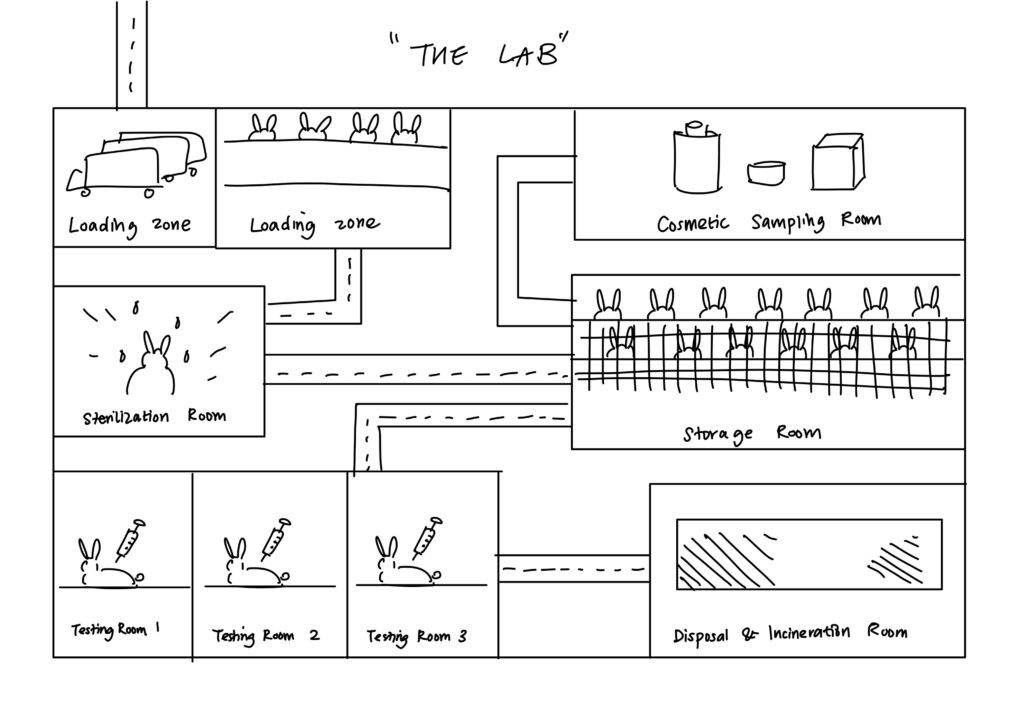
- Move: Hop between cage corners, different rooms, or corridors when opportunities arise.
- Communicate: Nonverbally connect with other rabbits through small gestures (nosing, nudging, grooming etc).
- Empathize: Make moral choices that reflect awareness (e.g. soothe a panicking rabbit, warn others of danger, or sacrifice safety for others).
Resources
- Rabbit’s senses: smell, hearing, sight, taste, and touch to navigate, detect threats, and identify emotional connection/communication from other beings.
- Health meter: rabbit’s health deteriorates as it undergoes lab testing (player needs to survive)
Game events
- Transfer from farm to lab facility: journey starts in a dark cage -> first exposure to unnatural smells and vibrations.
- Arrival and isolation: unfamiliar sounds, loss of familiar companions, first night in sterile light.
- Lab test procedures: injections, skin irritation trials, eye tests -> growing disorientation and deteriorating health
- Observation of researcher/clinician work: humans discuss you clinically -> muffled fragments (e.g. hear “Subject 47B” and “test dosage”).
- Observation of other rabbits: notice fear, sickness, or disappearance of neighbors -> decide how to respond.
- Awareness scene: discover written notes or overhear conversation revealing your fate.
- End: decide whether to attempt escape, stay to comfort others, or accept your fate/shut down emotionally/physically
Map
Project plan
- Oct 19th: Completing first draft of premise and mapping
- Oct 20th: Playtest 3, gather feedback, and revise game to create Version 3
- Oct 22nd: Playtest 4, gather feedback, and revise game to create Version 4 on Twine. Finalize premise and mapping
- October 23rd Playtest 5, gather feedback, and revise game to create Version 5. Edit on Twine and consider adding visual elements and styling
- October 27th: Make final edits to narrative wording and consider adding more stylistic elements to make game more engaging.
- October 29th: Final edits on Twine
- October 31st: Submit final game and write-up
Potential challenges I may face:
- Revealing clues about the player’s surroundings without using human language and instead relying mainly on rabbit’s senses—how can we do this in a clever way?
- Including a diverse enough range of actions the player can choose from to keep them engaged while being realistic about what a rabbit can do so players can deeply empathize