Observation & Comment
| Observation | Comment |
| The host briefly explained the rules and the test began.
The player asked if they were playing a certain role. The host replied that it was the role of “watching the protagonist’s memories”. The secret card was shown and the players were interested. An observer secretly peeked at the content of the secret card. |
At the beginning, it was announced that there was a “secret”, and the game goal and psychological expectations were set up. The effect was good and it successfully aroused curiosity. |
| The player read the content on the card.
The player read a new clue and got a new card (repeated multiple times). The player read a clue and unlocked two cards at the same time. The player was surprised. The observer commented that it was a bit like Her Story. |
The narrative branches were surprising and should be interspersed in the linear narrative. |
| The player unlocked the first secret and said after reading it: “So the person I caught was my lover.”
The player read six cards but only sorted them by number. The host prompted: “You can sort them by time.” The player arranged the cards by time. |
The protagonist and Camellia were lovers – this information was smoothly conveyed. The first twist. |
| The player unlocked the second secret. The host added: The file card is objective, the memory card is subjective.
The player read more cards and was surprised when they read about the revolution, not knowing how such a large span came about. When the player read about the gun, they couldn’t wait to unlock the next card. |
Regarding the subjectivity/objectivity of information, it should be clearly indicated in the game. (Which ones are logical anchor points)
By arranging the cards, the designer expects to arouse players’ curiosity and imagination about “what happened in this period”, which is the desired dynamic. |
| The player unlocks the escape memory. The player discovers a contradiction with the previous information (whether Camellia is dead or not).
Reading is completed. The host asks: Find the contradictions in the story. The player rearranges the cards again, focusing on the leap in the afternoon and the question of “dead or not”. The player tries to find a card but can’t find it no matter how hard they try. |
It is suggested that in the video game version, more guiding questions (scaffolding) be added instead of a large open-ended question.
It is also recommended to enhance content search to prevent players from not being able to find key information and having to traverse (two parallel search systems, one is to recall clues to activate memories, and the other is keyword search for content. The two are not equivalent). |
| Revealing the final top secret. The player exclaimed upon seeing “cognitive disorder”.
However, after reading the card that ultimately revealed “Alzheimer’s disease”, the player showed no obvious reaction. The host prompted the player to read the italicized date on the card. The player picked up the card and read it, attempting to find new information but failing to do so. The host explained the game’s empathy mechanism to the player. The player offered suggestions (refer to the suggestion section). |
When the suspense was revealed, it achieved the expected effect (reversal, surprise, eureka moment), but it did not have the anticipated impact on empathy.
After the final secret was disclosed, some previous texts (focusing on the 70-year-old) could reveal new content. This new content contributes to empathy and also indicates that “the game process has brought about some changes to the protagonist.” In video games, a special empathy section is added (where the player-controlled Camellia has a conversation with the protagonist’s memory entity). |
Suggestions
- Add some pictures to present the story more visually.
- Provide more detailed background information. The “big picture” such as the revolution, the protagonist’s and Camellia’s positions, etc. is not clear enough.
- If designing questions, pay attention to the convergence of information. (For example, the 40-year-old man that appears somewhere, my setting is the protagonist’s son, but the player might think he is just a passer-by.)
TODO
- To achieve empathy, the top priority is to design the final “empathy dialogue session”.
- Enhance the player’s agency during the process to prepare for solving the puzzles: some small questions should be arranged in the process. These questions will guide the player’s thinking without revealing the answer too early. Moreover, these questions should be simple enough and not require complex logical thinking. The player should focus more on the emotional experience of watching the story.
- Integrate the background story and empathy motivation as much as possible. (For example, in the current background, the dystopian regime restricts scientific research – could elements such as discrimination against the elderly and the sick also be added? Try not to separate the story of a 20-year-old from that of a 70-year-old. The story of “searching for a lover” has already been connected to the ad, but what about elements like the era background and revolution? Another solution: downplay the era background and focus on individual narratives.)
- Reduce some ambiguities, such as whether the protagonist killed Camellia or not. (Even if he didn’t, why does he feel like he did? A corresponding event in reality is needed.)
- Game interaction details. For example, how to display the text, how to display the search system. Should there be some “false options” added to each memory (selecting any option makes no difference, only the reading order is slightly different). Should the clue words be turned into question-driven?
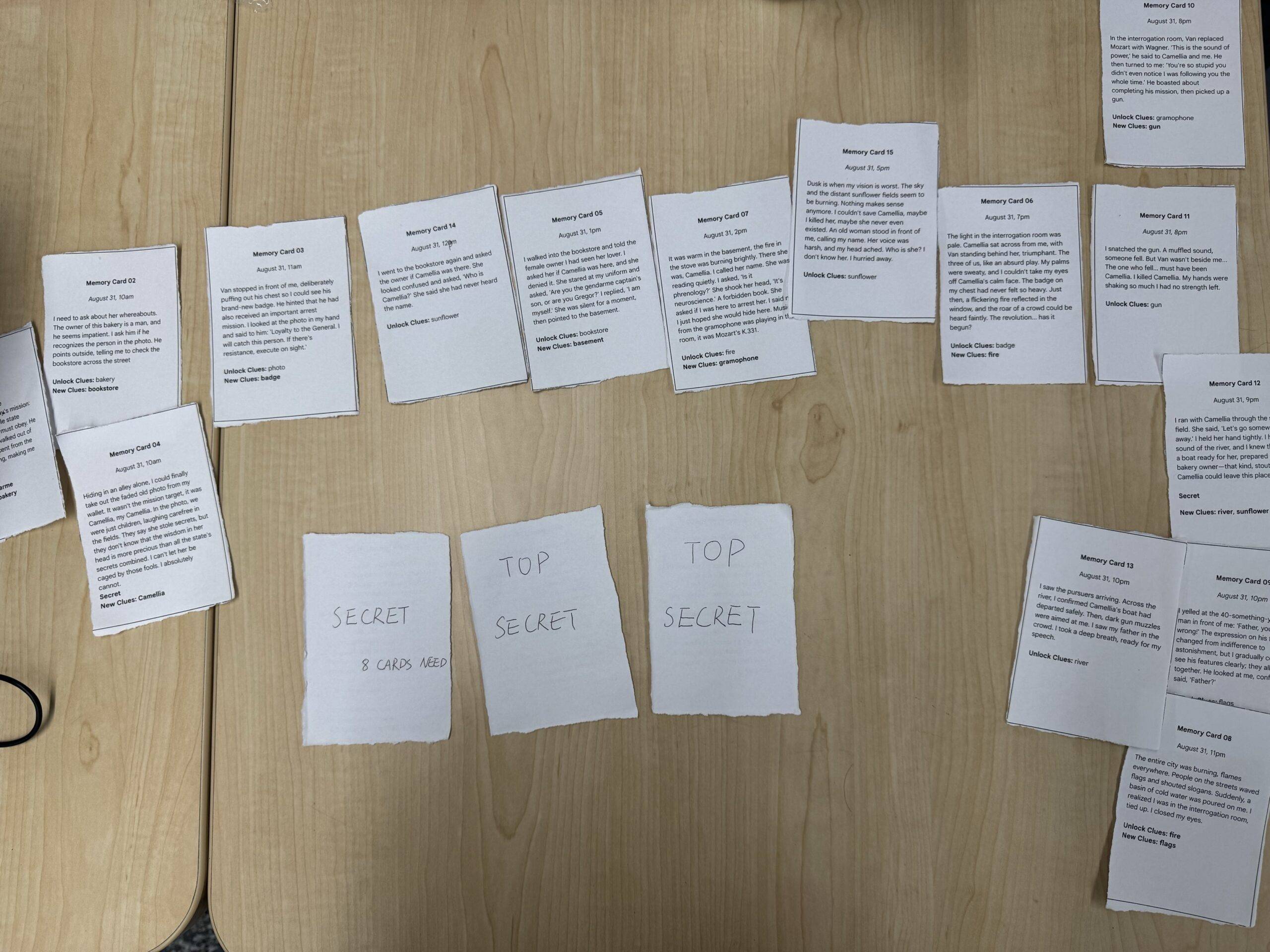
Figure 1: Memory cards arranged in sequence