Overview
For this critical play, I decided to play With Those We Love Alive, an interactive fiction game created by Porpentine and available to play for free on web browsers through Twine. This game isn’t likethe typical action game with fast-paced action or clear goals. It’s more for people who like slow, atmospheric experiences and aren’t afraid to sit with their feelings. I’d say the target audience is teens and adults who are open to experimental storytelling, especially anyone who likes games that are more about mood and introspection than competition or “winning.” The game is all text, with dreamy visuals and ambient music that set a really unique vibe. It’s the kind of game that invites you to slow down, reflect, and just exist in the world it creates, even if you’re not sure where it’s all going.
Experience
I came into this game never having heard of it before and honestly not knowing what to expect. I’ll admit, it took me more than a few seconds to realize I was supposed to click the heart at the beginning (that was a little embarrassing). But right away, I appreciated how the game told me that no decision I made was wrong. As someone who struggles with indecisiveness and anxiety, that made me feel a lot better. It made me feel like I could just play without worrying about messing up or receiving any consquences for picking the “wrong” thing.
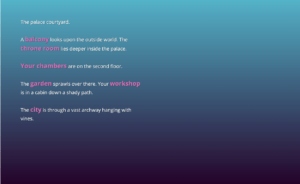
The whole vibe of the game is super relaxing. The colors, the music, and the general ambience just kind of reel you in and make you feel comfortable. The meditation sequences caught me off guard at first, but I actually ended up enjoying them. As I played, I kept searching for some kind of objective or clear storyline, but the more I moved forward, the more I realized there really wasn’t one. I found myself trying to piece together the narrative, looking for clues that might connect two things, but that is not at all what this game is about. It reminded me a lot of Dear Esther as they are both really slow, nonlinear, and kind of mysterious, but in a way that feels very feminine and gentle. It’s not fast or adrenaline-filled, but it’s got its own kind of pull. After a while, I became stuck in the palace courtyard, where all of the links i clicked lead me nowhere new, and I wasn’t able to reach the part where I was supposed to write on my hand.

Analysis
Playing WTWLA as a feminist honestly just feels right. The game doesn’t care about high scores or getting passed challenges. It’s more about feeling things, reflecting, and just being present. That lines up with what Shira Chess talks about in Play Like a Feminist. Chess entions how most mainstream games are all about competition, power, and “winning,” which are pretty much the opposite of what this game is doing. Here, you’re not trying to conquer anything. Instead, you’re just existing in the world, making choices that feel personal but aren’t about “winning” or “losing.”
The game is super intentional about making space for emotions and vulnerability, which is a big deal in feminist game design. It’s like the game is saying, “Hey, it’s okay to just be here, to feel what you feel, and not have to prove anything.” That’s a huge contrast to games that push you to always be productive or “better” than someone else. The way the game reassures you that no choice is wrong and gives you space to meditate or just sit with yourself is honestly kind of radical. It’s a soft, gentle rebellion against what most games expect from players.
But if I’m being honest, there are some things that could be better. The game is really abstract, and while I liked the dreamy, open-ended feeling, I can see how it might leave some players (especially those looking for a clear story or more direct feminist critique) feeling lost. It’s definitely got a feminine vibe, but it doesn’t really dive into intersectional stuff like race, class, or disability, which Shira Chess says is important for feminist games. I think the game could go further by weaving in more perspectives and maybe giving players a few more meaningful choices that actually impact the world or the narrative.
How Feminist Perspectives Could Improve the Game
If I were to make this game even more feminist, I’d want to see more voices and perspectives included such as stories that touch on race, queerness, or disability, not just a general sense of “softness” . I’d also love to see the meditation parts go a little deeper, maybe asking players to reflect on bigger social issues, not just personal feelings. And while I actually liked the open-endedness, I think it could be cool to give players a few more chances to make choices that really matter, maybe letting them build relationships or push back against the world in small ways.
I also think it would be awesome if there was a way for players to share their experiences or create parts of the story together. That kind of community and collaboration is a big part of feminist play, and it would make the game feel even more welcoming and powerful. Overall, though, WTWLA is a really refreshing break from the usual game formula, and it shows how games can be soft, emotional, and feminist, all at the same time.