[major puzzle spoilers. minor story spoilers.]
Cube Escape Paradox is an point-and-click escape room themed about a detective trying to rediscover their past memories. It is the tenth game in the Cube Escape series, developed by Rusty Lake. It is designed for older players, about 16+, with a taste for psychological horror and mystery, with a dark subject matter and tone, and several legitimately unsettling visuals and jumpscares. The setting of the game–a mysterious, locked room–evokes the atmosphere of a detective driven mad, with a shelf of case files, a projector with cryptic messages, and a notebook with evidence. Each of these items also provides clues to solving the mystery–as well as the puzzles to escape the room. The game weaves together narrative, mechanics, and mystery, by embedding its clues naturally into the setting.
Firstly, the setting defines the narrative and goal. The four walls of the room and the locked door create a goal for the player: to escape. This is an example of how architecture defines obstacles, by limiting player movement and providing a clear path forward. On a lower level, the architecture of locks and keys tells the player where to go and where to look next. By having locks, both in the form of literal locks, as well as the Case 23 notebook, the player knows what they are looking for. More broadly, the setting is the medium through which the narrative is communicated. Besides the obvious fact that the player is trapped, the player also pieces together photographs, evidence about the murder of Laura Vanderboom, and audio and video recordings of the past.

[the case files, which establish a detective mystery setting, while helping advance the escape room puzzle]
Secondly, the clues about the mystery and the hints about how to advance are tied together and embedded in the setting. For example, to figure out what to type into the typewriter, you need to piece together the pieces of the photograph. The assembly of the photograph reveals key characters as well as what to do next. Another example is the use of the projector to figure out the order of the runes. The order of the runes is given by watching the TV and paying careful attention to the projection onto the painting. This puzzle combines characters, in-world objects, and puzzle mechanics smoothly, making the player feel like a true detective.
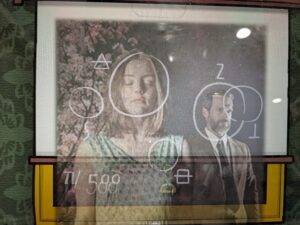
[the projected image overlapping with the painting and the projector screen reveals runes and text, which must be used in combination with the TV and the painting to solve the puzzle]
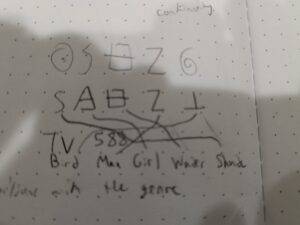
[my detective work, handwritten]
Mechanically, the puzzles are also designed to create suspense. My favorite “puzzle” was actually flipping through different channels on the TV. It was very simple–each channel just directed you to another channel–but the drama of turning the dials, seeing static, and expecting a jumpscare or bloody scene kept me immersed as I was following instructions. Using a TV instead of a benign puzzle object, like a combination lock, creates mystery because the TV can reasonably be expected to portray something scary. As a designer, this encourages me to use in-world elements whenever possible to communicate in-game information, to reinforce tone.

[turning the dials of the TV. very suspenseful.]
One issue of ethics in this game is the naming and physical embodiment of a character. Giving the player a defined physical self prevents all players from identifying with the protagonist. Especially in an industry that is often centered around white men and their heroic fantasies, it is frustrating that the protagonist of this game is represented in a way that may discourage players from feeling like they’re playing as themselves. This is not only an ethical harm, but from a game design, it can break immersion.
Other games, such as Crush Crush dating sim do a better job of this. Firstly, all the characters in Crush Crush use gender- and body-neutral language when referring to the player, which allows anyone to feel as though they themselves are immersed in the game. Secondly, the player customization screen is designed to be customizable and open the interpretation. The player can equip different hairstyles and outfit, and the actual player icon is basically just an outline with no distinguishing features:

[the player icon]