Game: Tiny Room Stories: Mystery Town
By: Kiary Games
Platform: iOS, Android, PC
Target Audience: Puzzle lovers, fans of atmospheric games
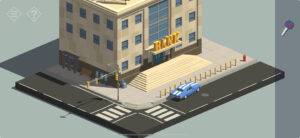
Tiny Room Stories: Mystery Town offers an effective model on how narrative can be seamlessly integrated into gameplay mechanics. The game places you in a fully explorable 3D environment, but instead of first-person immersion (that lots of escape room games tend to employ), it embraces an isometric camera and rotation mechanic that makes the space feel like a diorama or toy world. In the first level, that narrative is not something explicitly told, but it builds upon itself as you explore and progress through the revels. You are able to interact with the space and the objects in the environment, gradually piecing together clues for the story.
The central narrative begins simple, as you’re told you’re investigating the disappearance of your father. However, there is no narrator holding your hand throughout the story, but rather it depends on your progression through the levels and your attention to detail to the clues in each level. The mechanic of rotating the world is crucial: each room, wall, and drawer in each scene is part of the storytelling. The act of rotating a house and seeing new entrances or furniture gives you the feeling of peeling back a layer of mystery, especially when these objects are interactive and reveal more hidden secrets. One clever moment in the first level involved unlocking a door that, due to the camera angle, I didn’t even notice existed on my first pass. That moment is design working in parallel with the narrative.
The game feels to have a natural rhythm, driven by the space you are currently in. First, enter the space, then, rotate the space around to discover interactive objects and clues. The backtracking loop is where a lot of discovery happens, and it turns mechanics like tapping and rotating into narrative tools. Not only are your navigation tools used for visibility, but to discover meaning as well. What I really love about Tiny Room Stories is that it supports this exploration without overwhelming you. Oftentimes, narrative-based games like this dump too much information and lore onto the player that might cause cognitive fatigue. Tiny Room Stories does a great job of balancing this, as the story is broken up into interactive tasks instead of long lines of text or dialogue. However, the rotation mechanic, while smooth, may be improved. I found myself stuck throughout the levels due to simply missing objects that were hidden from my current view— perhaps a very faint outline of the rest of the objects in the view (with low opacity, etc.) can be implemented to inform the user of alternate views.
From an MDA perspective, the mechanics (object interaction, world rotation) lead to dynamics that emphasize exploration and memory. Aesthetically, the game generates a sense of curiosity and peaceful isolation. The formal elements (rules, space, objective) are all in alignment with the mystery story the game is attempting to craft. Furthermore, the decision to exclude NPCs or other players forces the narrative development of the game to stem from inanimate, yet interactive objects in the environment.
In regards to accessibility, the game raises some issues. There is a heavy reliance on visual cues, especially with detailed objects that reveal specific, unique clues. This could be a barrier for players with low/impaired vision. In addition, the puzzles depend heavily on social perception, which can be a challenge for neurodivergent players or those with cognitive disabilities. On the settings of the game, there were no visible accessibility features, which is a missed opportunity for a game who’s slow and thoughtful gameplay invites gamers of all kinds.