

Introduction
I played Babbdi, a free walking simulator adventure game designed & published by Sirius and Leonard Lemaitre, which was available on macOS via Steam. Based on my own gameplay experience, I believe Babbdi is targeted at young adults who enjoy open-ended exploration and are intrigued by the suspense associated with the unknown. The world of Babbdi is bizarre and surreal, allowing for the emergence of storytelling through movement and exploration of vast space.
Central Argument
Walking as a means of traversal in the world of Babbdi is how the designers achieve spatial storytelling; the intentionally slow movement allowed me to experience the sights and sounds of each distinct environment, landmark, and character in the world. Whereas many other walking simulator games tell a story through text or verbal narrative, Babbdi highlights how the act of walking itself can be used as an expressive tool for conveying moods and emotions that heighten the suspense of gameplay. Overall, walking through the vast, brutalist world of Babbdi allows players to experience the feelings of eerie isolation and underlying resistance associated with searching for meaning and hope within a decaying society.
Analysis
From the beginning of gameplay, it is clear that Babbdi is a dystopian city that is rundown and mostly abandoned, with the exception of the few remaining NPCs that the player runs into throughout the exploration. The game places you in the world with no given instructions, no guidance on where to go, and no enemies to battle. Yet, I quickly realized that the game is not aimless. The layout of the city itself – with walkable beams, landmarks mimicking obstacle courses, visible tunnels, and oddly placed gaps just big enough for me to fit through – acted almost like a map, providing me intuition with where to walk.
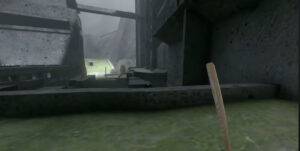
At each turn, there were multiple directions I could go to explore different environments. In the above image, I have the option to jump on the obstacle course that would allow me to directly cross the cross; I have the option to turn left to explore a different landscape; or I have the option to walk on the balance beam around the cavern. The act of choosing which way to go felt as if I were implicitly communicating the game system, mimicking a “choose your own adventure game”. Each time I determined where to walk, it felt like I was taking a step forward in the narrative of the game.
I also want to analyze the mechanics that drive narrative and emotional investment in the game amidst a mostly unresponsive world. One of the most important mechanics in the game are the NPCs scattered sparsely throughout the world. As evidenced below, NPCs are singularly located in vast empty spaces, making them extremely noticeable to the player; thus, NPC sightings are used as “next step” signals that inspire action to drive the story forward.
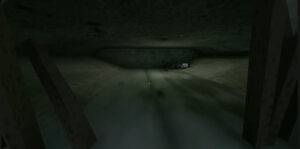
Because of the scarcity of NPCs and their stark contrast against the otherwise muted landscape, players approach NPCs with purpose in hopes of discovering a new clue for actionable progress. Yet, most of the time, they simply offer cryptic lines that add context to why Babbdi is decaying without providing help in the player’s mission to find a train ticket. Although these interactions may appear to be meaningless, the lack of direct assistance by the NPCs, combined with the fact that NPCs are always eerily staring at you regardless of where you’re standing, reinforces the themes of alienation and self-reliance. This points to the fact that players must discover meaning and direction in the game on their own without being given the answers outright.
Another important mechanic in the game are the tools that players discover and use to interact with the world. Throughout my gameplay, I discovered a baseball bat, axe, grappling hook, and glider machine which played a critical role in allowing me to access new parts of the world. I noticed that tools are strategically placed throughout the game as rewards for a player’s curiosity and persistence; the more the player explores and engages with the world, the more powerful the uncovered tools become. The tools also embody the overarching theme of self-directed growth as each tool increases player agency to “challenge” the architecture in an otherwise disempowering world.

For example, as evidenced above, the pick axe allowed me to scale large walls to access higher rooftop points that I couldn’t previously explore. This unlocked ability is symbolic of a character’s ability to “defy” the city’s oppressive architecture, representing a shift from passive discovery of the world to empowered exploration of what may be uncovered.
As the game progresses, the player weighs feelings of aimlessness with the desire to unearth clues. Walking can thus feel heavy and imposing, yet also serene and exciting due to the open ended-ness. Currently, the balance between these two moods is 50/50; however, I found that at certain points in the game where I was wandering without any clues, tools, or NPCs in sight, I felt extremely de-motivated to continue playing the game and was a bit bored. If I were to improve the game, I would include more guiding elements that inject forward motion into the game without compromising the main idea of player-driven exploration. For example, a shift in environment (ex. Sunrise, sunset, rain, dusk, etc) could signal that new game elements or mechanics will be introduced; audio cues could signal if I’m approaching a significant game element (ex. NPC with crucial information, special treasures, powerful tools, etc). I think these elements could offer just enough to enhance player engagement while maintaining the mood of isolation and solitude.
Connection to Class Learnings
When analyzing Babbdi in the context of MDA, I think it is important to recognize that the mechanic of walking creates a slow, yet deliberate dynamic of exploration which achieves the aesthetic goal of existential detachment. There are intentionally very limited formal elements (players, objectives, rules, procedures, etc) so that walking becomes the central engine for narration.
Ethics
Violence does not play a central role in Babbdi as there is no battling of characters in the game; however, the boundaries of the game do not necessarily exclude violence either. For example, when I had the baseball bat, I had the ability to swing the bat at NPCs at will. Hitting the NPCs had no consequence at all; I simply repelled away from the NPC but there was no evidence of the impact of the hit. The exclusion of visible injury due to violence ensures that violent actions do not take away from the central theme of self-exploration. However, this is a double-edged sword as the exclusion of visible injury indicates to the player that their violent actions are acceptable without consequence, potentially encouraging players to repeat the violence as much as they want. Overall, I think the act of hitting/breaking objects is essential in the game in order to uncover new landmarks; however, I think a more distinct boundary should be drawn to prevent players from swinging at NPCs as to discourage violent behavior both in the game and beyond.