_________, a close second place to Perfect Match.
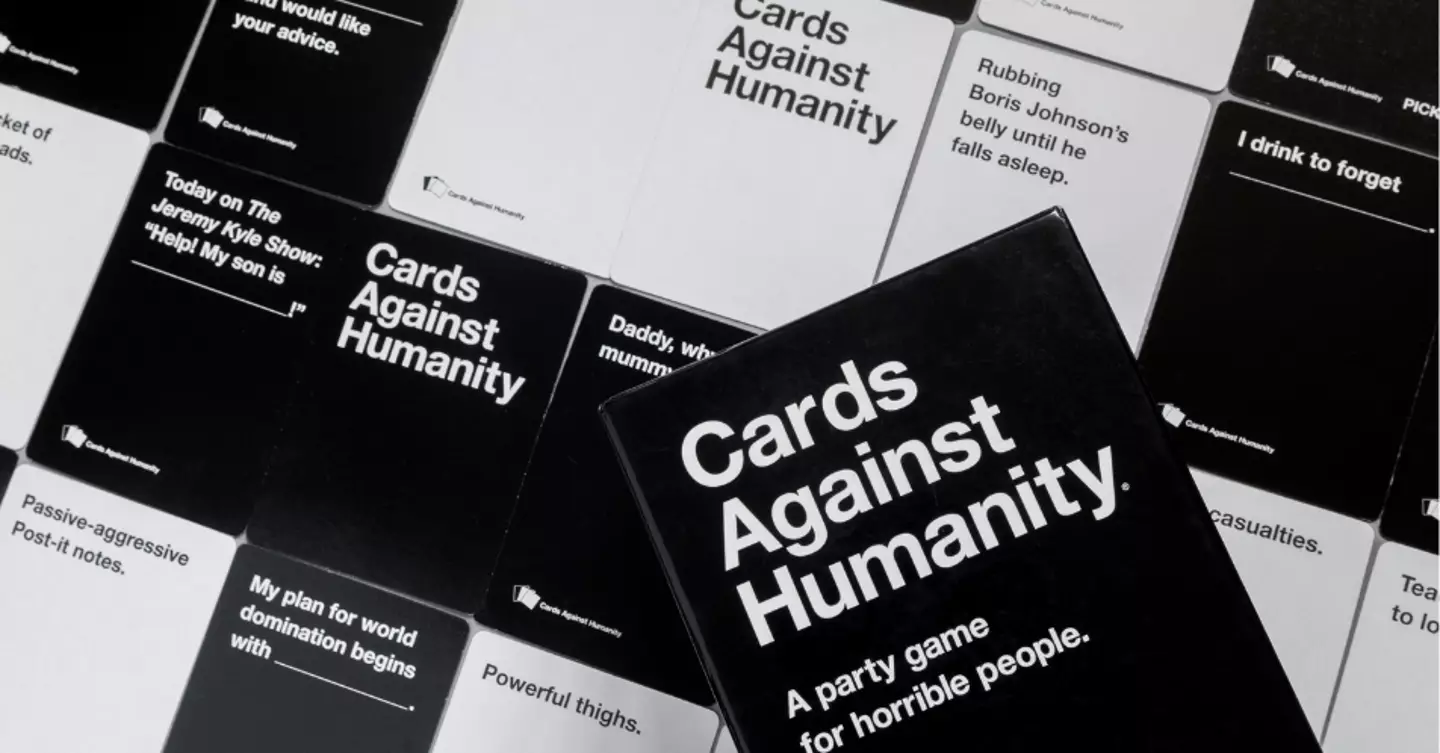
Cards Against Humanity – a card-based game designed by a group of 8 friends from high school – was designed for social, party-like gatherings of young adults (age 17+). It is intended to be a hybrid of MadLibs and Apples to Apples with a wicked sense of humor. I played both Cards Against Humanity and Perfect Match (my game for 247G) with a group of five friends to uncover how similar, yet altered sets of mechanics, dynamics, and formal elements can inspire two different forms of gameplay with new types of fun.
Thesis
Cards Against Humanity and Perfect Match share the core mechanics of “fill-in-the-blank” and “judging” that allow for the development of fun in the form of fantasy as each player attempts to devise humorous scenarios that will delight the judge (Card Czar in Cards Against Humanity, The Bachelor in Perfect Match). However, Perfect Match enhances the premise of Cards Against Humanity by introducing the mechanics of “Box of Chocolate boosters”, spicy prompt cards, and secret crushes. When combined, these new mechanics force players to use their creativity to form cohesive narratives inspired by the response cards. This dynamic of narrative-building and storytelling requires intimate player interactions, allowing players to learn more about one another to ultimately build stronger friendships within the group. Thus, Perfect Match distinguishes itself from Cards Against Humanity by building upon fantasy through introducing fun in the form of fellowship.
Analysis
I want to use the “Formal Elements” framework to compare and contrast Cards Against Humanity with Perfect Match. Both games have a Player structure of “player versus player” in which every player submits response cards that directly compete with one another as the judge picks their favorite submitted response. Additionally, both games have the same Objective of outwit (albeit the mechanics of outwit slightly vary) in which each player attempts to submit a response card that will appeal more to the judge than the other players’ cards. However, it is the difference in Procedures, Rules, Resources, and Boundaries between the two games that allows for two unique Outcomes. In this section, I will break down different play scenarios within Cards Against Humanity and Perfect Match that exemplify the impact of different formal elements on the gameplay.
1.Different Boundaries

In Cards Against Humanity, one of the most important boundaries is that the judge must make their decision about their favorite card in isolation, without any justification from the players themselves. This boundary of prohibiting any type of user input during judging prevents noise from swaying the judge’s decision; however, this also creates a more solitary dynamic of play during the judging phase. Another important boundary in Cards Against Humanity is the White Cards themselves; each player’s submission is limited to whatever text is listed on the White card.
Perfect Match expands these boundaries of the game by introducing spicy cards and boxes of chocolate. Spicy cards are prompt cards that require players to use a response card in their hand in order to complete a spoken word task (ex. a proposal, a pickup line, etc). By expanding beyond what is simply written on the response cards, Perfect Match allows players to use a response card as an open-ended opportunity to leverage personal strengths in creativity, persuasion, humor, and/or storytelling. Similarly, by playing certain box of chocolate cards, players have the one-time ability to attempt to sway the judge’s decision-making by giving a pitch about why their response is the best. This directly violates the boundary outlined in the previous paragraph; however, we intentionally chose this strategy because we believe that the act of a player trying to convince another creates a more humorous dynamic through a change in pace of gameplay.
2. Different Resources

In Cards Against Humanity, winning a round allows you to gain a black card which represents earning a point. At any point in the game, a player’s resources are limited to the black cards earned and the ten white cards in the player’s hand. Perfect Match differentiates itself by providing further resources to a player that allow for a more dynamic game play. In addition to collecting prompt cards (referred to as “roses” in the game) for earning points, players can also earn bonus cards in the form of “boxes of chocolate”. There are different chocolate cards– some are sabotage cards, some are advantage cards, and some are simply meant to switch things up! By playing a chocolate card in any given round, players can alter the pace of gameplay in a strategic way that tips the game in their favor. This added resource enhances the dramatic element of challenge in the game by adding a layer of unpredictability. Players don’t know if or when another player will play a “box of chocolate” card, so the added tension allows for maximum excitement when chocolate cards are played (especially if multiple players decide to play them at once!).
3. Different Procedures
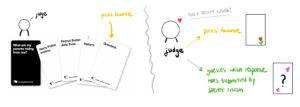
Finally, the procedures of the game fundamentally differ between the two games. In Cards Against Humanity, there is the standard set of procedures including answering the prompt, judging the responses, earning a point, and then moving onto the next round. This creates a steady rhythm of gameplay that helps players pick up on the premise of the game with ease. However, after about 15 minutes of gameplay, one player pointed out “This is sort of getting boring. Can we play something else?”. I believe that this standard, yet unchanging rhythm of gameplay is what contributed to boredom over time, encouraging a shorter period of gameplay as compared to other social games. Therefore, Perfect Match introduces a procedure in each round that also allows the judge to earn rewards (in addition to the player whose response was picked by the judge). Our “secret crush” mechanic allows the judge to select both their favorite response and the response that they think their crush submitted. This added guessing procedure is meant to foster deeper engagement from both the players and the judge.
Learnings
One of Cards Against Humanity’s greatest strengths is that the boundaries, resources, and procedures are so simple that anyone can pick up the game without reading an instruction manual. When creating a social game with a large number of players, this level of simplicity and familiarity is important to the success of the game. Although the basic judging mechanic of Perfect Match was intuitive to users (due to parallel rules, procedures, and objectives with Cards Against Humanity), we found during playtesting that the mechanic of “secret crushes” sparked significant confusion regarding the rules and the contexts in which crushes are actually useful to the player’s objective to outwit others. Moving forward, our team would like to strengthen the mechanic of “secret crushes” to make it more intuitive such that players can remember the procedures without having to refer to the rules.
Conclusion
Ultimately, Perfect Match is a mod of Cards Against Humanity with an alternate premise (romance) and tone (game show-like) which optimizes for a more creative and social game experience to elevate the dramatic element of challenge for each player. Cards Against Humanity expertly crafts an experience filled with laughter through a strategic assortment of Black cards and White cards. Our team can learn from the strategies used by the game designers of Cards Against Humanity to create a more cohesive set of prompt & response cards to maximize both the fun of fantasy and fellowship within our world of cheesy and silly romance.