Game: Portal 2 (2011)
Creator: Valve Corporation
Platform: PC (Windows/Mac/Linux), PlayStation 3, Xbox 360
Target Audience: Puzzle game players aged 13+ who enjoy spatial reasoning challenges and narrative gaming experiences.
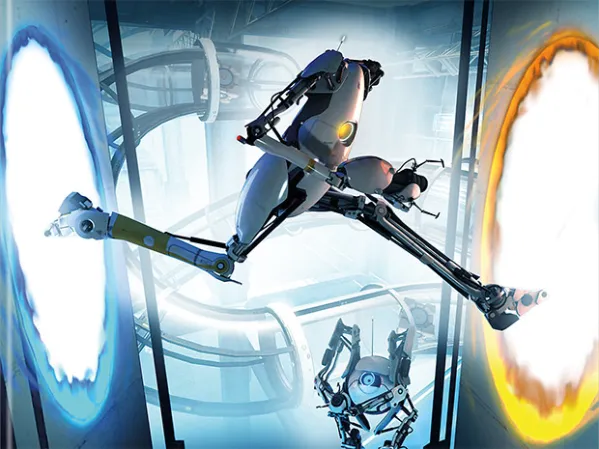
Portal 2’s puzzle mechanics are at once simple and highly sophisticated. The central device is a ‘portal gun’, playing on the commonly known term ‘teleportation’ to provide the player an intuition of disappearing into one portal and coming out of the another instantaneously. This simplicity of mechanics nurtures sophisticated user gameplay: experimentation with the space and physics of the game is essential to progress further. Put another way, puzzles in Portal 2 are not self-contained riddles to answer with a sense of gratification; rather, the game demands that the user reinterprets space, walls and blocks anew in the context of teleportation through the portal gun. This lends a vivid gameplay experience: there is the tool, there is a puzzle, but the sense of discovery and ingenuity is baked into the nature of the solution.
The Mechanic and Its Rules
The emergent dynamics from the portal gun’s mechanics are vast. Certain physics laws are respected in-game: momentum is conserved across portal boundaries so a falling body accelerates and exits the opposing portal with that same velocity. Mechanics develop over the game’s progression, such as Propulsion Gel (speeds you up), Repulsion Gel (bounces you), and Conversion Gel (allows portals to be used on that wall). This keeps the puzzles and solutions consistently challenging and novel.
Using the MDA framework, we can make the links between mechanics, dynamics and aesthetics visible. The mechanics of the portal gun and momentum conservation produce dynamics like spatial experimentation and stumbling into insight loops. Naturally, this in turn yields aesthetics: mastery of the unfamiliar, a simultaneous holding of several physics principles, a sense of true discovery and/or invention.
What distinguishes Portal 2 from its puzzle-based contemporaries like The Witness (Blow, 2016) is the sheer lack of separation between the player and the puzzle-solving aesthetic. To elaborate: Portal 2’s rules are physical and embodied, while games such as The Witness play on pattern recognition from an observational, thinking stance on behalf of the player. Portal 2 implicates the player’s body directly rather than providing symbolic logic spaces. The player is the object being redirected through space to ‘solve’ the question of gaining passage through to the next chamber and eventually out of the facility.
Critique: Teleportation, too, has limits!
Portal 2 is not without design weaknesses. Several chambers in the single player campaign rely on finding a single hidden surface to portal through. This reduces the game to pixel searching and a kind of exhaustion of attention rather than sleek cognitive challenges. In the latter, the player’s time is usually spent experimenting and building on to the final solution. In some mid game chambers, this is contrasted with little experimentation and more hitting roadblocks until you find the one ‘path’ forward. This narrowness of the solution space hurts Portal 2’s charm and genuine sense of discovery, for instance, particularly in the Wheatley sequence.
Ethics: Who Starts Off Farthest From The Box in Portal 2?
Puzzle games are, naturally, about balancing challenge with ease, exploration of ideas with execution. Invariably, a puzzle game’s fundamental logic will cause certain kinds of design friction for players from diverse backgrounds. Portal 2 is no exception to this: the narrative elements of Glados’s dry humor may appeal to certain American audiences more than others. Personally, I feel Portal 2 does a decent job at equalizing the playing field in terms of the puzzles themselves. I do not feel one has to have heard about Newtonian momentum to traverse the gel chambers in Portal 2; many of the game’s physics elements are simple or demonstrated first before progressing into challenge.
Conclusion: Portal 2 May be My Favorite Puzzle Game
Certainly, the characters in this game have become cultural staples: Glados and Wheatley are popular cultural symbols for Valve. What stands out to me is what is most central to the game: the puzzles. When I approach Portal 2, I do not feel I am approaching the opportunity to wrestle with well-balanced puzzles; instead, Portal 2 creates a distinct epistemological space where the rules of space are bent in a clear, specific way that allows portals. Simultaneously, the rules of physics appear identical to real life. This becomes more than an escape; rather, the game feels like a step into a unique world where the puzzles are neither extraneous nor the only thing the game offers its players.