EXIT: The House of Riddles | Thames & Kosmos | Tabletop | 1-4 players, ages 12+, puzzle and (allegedly) escape room enthusiasts.
I argue that The House of Riddles mistakes decoration for design, episodic puzzles for narrative architecture, and hidden object requirements for difficulty. Its central question—why are we trapped?—goes unanswered. The game isn’t a mystery. It’s a puzzle collection with a haunted house costume.
The game makes attempts at establishing an embedded narrative but ultimately fails because no detail included accumulates meaning. We understand Tom is “organized” from his clean room but his books are out of order with no explanation—they’re simply out of order for the sake of having a puzzle. There exists no narrative as to why Tom’s room is out of sorts. The game has you go through cycles of ‘someone disorganized Tom’s room…why…eh doesn’t matter oh well…let’s crack this safe puzzle instead now’! Similarly Mario is “lazy,” but putting away his jerseys solves nothing about why we’re trapped. Sandra “had to leave somewhere,” so her room isn’t even a personal room like Tom’s where we learn something about where she likes to spend her free time she’s just in this weird dungeon space? These aren’t clues. They’re set dressing. You could replace every character trait with a grey box and the gameplay is identical. The narrative is pasted on.
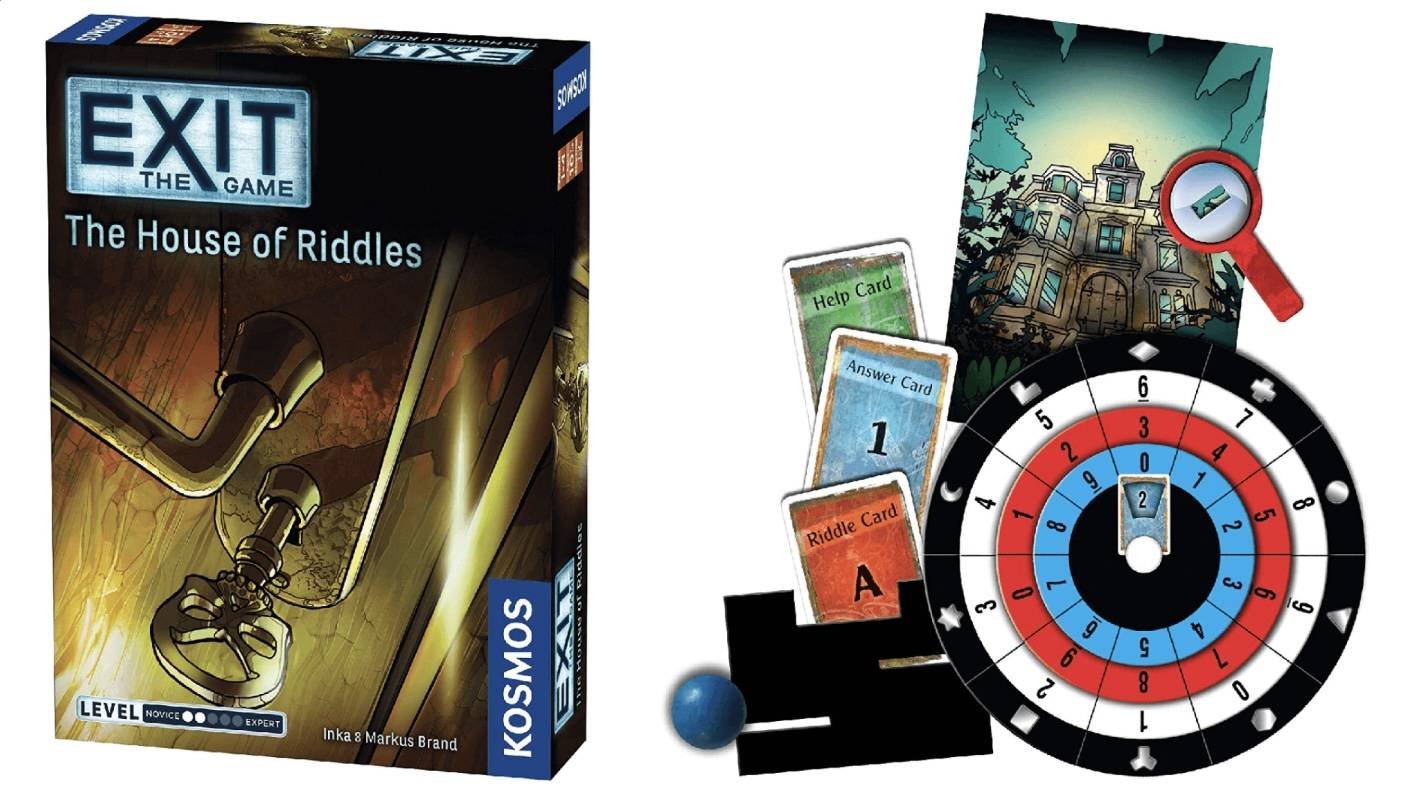
The game’s physical architecture technically does its job. They fulfill Adams’ primary function: constraint (the disk limits what answers you can input), concealment (cards hide puzzles until you earn them), exploration (you move through rooms in a set path). Fine. Whatever. But where EXIT falls apart is Adams’ secondary function: atmosphere, familiarity, emotional resonance. The game has none. You don’t feel trapped. You don’t feel curious. You don’t feel anything except mild annoyance that you’re now looking for a drinking glass (more on this soon!). The rulebook tells you to “immerse yourself in the mystery” but how? The rooms don’t flow! The detectives don’t matter. The only atmosphere is the growing realization that none of this is building toward anything. Adams says architecture should tell you where you are and what might happen there. EXIT’s architecture tells you only one thing: solve the next puzzle, and then the next, and the next…and then stop playing, because you won’t want to finish anyway.
(I almost felt too critical writing that. I tried to gaslight myself, maybe I just don’t like escape rooms? But that’d be a flat lie—I love physical escape rooms. It’s just this one that fell flat. I tried to give it another chance: well-rested, established friends, candy in my system. But I still couldn’t really care. Satisfied with the company, dissatisfied with the shared activity. Weird feelings!)
Now…there’s the clock puzzle in Sandra’s “room”. It requires a real physical drinking glass. This is not in the box, not in the rules as needed materials. Only on the hint card. You have to flip it—spoiling part of the solution—just to learn you need a household object the game didn’t warn you about. Suddenly you’re not a detective, you’re in your kitchen, rifling through cabinets: “why didn’t they put this on the box?… why is this my life?” This breaks the Magic Circle, it did for me completely. The immersion shatters. The mystery dies. Miraculously, the second time I played my friend Marcarious had a glass bottle and it still didn’t work as advertised!

I didn’t finish either playthrough. Not because I couldn’t. Because I didn’t want to. The drinking glass broke my immersion. The LA Skyline puzzle required visualization I cannot do (without tearing this game up). And after minutes of glass-needing based irritation, the question stopped being “how do we escape?” and started being “why do we care?” The rulebook encourages you to “time yourself”…in a game you can only really play once, that requires destroying components, that doesn’t include everything you need. What are you racing against? Your own confusion? So I stopped playing. I don’t think that’s on me.
Compared to physical escape rooms they were trying to emulate, EXIT feels incomplete. But the pool puzzle proves the designers could do better. You place the board inside the box to create walls. You roll a ball. You listen—counting the clangs as it hits the walls. Tactile. Auditory. Genuinely clever. This is the MDA chain working: the mechanic (auditory counting) creates a dynamic (focused listening) that produces an aesthetic of discovery. It worked. It was fun, it proves they knew how to design. The rest proves they chose not to.
Ethics
Back to the glass…because it creates multiple failures! First, it’s an informational barrier: players who avoid hints (to preserve challenge) are punished—players who peek are spoiled, there’s no winning. Second, it’s a logistical barrier: we played during office hours, not home. There were no glasses. The game assumes a specific environment—a home with ready access to household objects—without warning.
Then there’s the destruction problem. EXIT games require you to cut, fold, and write on components. You can’t play twice. For players who don’t want to destroy their purchase and who, like me, have aphantasia and rely on physical manipulation instead of mental visualization—this presents a barrier. The LA Skyline puzzle expects you to tear up the booklet to visualize spatial relationships. If you can’t mentally picture it, and you don’t want to destroy the game, you’re stuck. That’s not difficulty, that’s exclusion by design. Boom.