
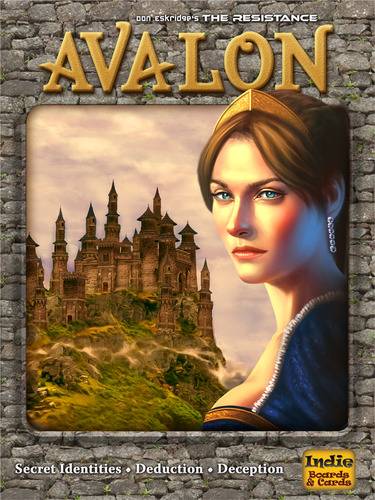
For this critical play, I played Avalon, a social deduction board game for teens and young adults by Don Eskridge, with 7 other fellow cs247g students and staff. I played as Percival. I’d say Avalon is a game that heavily encourages lying, bluffing, and player deceit through its game mechanics and dynamics, creating an environment that allows all types of players to thrive, have fun, and learn more about one another.
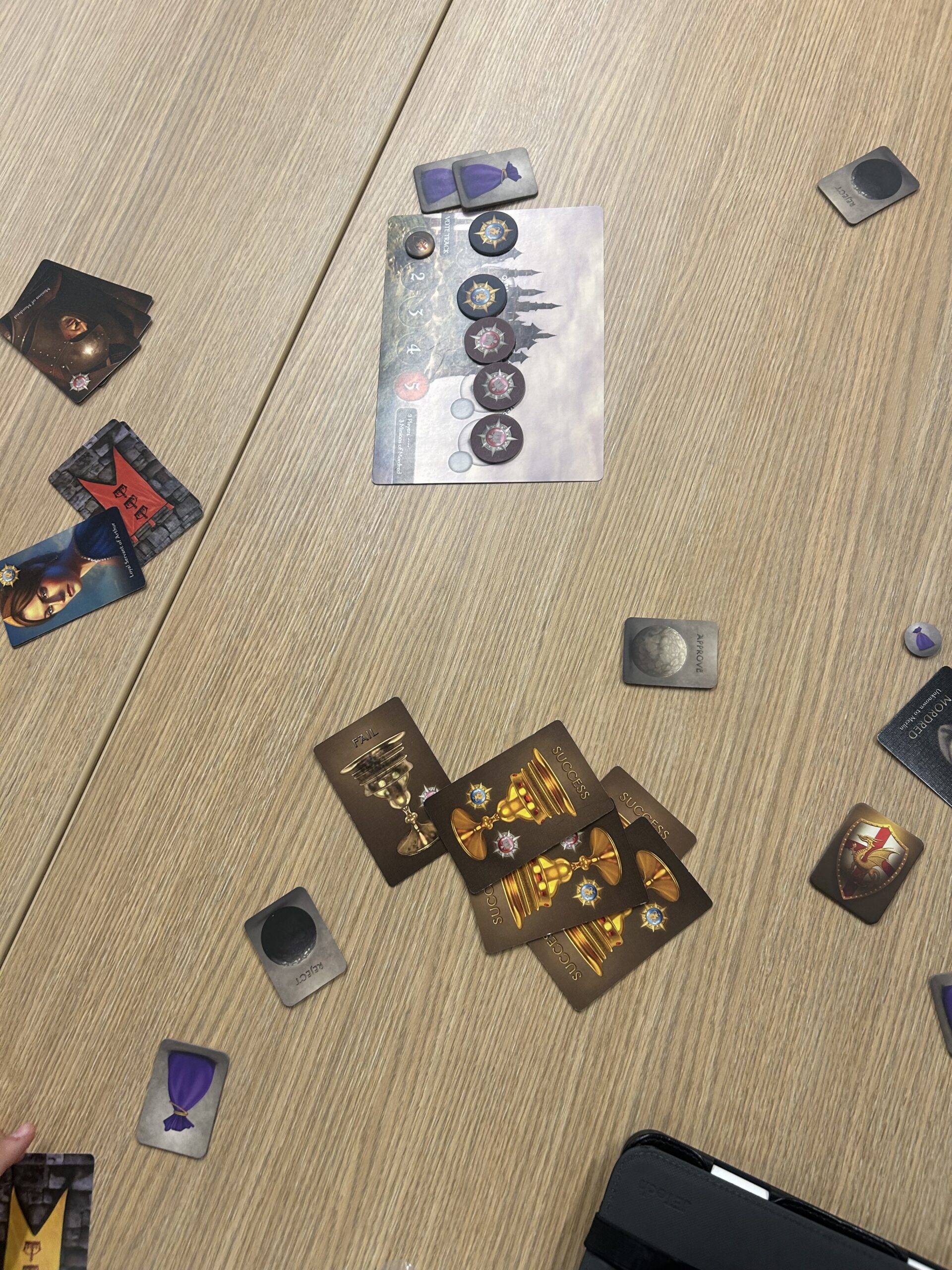
Completed Game of Avalon – Evil Team wins
As someone who is not particularly amazing at social deceit games and is usually fairly quiet, being Percival was fairly scary. However, throughout the game, I came to realize that Avalon doesn’t necessarily punish these players as much as other games. Only select players will receive information on good and bad guys in the game. And while this information is powerful (Merlin knowing nearly all of the bad guys), Avalon discourages players from revealing their roles: Bad guys want to convince everyone else they are good so they can be sabotage quests, and the bad guys can immediately win if they figure out who Merlin is. In combination with a lack of an ‘elimination’ mechanic as in Mafia, no player can be silenced or left out. Thus, ALL players must exercise all kinds of caution to gain a credible reputation as a good person without outing themselves in order to achieve a win for their team. Any small slip-up (shift in personality, body language, facial expressions) can reveal your role and possibly end the game. This promotes secrecy and player caution, but also produce unique kinds of bluffing: one member of my group threw everyone in disarray by continuously proclaiming “I AM EVIL” (he was not, but who could tell in the moment?), and by stupidly revealing the candidates for Merlin and Morgana, I somehow won the game for us by pointing to the wrong person for Merlin, playing to the evil team’s impatience after long discussion. These different possible playstyles contribute to a more chaotic (but fun) experience!
Avalon’s mechanics also provide far more bread crumbs for players to work with and use to inform their decisions. This manifests itself especially in the public voting system to approve/disprove quests, as well as the need for one ‘leader’ to pick all the quest party members. A leader must select all the questing members, and all players must publicly announce if they approve or reject a proposed questing party. This not only provides quieter players an opportunity to freely share their thoughts, but it also provides more vital information to digest. I specifically remember how, during discussion for the final quest, someone in my group called out another member for being too eager to approve a quest that they were on, despite the fact that, if we chose wrong, the good guys would immediately lose. In that same discussion, suspicions were raised when the quest leader decided to not include themselves in the quest, even though intuitively if you were a good guy you would pick yourself to maximize your chances of a successful quest. Information is readily available in Avalon, and players must carefully make their choices and be prepared to justify them to the group.
As for critiques, I found the role of the Assassin to be rather unbalanced. There is nothing discouraging the evil team from blindly shooting into the dark at the end of the game and still managing to win. Even if the good team had played perfectly, hiding Merlin’s identity, figuring out all the bad people, and completing three quests, they can still lose if the evil team simply gets lucky. It feels rather unfair, especially as all the bad people are in the know of who is on their side, so the odds of randomly picking Merlin are ⅕ instead of 1/8 (atleast for my group). If the good guys could have some additional counterplay to stop this from happening, maybe the game will feel more fair for both teams.
Lying in Avalon isn’t inherently wrong. It has little to no real-world weight since you play less as ‘yourself’ and more as ‘Merlin’ or ‘Morgana,’ etc…. In addition, it is necessary in advancing Avalon’s core mechanics of hiding one’s identity and sabotaging quests. Even so, you get to learn a lot more about yourself and those you play with by putting yourself into an alternate role. For example, I learned that I am a very reserved person, and that Butch is (scarily) good at reading other people and deciphering their roles. If games are intended to be a ‘fun’ way to learn about something, then social deceit games are a fun way to learn about close friends and complete strangers alike by just completely lying to one another!