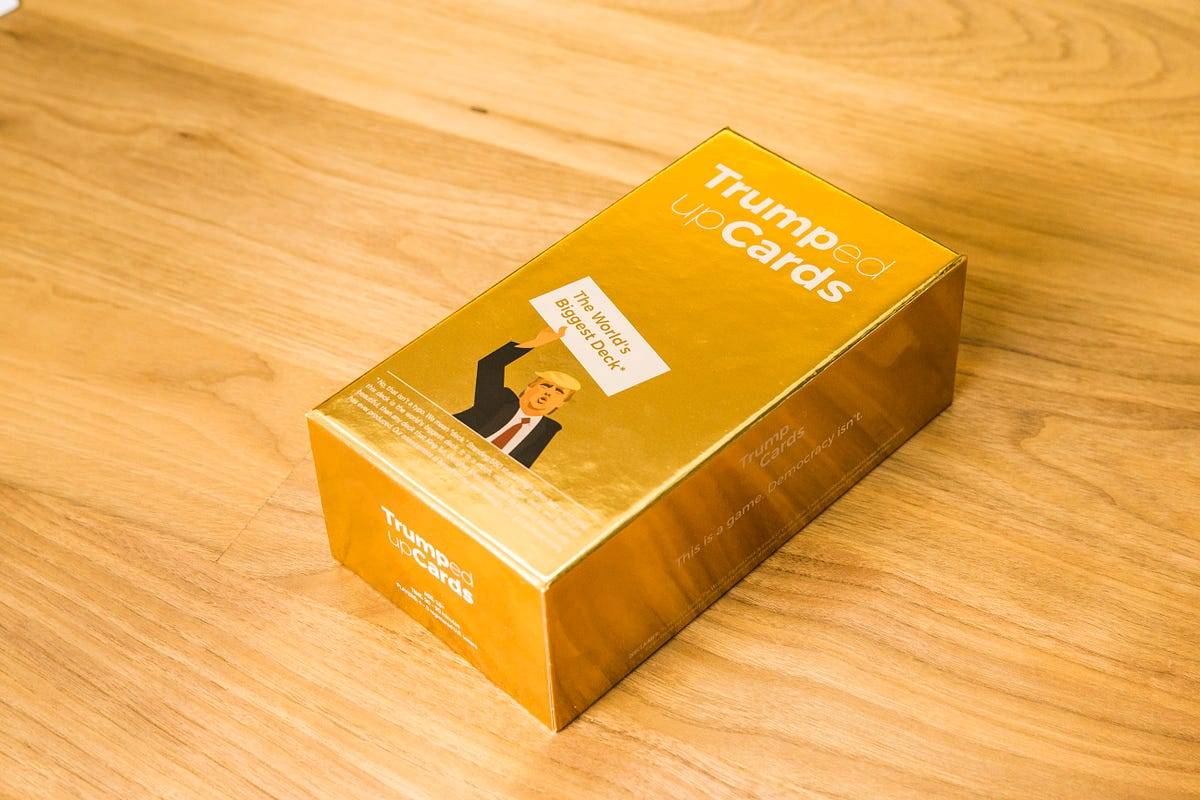
This week, I made the *somewhat unfortunate* choice of playing Trumped Up Cards, designed by Reid Hoffman and published in 2016. Recognizing it to be a politically-charged version of the well-loved tabletop card-game Cards Against Humanity, I had relatively positive expectations to smile, laugh, and be completely baffled by the responses chosen by my fellow players. The game box noted an intended audience of players above the age of 18 (which was later explained in the game instructions to insinuate “players who are registered voters”); while this is true, I found several more baked-in specifications for the target audience as we played: liberals, left-wing, politically active, Trump critics.
Trumped Up Cards is a judging game; each “round”, a single player (who I will call the temporary judge) selects and reads a card with a prompt – a sort of “fill-in-the-blank”, Mad Libs-style sentence starter. Other players individually and privately select responses they deem humorously appropriate to the prompt from their set of response cards, and give these to the judge. After shuffling the responses to eliminate potential bias based on order, the judge reads the prompt with each of the retrieved responses out loud (this usually produces many laughs of surprise and sometimes disgust…). Pending deliberation, the judge announces the winning response and gives the winning player the prompt as a trophy to keep (representing one point). Gameplay tends to go on until the players’ stomachs hurt from too much laughter, or the novelty of the game dies away naturally.
The mechanisms of judging games tend to reveal two primary details about each player: (1) the patterns of their individual communication styles and (2) how others might perceive them in a social setting. These types of games do both of these in very strategic ways, to avoid placing blame on either the player or the judge, but they nevertheless leave emotional impact – sometimes support, sometimes damage. As a player whose responses to the prompts in Trumped Up Cards were never selected as the winning ones, I have to say it wasn’t a great feeling. Like many players who I’m sure this has also happened to in the past, my human brain automatically started observing patterns that fell along the lines of: if my answers are never getting picked, what does that say about me? Am I not funny?


Valid questions to ponder, of course, even if they don’t actually hold water. In reality, there’s very little indication that any of the results actually mean anything. The judge has no way of knowing which response each player submitted, so there’s no direct targeting based on prior animosity (even if they truly hated someone who was playing, they couldn’t take it out on them – what a shame). Even the cards themselves might be unbalanced – it’s true that some responses just pack a stronger punch than others.
When I have to choose from my set of cards, I first eliminate based on how well the response grammatically connects to the prompt – this is just me being as syntactically picky as possible to help with elimination, but I also think other players do this (incorrect grammar has its moments, but this is not the space for it). Next, I look at the remaining options to find the most relevant ones (e.g. a prompt about a hotel resort, and I zero-in on a response mentioning beaches or face cream). Finally, I read the finalists out loud (in my brain) to figure out which one has the best ring to it and which one wants to make me start laughing right there. This last step is kind of personal – I’m judging the responses on my own sense of humor, because I assume mine is equivalent to everyone else’s, or at least the judge’s.
My mistake. But also, not my fault!
Humor is a very personal attribute that we don’t really think about – when making friends or starting relationship, we say “I hope they have a good sense of humor”, but what does that even mean? Ain’t no way everyone in the world could have the same sense of humor – we’d all be such boring people (and how would that make any sense?). But there’s even more nuance to humor: there’s written humor, spoken humor, visual humor, intellectual humor. There’s a reason why comedy has different genres: the academic raconteurs may find slapstick distasteful and shallow, while the slapstick lovers watch as the more “sophisticated” jokes fly over their heads. Judging games primarily tend to focus on a single form of humor, which may not be everyone’s cup of tea. So here, we get into the accessibility and multimodality of games. In HCI, we’ve all been taught, through various readings and classes and ethics discussions, that accessibility is an important consideration to have when designing a product. We want our products to be available universally, and cater to as many users as possible. Ideally, games would do the same, right? Take Uno, for example. It’s a game that requires you to know your colors – or at least, that was the case until they realized that there’s a large portion of people who want to play Uno but find difficulty differentiating between red and green. So they added shapes.
It’s not the same accessibility problem here, but there are questions here that make me wonder: these really simple card games that have us “judge” each other – are they truly leveling the playing field just by having responses be submitted anonymously? For those of us who engage in more freeform, conversational comedy, we’re forced to contain ourselves in this little box of a blank line on a card. And then we start to believe we’re not really as funny as we thought we were, as everyone told us we were – not when it really matters. That might be something to consider when developing future judging games: how can a game be made accessible to different formats of communication?

Now, let’s just consider Trumped Up Cards. We had one clear winner from just the first rotation of judges around the table (to which I could be heard saying “Come on, again Mai???” several times). While this was the case, we all agreed in the end, even the winner, that the game felt forced compared to the other versions of Cards Against Humanity we might have individually played in the past. The prompts were unrelatable, the responses weren’t as seamless to fit in as anticipated, and the vibe was just not there. One player, Zach, mentioned that he probably connected to all of these prompts better than anyone, since the game was released during Trump’s first presidential campaign, when the majority of our group was still in their pre-teen years and most likely quite politically oblivious. Context clearly matters.
In that way, it might have been our fault that we chose to play a game that we couldn’t connect to. There’s no built-in support for propping each other up, just to distribute the wealth and make everyone feel good – the game doesn’t allow it. Does that mean we avoid judging games altogether? No – the fact that there is no way to demonstrate bias means that each player has as much chance to win as the next person. But it is important to be self-aware: feelings might get hurt, but there’s no foundation or implications of that. Playing games like this more and more can help a person develop their thick skin and ability to shrug things off. It’s an important life skill.
Would I play Trumped Up Cards again? Probably not. Will I give myself more opportunities to be humiliated and disappointed? Absolutely. What’s the fun in a life without a little embarrassment now and then? I have to learn how to pick myself up and move on to getting better at reading the room and understanding the morphing social dynamics of my game groups. That’s my job as the player.