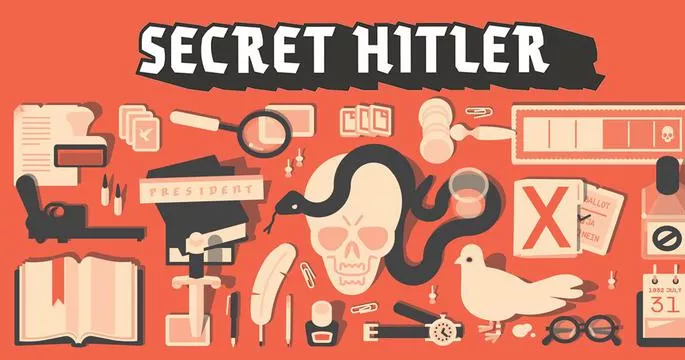
Secret Hitler is a social deduction board game created by Max Temkin. Usually, people play with groups of 5-10 people (17+) who love strategy and social interaction. I chose to play with 5 other sophomore friends from freshman year. Honestly, I thought it would feel like an educational political or history game. Soon, I realized that the game revealed my conflict-avoidant communication style, neutral decision-making tendencies, and flexible role within a group through its hidden information, voting, and persuasion mechanics.
First, the hidden information mechanic made it hard to rely on facts. I was pushed to pay attention to my friends’ pauses, tone, and strange explanations. Even though the game is built around lying, I didn’t want to lie if I was a fascist! It felt uncomfortable to accuse my friends without being sure, so I defaulted to being honest and keeping the group “comfortable.” The game didn’t change who I am, but it made these tendencies more obvious. At the same time, that discomfort is what makes the game engaging.
Second, the voting and persuasion mechanics made my decisions more intuitive than logical. I was a liberal, and by round 3, things started getting tense. Jonathan was President and picked Brandon as Chancellor. After the round, Jonathan said he had drawn “two fascist and one liberal” and claimed Brandon must have chosen fascist. Brandon pushed back and said, “No, you gave me two fascists.” I didn’t have proof, but Jonathan had hesitated earlier when explaining his draw, so I felt suspicious of him. I voted no. Katrina immediately said, “Why are you voting no? That makes no sense,” and I froze a bit trying to justify it. The game pushed you to vote on instincts even when there wasn’t clear information. Simple votes could be very socially loaded.
Throughout the game I started to pick up on my lack of assertiveness. Even when I felt strongly I added phrases like “I might be wrong.” I think I was trying to avoid being wrong or making things awkward, but the game rewards confidence. People who spoke clearly had more influence. By holding back, I made myself less impactful even if my instincts might have been right. This created an interesting balance that let more vocal players dominate.
This became most clear in round 4, when I was President. I suspected Jonathan from the previous round, but I still chose Kelly as Chancellor instead of confronting him directly. I avoided saying my suspicion out loud. The policy that passed ended up being fascist again, and Kelly said she had been given no choice. Lumina questioned her, and Brandon stayed quiet, which made things even more confusing. I felt frustrated, but it also made sense. I avoided the risk, and it cost the group. At that moment, I realized it’s hard to play the game by just adjusting to the group. That feeling of knowing what to do but not doing it, is a big part of the game’s emotional experience.
Looking back, the design brought a lot of this out with an aura of uncertainty from hidden roles yet voting that forced public decisions. The policies passed gave very limited feedback, reinforced by the simple binary blue vs red aesthetics of the game. Together, this made communication everything. You have to interpret people and take social risks.
Compared to Among Us, Secret Hitler is much more focused on talking. In Among Us, you can see movement and tasks. There is some solid evidence. In Secret Hitler, there is almost none. Everything depends on communication. This makes the game more intense, but also harder for quieter players.
If I were to improve the game, I would add a small way to confirm one piece of information, just enough to give players more confidence and something to debate off of. Right now, the game relies heavily on social intuition. At the same time, the uncertainty is what creates the tension, and that tension is what makes the experience memorable.
Ethically, it feels different to lie when you are playing a game. Lying feels wrong because it breaks trust, but in Secret Hitler everyone knows that lying is part of the rules. Thus, everyone expects you to lie and will forgive you for lying because it doesn’t harm anymore in the real world. You are lying and betraying within the magic circle, which can be forgiven outside it. Lying becomes the right action to play the game correctly and potentially induce more fun.
Still, it’s not completely comfortable. Accusations can quickly get personal in the game when you’re emotionally invested and people can seem genuinely frustrated and have real emotions of being betrayed. Rules are different in the magic circle, but people are still people.
Designers create the system, but the players shape the experience. Both have responsibility over the game. At the end of the day I think that even in a game about deception, there should still be some level of care for each other. Though next time, I hope to play more ruthlessly!