

No alt title this time ;3
What if no one wants to have a prayer session with you?
Welcome, dear brother cardinal, to the conclave! Conclave: A Prayerful Dating Simulator is a visual novel/dating sim in which you play as a Catholic cardinal with the goal of becoming the next Pope of the Catholic Church. In your search for the necessary votes to achieve the Papacy you’ll meet the other cardinals sequestered with you in the papal conclave. Have conversations, debate, gain and share perspectives on spirituality, and ultimately sway the other cardinals into voting for you! And who knows – maybe you’ll get a chance to have a prayer session with a few of them along the way…
Play our game in your browser here on itch.io! Yes, this is a different link from Amaru’s P2! This game was developed in Ren’Py with absolutely no AI used in code, writing dialogue, or asset creation.
Note: This version of the game only contains up to “Day 1” with 2 possible prayer sessions and 5 characters. Given more time, this game would have up to 5 days worth of scenes with more romanceable characters. This is an MVP of what the game could be with the resources and time allotted. Changes from P2 to P4 will be mentioned… in the next section!
Overview
Conclave: A Prayerful Dating Simulator, while being on its face a game about earning the Papacy through diplomacy with your fellow cardinals, explores more than just allowing the player to experience the conclave. Through 15 playtests and 2 separate intense design rounds spanning a total of 4 weeks, Conclave subverts the tropes of its genre in order to tackle a handful of different themes by way of interactions with the characters:
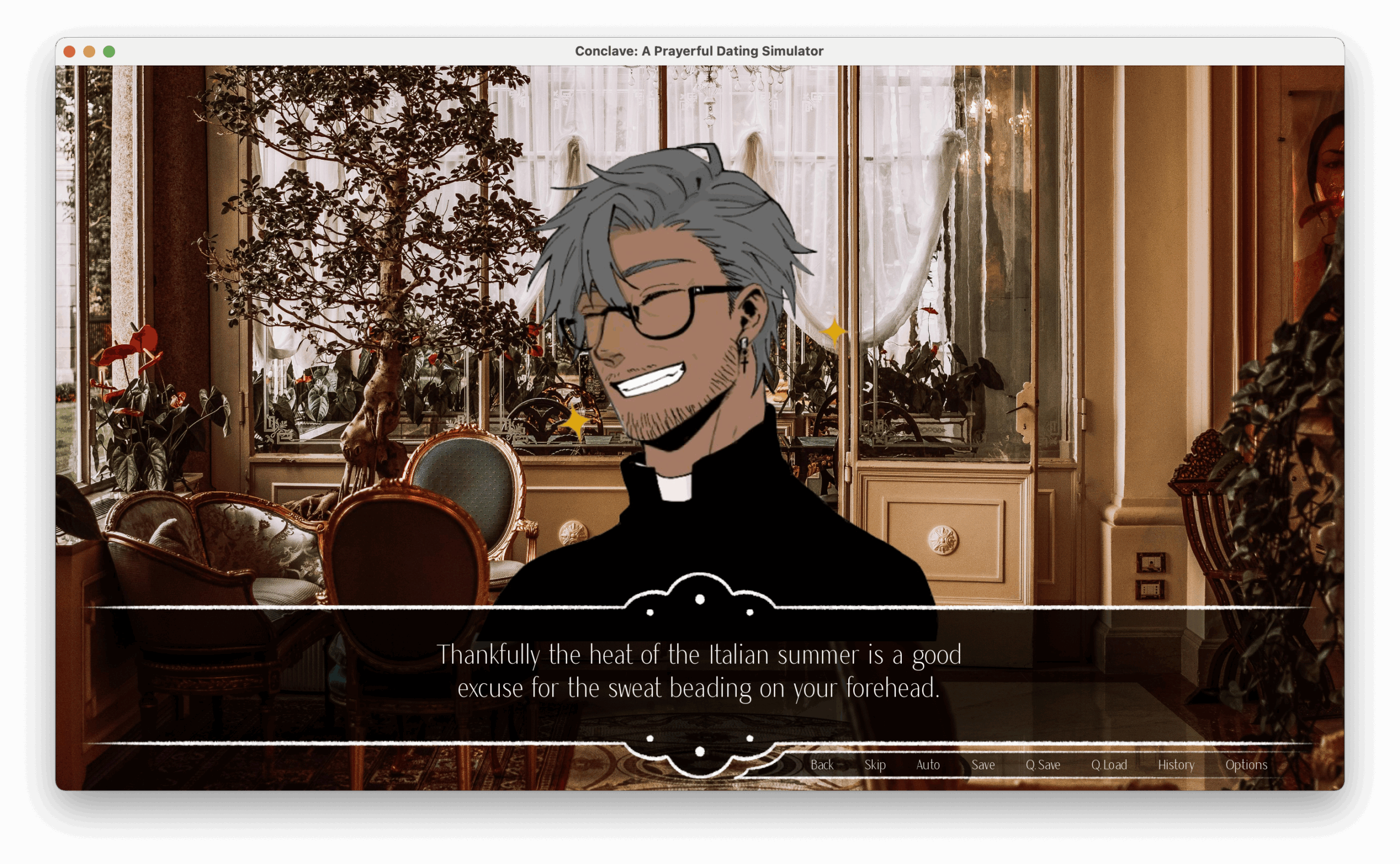
- Comedy. Humor disarms! Religion is a tricky topic to talk about. It is a deeply personal subject matter, and is often rooted in culture, family, and impactful lived experiences. For Conclave, humor acts as the key to unlock more vulnerable conversations, and drives player interest so they continue playing the game (Fig. 1). It makes sure that players have fun even while diving into more challenging topics of discussion.

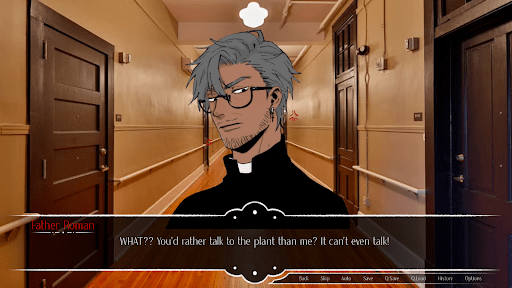
- Vulnerability & Intimacy. Due to Conclave’s perspective and debate mechanics, intimacy and vulnerability present in dialogue options throughout the game (Fig. 2). Sharing about spiritual and religious experiences often comes with a high cost in real life. The dating sim format affords a more gentle way of exploring religious interpretations, reasons for spirituality, and conflicts within those spaces. Characters embody certain sectors of Catholic beliefs in such a way that the player must handle conversations delicately and compassionately in order to win the papacy. Delving into such vulnerable and intimately personal discussions helps set this dating sim apart from others—that, and of course, the intimacy from your deliciously, heavenly prayer sessions~<3
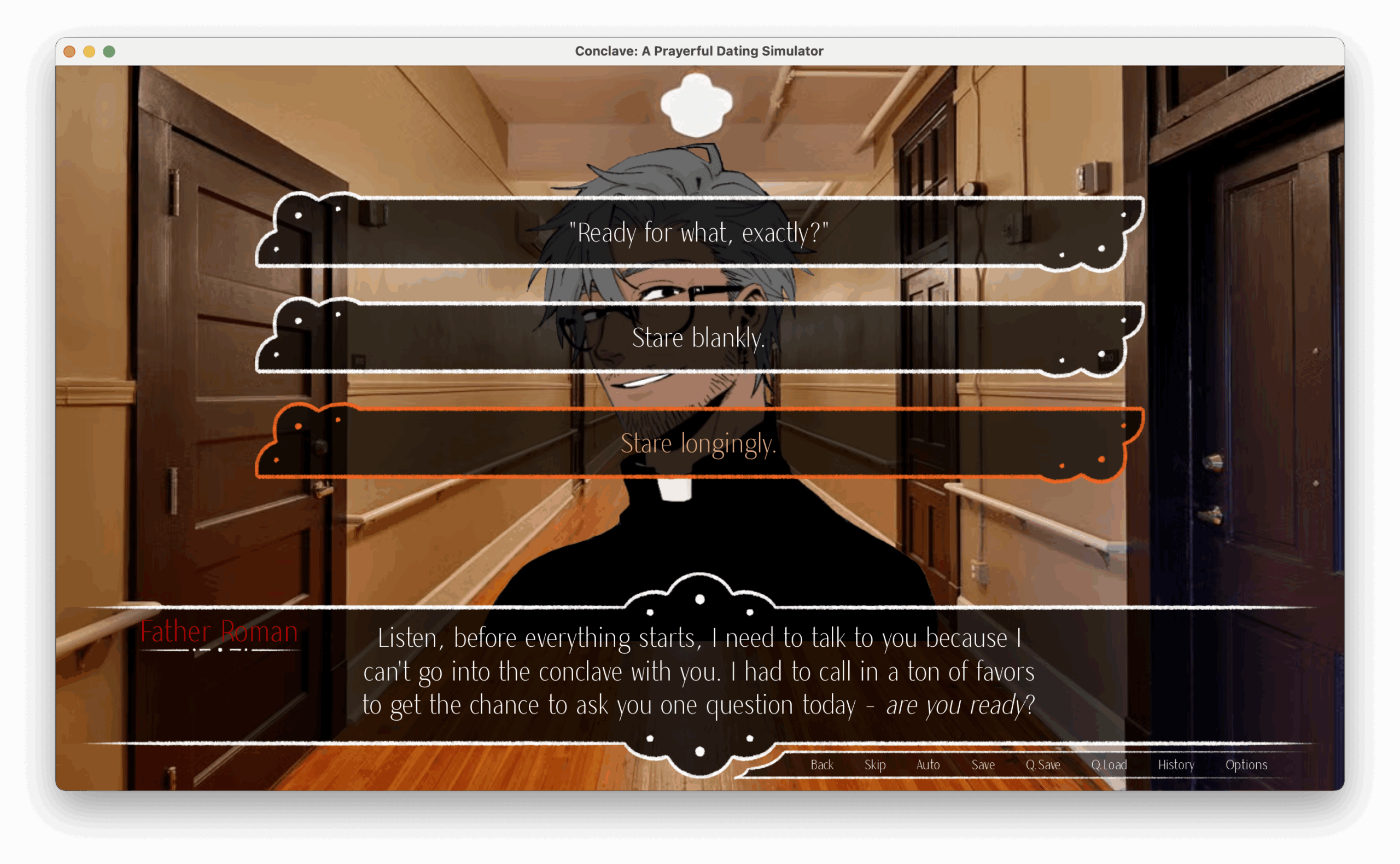

- Spirituality. While Conclave is very forward with its comedic interpretations of Catholic traditions, the original conception of the game was to allow people to experience and understand firsthand why and how people engage with spirituality. The subversion of both dating sim tropes and Catholic tradition provides a uniquely accessible lens into aspects of Catholicism that are often kept guarded away from discussion. Essentially, this game facilitates the opportunity for religious introspection through joy and laughter.
Medium and Target Audience
As this P4 was developed further from Amaru’s P2, we decided to not make any changes to the game engine due to how comfortable Ren’Py is to write in as developers and engage with as players. There were a few notes we received from the previous iteration of the game that we wanted to address head-on, particularly in the visual design aspect of the game. Although neither of us are graphic designers in the least, a plethora of free online resources exist on sites like itch.io and Picrew that allow us to improve immersion through visuals. As we are designing a game with an enacting stories narrative, improving immersion in order to allow players to fully lose themselves within the role of the main character is critical.
Due to player feedback from P2, we made the following changes to the visuals:
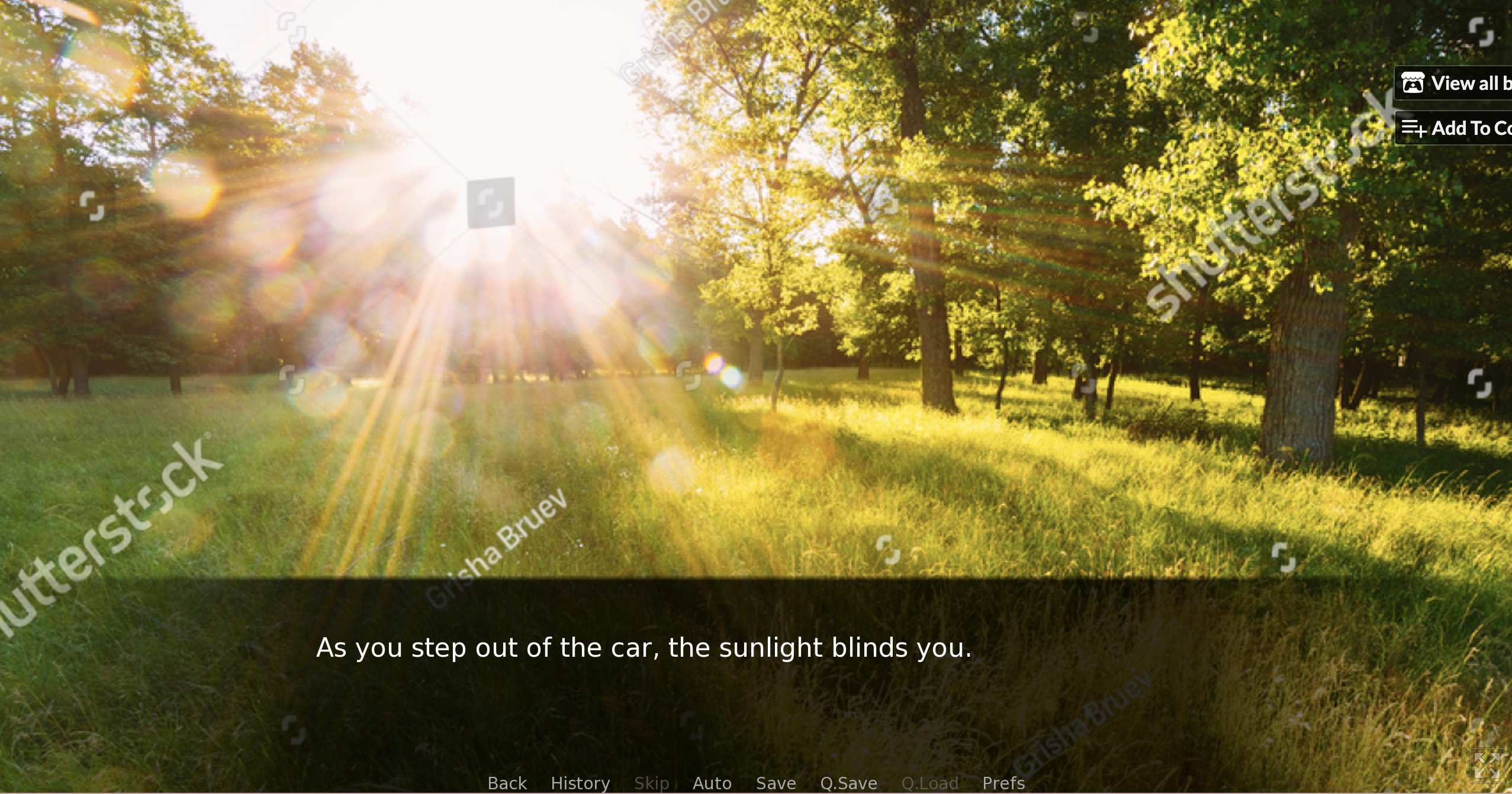
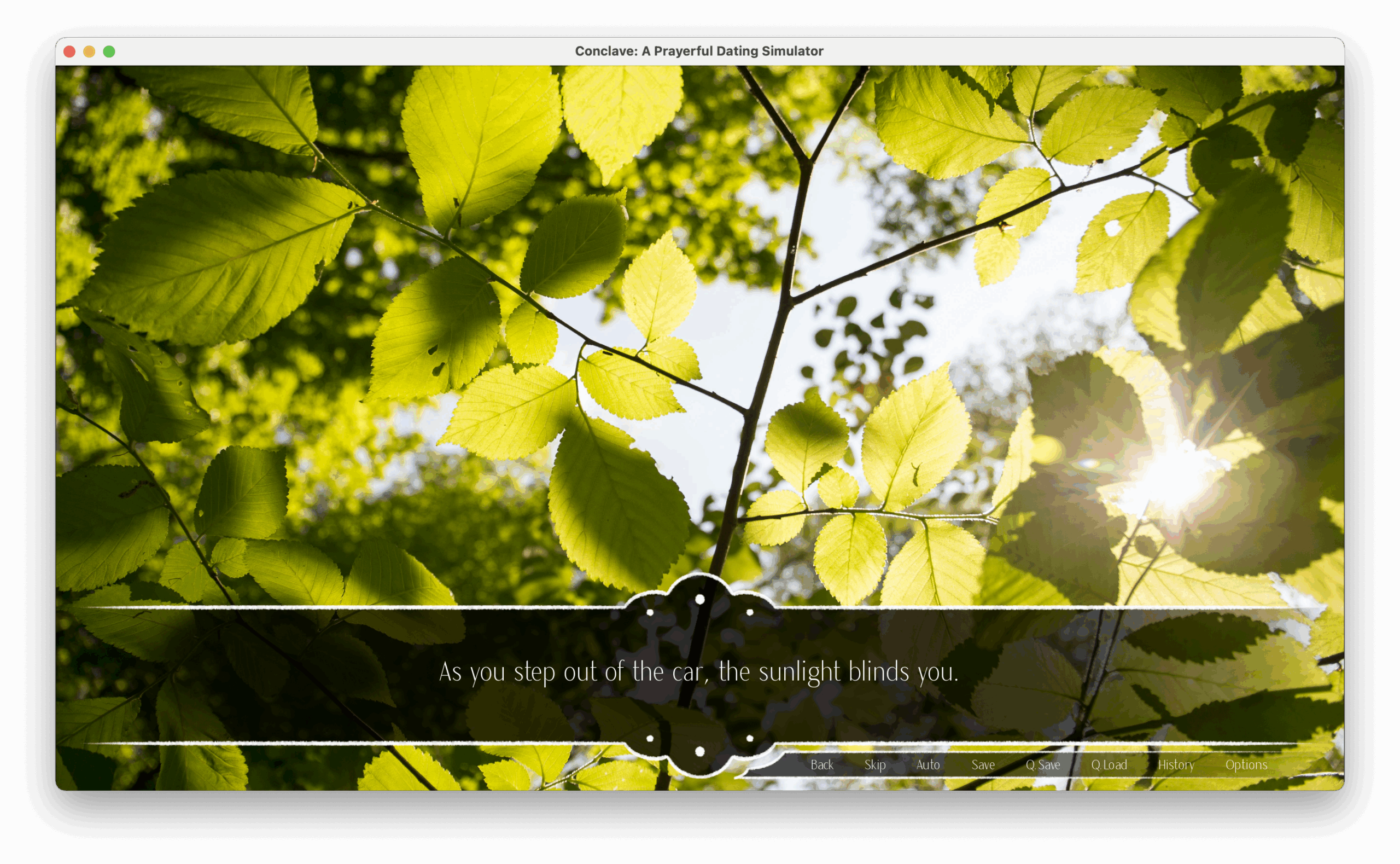
- Backgrounds: In the previous iteration of the game, Amaru had made the decision to use stock photographs as backgrounds during gameplay (Fig. 3). The reason behind this was twofold – 1) stock images are easily accessible, and 2) Amaru thought the contrast between the animated characters and live backgrounds was funny. Although playtesters during Amaru’s P2 were generally favorable towards this contrast, feedback from P2’s peer grading heavily encouraged changing the backgrounds, especially if iterating on the game for a potential P4 due to immersion breaking in the player. To this end, we have completely revamped the background images, removing any watermarks and including images that are still appropriate for each setting.
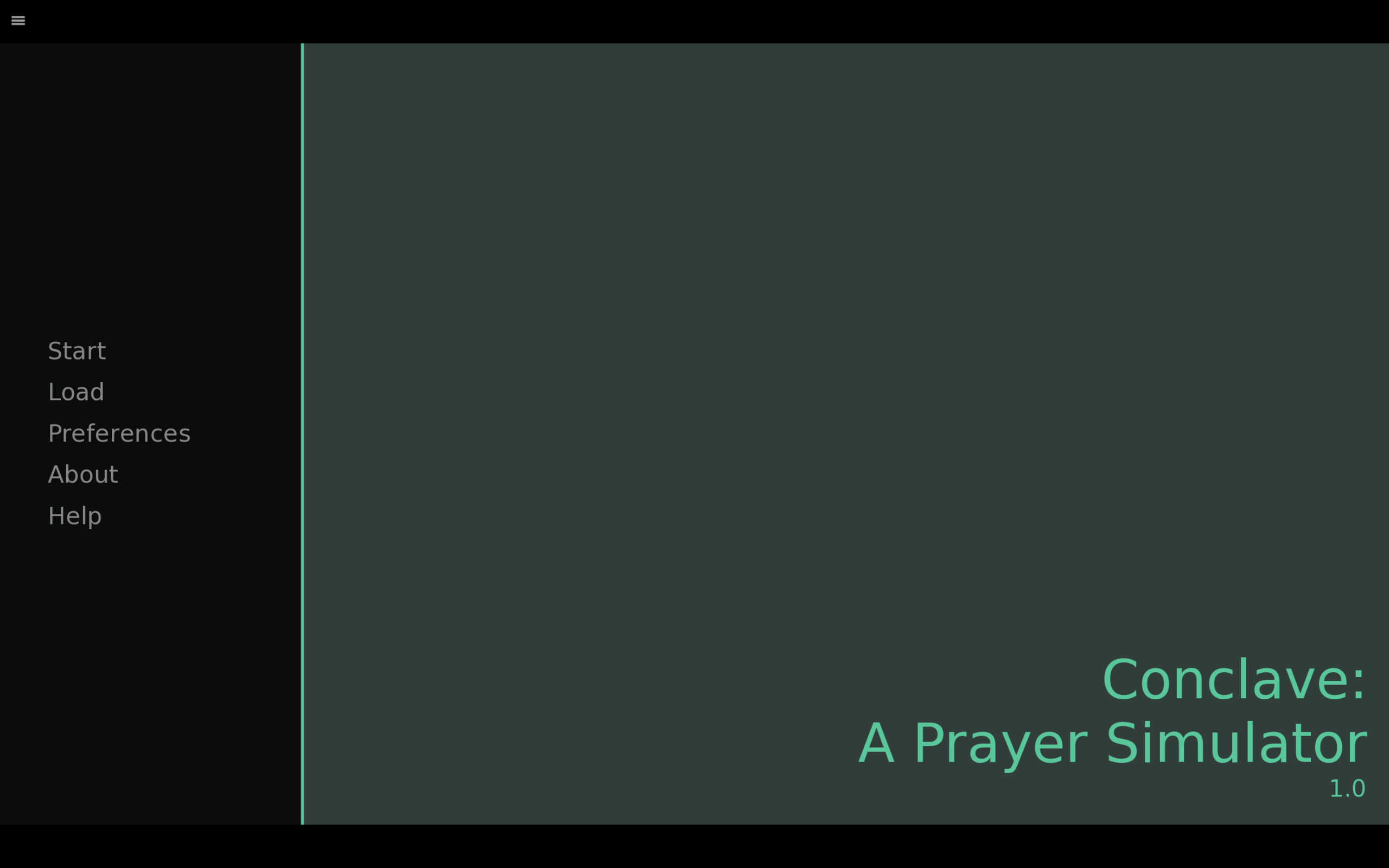
- GUI: Although we didn’t receive significant feedback commenting on the GUI, we felt that it would be appropriate to give it a fresh coat of paint if we were to truly polish this game. As such, we imported a free, open-source GUI kit for Ren’Py (Fig. 4) on itch.io (linked here, as well as on our itch.io and in the game itself). Feedback to this change was overwhelmingly positive, suggesting that it greatly improved immersion.

- Characters: As more characters were added to this version of Conclave, Luna found more art on Picrew to maintain immersion as with P2 (Fig. 5). All credit on the itch.io (for real this time)!

Our target audience was maintained from P2 – people interested in enacting stories through dating simulators, especially queer dating simulators with men dating men. Although during P2 Amaru mostly playtested with people in and around this target audience, Luna managed to find playtesters outside this target audience in an effort to understand how players would react to the story, tropes, tone, and message of Conclave. This will be discussed in more detail in Testing and Iteration History, but overall we were surprised by how willing people outside our target audience were to engage with the story, comedic elements, and even romantic elements of the game.
Project Focus and “Bright Spots”
One question we know will be asked is:
“What the hey? Wasn’t Amaru’s P2 also just one day of content?“
This is a completely reasonable thing to be wondering, dear reader (or grader), and we would like to address it head on in this section (don’t we know you so well?).
During Amaru’s P2 and further playtesting, we realized that although players were engaging with Conclave‘s story, setting, and characters, across all playtests there was a palpable lack of empathy towards the characters’ motivations. Players on the whole simply didn’t know enough about the characters in order to create a meaningful, intimate bond with them. Most of the effort to engage with characters in Conclave was simply driven by players’ lust for prayer scenes with each character (particularly Cardinal Bruce, our resident tsundere).
We didn’t have a finger on the pulse of why this was happening until our very last in-class playtest, Version 2.2 (discussed in further detail in Testing and Iteration History). After this playtest we asked our playtester a now-routine feedback question: “What did you feel about the characters?” their gut response boiled down to: “Not much.” However, they then provided some incredible insight into character- and world-building that we hadn’t considered before — the concept of “bright spots,” or character moments, that would further engage players and give them a reason to care about the characters they were trying to romance, not only for the sake of romancing them.
To this end, we went back to the drawing board. Stashed away temporarily were our plans to expand to 2 or 3 days, instead we focused on how to create bright spots with the main characters — Dean Cardinal Leo, Cardinal Bruce, Cardinal Kristoff, and Sister Nina — to get players to truly feel empathy and connection with these characters beyond the carnal. As shown in the Broad Choice Map at the end of this writeup, the current Day 1 is more than twice the size of our previous Day 1, including more characters, more bright spots, and more reasons for players to want to continue engaging with each character we introduced. As discussed in the next section, the fleshing out of the world in Conclave strongly improved player engagement and immersion, making players feel like they were truly enacting the story of their on papal conclave harem.
Finally, we wanted to address the notion of spirituality as it pertains to the focus and themes of our game. Our intention through honing in these bright spots was to bring some of the sense of spiritual background behind the characters. Although we were unable to confirm whether these bright spots did indeed improve spiritual understanding of our characters, they did strengthen the connections players had with the characters, which was the ultimate goal of our game. As such, spirituality became less of a focus for our development in this P4.
Testing and Iteration History
Version 2.1 – New GUI + No More Watermarks
Playtester 1: Regular playtester of Conclave during its stint as a P2, in the same game design class (CS 377G). Experienced visual designer and familiar with dating sim tropes. You can find the full playtest video here (links to YouTube).
Our first playtest for P4 was done with a classmate. They had tested the game prior during its P2 version, but had yet to see our updated changes. Our goal for this first playtest was to get a baseline understanding of the impact of our most recent visual design changes, to get a better idea of which design directions we should prioritize, and to find out what narrative changes we should focus on implementing for the greatest impact.
Positive Remarks
- Moving off of Renpy’s basic interface and into a free GUI gave the game a specific gothic-romantic aesthetic that we felt conveyed a “sinful” atmosphere. [0:36]
- We also removed watermarks due to previous feedback about how watermarked assets were immersion-breaking for players, and that seemed to be a good choice, as their design feedback was more about aligning the art styles used in the game.
- They visually and verbally had a very positive reaction to the added touch of interpolation for Father Roman’s arc [7:39].
Constructive Feedback
- Add/adjust background sounds and music [1:36]
- Make sure to align the art style for all humans who visually appear the same in your game, ideally as just anime style. [5:28]
- The playtester was confused by which characters were ‘dateable’ or not, and advised us to find ways of telegraphing that through our visual design. They assumed Dean Cardinal Leo was not dateable at first, but upon seeing that the art style was so different for each character, wondered why Leo was not dateable at all. [18:20; 30:19]
- When asked what content they would like to see, the playtester said they wanted a situation where they needed to choose having a relationship between two characters with consequences for choosing one or the other [48:33].
After this playtest, we decided to prioritize our narrative changes on completing a full playthrough of the game with a character winning the papacy. The playtester’s comments about Dean Cardinal Leo led us to adding in a prayer session scene with the character. We then thought it would be best to extend Cardinal Bruce’s character arc to Day 2, providing space for us to add a third dateable character. The playtester remarked that a fully playable game would not only have a winner for papacy, but also the player needing to choose between two characters. We figured that we needed at least two full arcs for dateable characters to get close to a finished version.
Version 2.2 – New Morning Scenes + New Playtester
Playtester 2: Not a classmate, still a Stanford student, around mid-20s. “Moderately” familiar with dating sims. The playtester did not consent to having their video published online, so we uploaded the following screenshot (Fig. 6) instead.
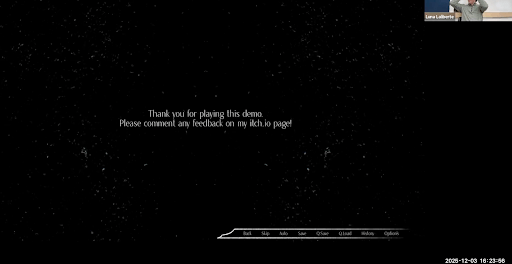
This playtester was very excited to play Conclave! When asked about what drew them to the game, they said they were drawn to it due to the absurdness and were looking for witty humor [0:55]. The playtester also clearly had fun with the game, smiling often, sometimes giggling or laughing out loud, even making jokes with us after recording about one of the characters.
Positive Remarks
- The introduction is strong, though the cab scene needs stakes to make it more interesting [4:30].
- The playtester said they liked that we were subverting common dating sim tropes [1:41].
- Writing became much stronger after the cab scene, and there was good use of humor throughout. Onboarding felt natural and well integrated. [37:51]
- Not all choices will go over well with the characters, and it’s a good thing to have that happen early in the game [9:00]
We were lucky to receive an enormous amount of feedback from this playtester. Below are just a few of the stand out comments they made:
Constructive Feedback
- Create “bright, fixed points” to rely on strong characterization that is consistent throughout gameplay while writing the playable character [42:13]
- Add intrigue and relevance to the cab scene so that players are more invested in the scene. Use it to indicate values about the MC. [4:30]
- Add more sounds and music to the game, like organ music, choir music, hymns. At least the Grindr sound effect! [10:30; 11:21]
- Motivate a stance from the playable character so players can make an informed decision for the candy bowl, like something in the dialogue exchange or in the inner monologue for the MC. [29:47]
Due to time constraints and keeping the scope of the project achievable within the weeks that we had, we felt it best to focus our efforts on aligning the “bright spots” for our main characters. This would help us more effectively write a full arc for a minimum of two dateable characters. As such, we created a brand new tab on our ever-expanding document, specifically writing out and designing bright spots that players would be nearly guaranteed to hit within “Day 1” of play (within 20min). Bright spots are denoted in the concept map by a star.
Version 2.3 – Complete Day 1 + Outside of Target Audience
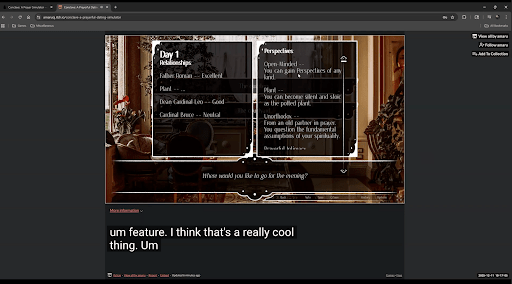
Playtesters 3 & 4: Playtester 4 has prior experience with the old version of the game, Playtester 3 did not. Both were in their mid-20s, and Playtester 3 was the only one with dating sim experience, having played Doki Doki Literature Club. Neither are in the target audience. The playtesters did not consent to having their video published online, so we uploaded the following screenshot (Fig. 7) instead.
For this playtest, we intentionally sought out someone who was not in our target audience. We wanted to test:
- What player behaviors they exhibited and how they contrasted with behaviors from those within our target audience.
- What parts of the game they found fun and what kinds of fun they were experiencing.
- If our choices and narrative structures accomplished the balance between vulnerability and humor we wanted.
- If that player experience was heavily dependent on being part of the target audience or not.
Playtester 4 did not know anything about the game before they were sent the itch.io webpage. At the end of the playtest, they said that if they had been sent the game via Steam page they would have been convinced it was a real game…
What stood out right away was how the playtesters decided to give characters voices. It seems like this is something Playtester 3 does regularly with playing games. Dating sims, being their own genre of visual novels, have writing styles that lend themselves well to scriptwriting. The playtester did refer to themselves as a writer so it seemed like they were used to acting out narratives as a form of workshopping a piece.
The playtester also seemed immediately amused by the premise of the game. Conclave relies on subverting familiar mechanics and character tropes of the dating sim genre for most of its comedic effects. The narrative utilizes players’ pre-conceived notions to evoke the gameplay of a dating sim while simultaneously contradicting expectations by focusing on gay relationships amongst Catholic priests.
Throughout the onboarding process, the playtester was giggling and ad-libbing on to the characters, already fully immersed in the game based solely on their commitment to the comedic bit. In our opinion, they were already enacting the narrative in several key ways. Firstly, they chose dialogue options that they explicitly stated would either increase or decrease their relationship with a character of interest. Secondly, the playtesters searched for embedded and environmental details in the game as cues for how to progress. They changed their voices when characters spoke in capslock or with emphasized punctuation; they laughed at sparkle indicators or blushes or smiles; they tried listening for auditory cues of how the relationship was changing; they frequently consulted the journal to decide if they should load from a prior save. (“We’re gonna bump that up, we are so gonna bump that up” [33:42], “The journal updates when necessary… I really liked the perspectives feature, I think that’s a really cool thing…” [1:19:22]).
As they played, the narrative emerged through their choices. They loved getting the perspective of the plant, and often chose the option of the plant to see how much they could anger the characters in the game. They were taken aback when Roman actually left the scene but they loved that there were consequences to their actions present in the game. (“We legitimately failed the tutorial [laugh] Oh my god [laugh]”, ~24:20). Combined, these experiences demonstrate that the addition of bright spots for our characters not only improved players’ connection to the characters, but encouraged them to enact other characters’ stories as well through voices and ad-libbing.
Although we couldn’t get to any of the new content in the game, they pointed out typos for us to fix. Judging by their excitement by consequences, going back in and clarifying the pros and cons of each choice through narrative impact. Playtester 3 specified that they wanted choices where there were meaningful differences in the reactions of the characters, whether or not it impacted the relationship between the character and the player.
We decided to do another playtest to get a more accurate understanding of how long our game took to play, and to try and get a player to reach an ending with a dateable character.
Version 2.4 – Complete Day 1 + Bug Squashing
Playtester 5 : Familiar with an older version of the game from P2. Avid player of visual novels; very familiar with the dating sim genre. You can find the full playtest video here (when the video finishes uploading to YouTube).
Admittedly, this playtest was a little chaotic, but very productive for debugging. Playtester 5 was eager to try out the game. They frequently made “ooh~” sounds as characters blushed and they would rub their hands together and chuckle darkly when they were making choices to “rizz up” the cardinals. They were also very amused by the plant sequence and laughed when they realized they could use the plant perspective throughout the rest of the game.
Unfortunately, many new dialogue branches they attempted were met with a game crashing bug. Through iterations of debugging and going back to playtesting, they were able to progress through some of Leo & Bruce’s storyline, encountering Bruce’s new backstory and how the cardinal became involved with Catholicism.
That said, we did get excellent feedback from the parts of the game that did work, and we plan on continuing to work on these elements as we develop the rest of the game. Thankfully we were able to squash the bugs preventing advancement earlier in the playtest and were able to receive the following feedback after playing a second time:
Firstly, the playtester agreed with prior criticism about the art style, and reminded us that we need to replace all background images so that the only humans visible in our game are in the same anime art style. Secondly, we need to change and add more sounds and background music to the game that is appropriate for the setting and genre, such as relationship change indicators and background music. Thirdly, we might consider changing the name of the “quarters” scenes so that people do not assume the main character is simply returning to their room and instead is actually going to a common space. This would make it much more likely for people to play through those branches of the narrative.
We wanted to end with a few quotes from this last playtest:
“I love it when they get nervous” Playtester 5 said as Bruce blushed on screen. Playtester 5 seemed particularly attached to Bruce. Playtester 5 at first seemed to find Bruce’s art unappealing, but after Leo revealed that Bruce was interested in the main character, playtester 5 said “Aww, he wanted to pray with me!”, indicating a favorable shift in their opinion of Bruce’s character. After one of the bug crashes, the playtester launched backwards in their chair and said “Tsundere Bruce! He’s a tsundere!”. We could tell that though the player was frustrated by the bugs, they were still eager to at some point get back and play through Bruce’s arc. This gives us enough hope that our game is worth working on even after class is over.
