

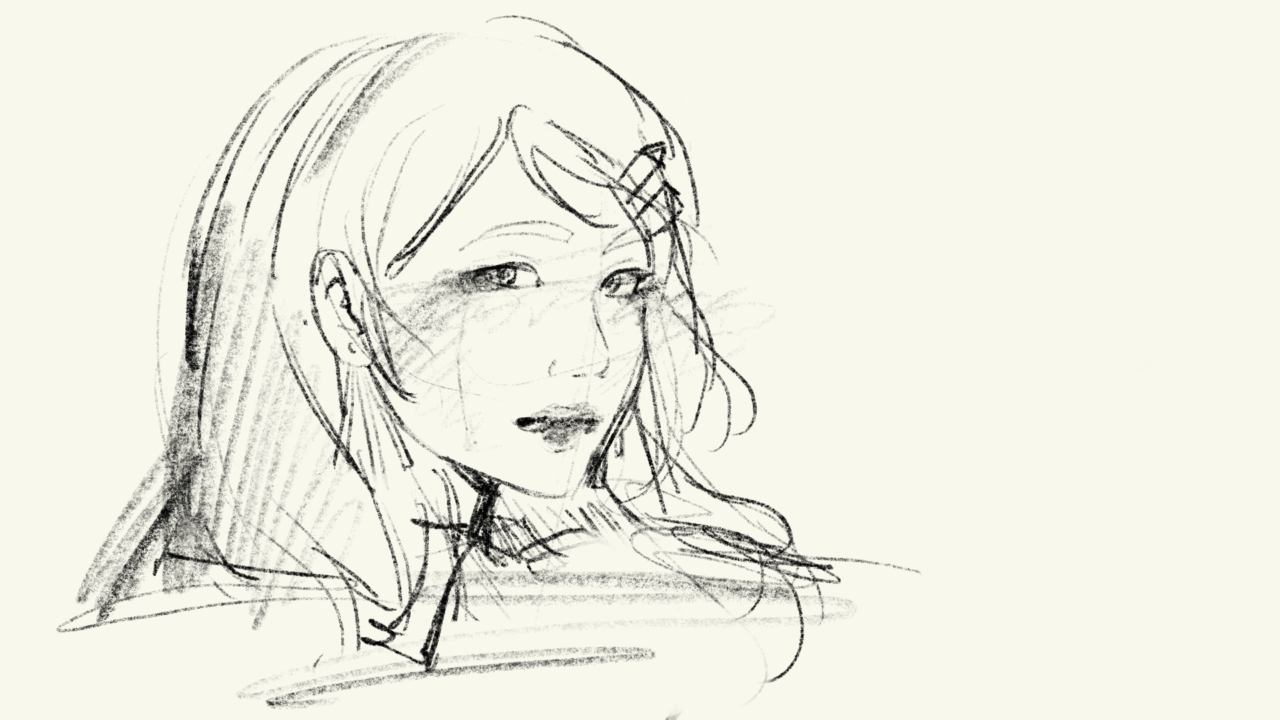
Introducing Blank Canvas.
Play here via Itch.io: https://knockdev.itch.io/blank-canvas
Note: Please use WASD (or arrows) with W/up and S/down to navigate, E to toggle interacts with paintings, and space to progress dialogue. You might need to zoom out a bit to see the entire thing. For example, I had to zoom out to 67% on my laptop, and 80% on my computer monitor. Have fun!
Overview
It’s the year 2030, and you’re an optimistic new-grad artist chasing your dreams in New York City. As you navigate financial burdens, the rise of AI-generated art, and the pressures of working in a competitive studio, you’ll struggle to find balance between survival and creativity.
Each choice you make — from paying your bills to deciding whether to embrace or resist using AI to make your life easier — shapes not only your career but also your sense of identity as an artist. Will you stay true to your passion, compromise your ideals to keep the lights on, or explore different perspectives?
In a world where technology blurs the line between inspiration and imitation, your journey explores what it truly means to be an artist in the modern day.
—- Spoilers Ahead —-
Branching Choice Map
There are FIVE endings to this game. Two that highlight the struggles of being an artist. On one hand, you can’t pay your bills in time and on the other, you don’t have health insurance and also overwork yourself. The last 3 endings explore the more relevant struggle artists face: ai and their perspective on it.
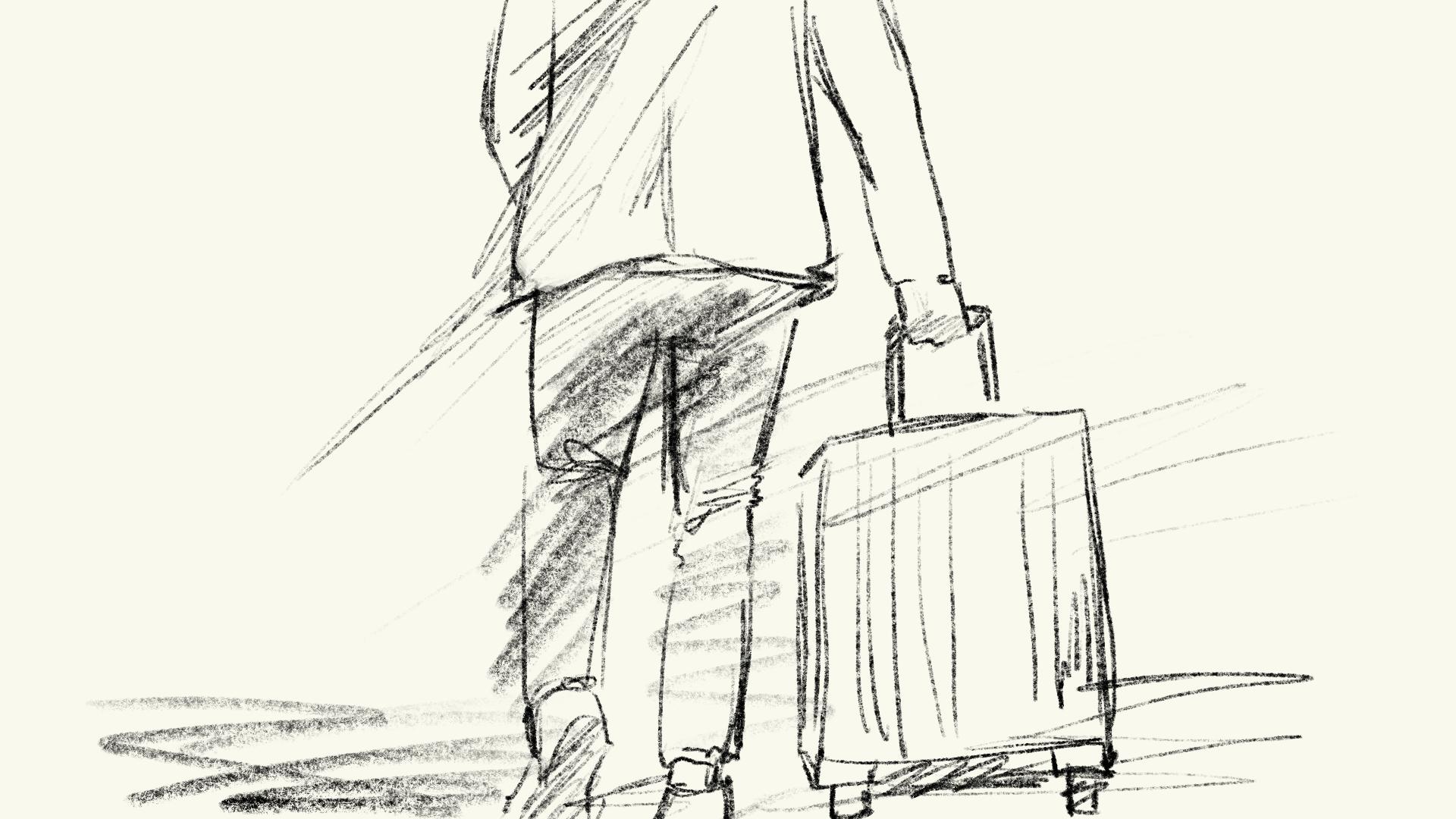
fig 1. ending 1 – you pack your bags as a failing artist
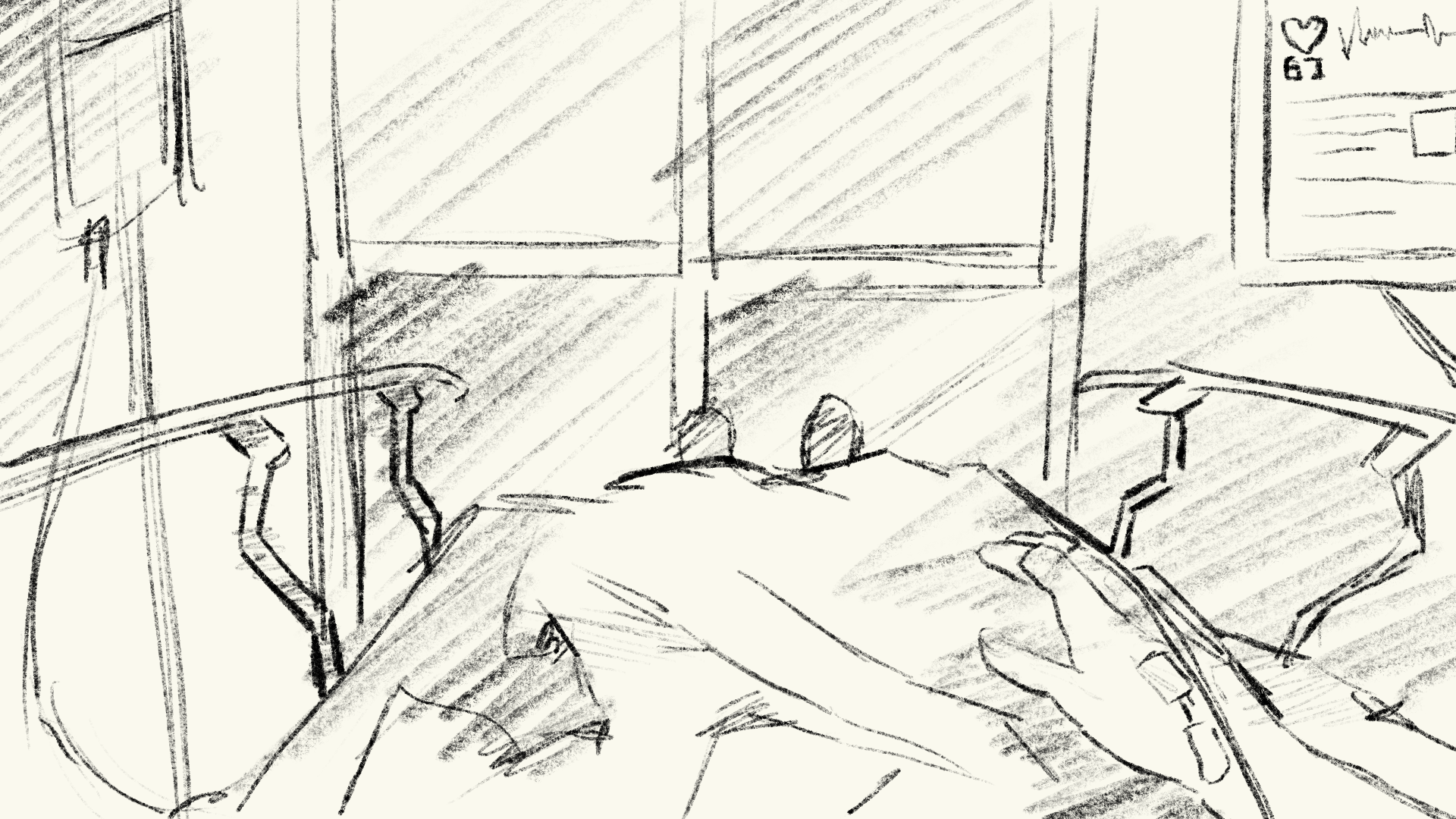
fig 2. ending 2 – you overwork yourself and faint, leaving you with no choice to quit

fig 3. ending 3 – you get fired from the anti-ai studio because you used ai and got caught
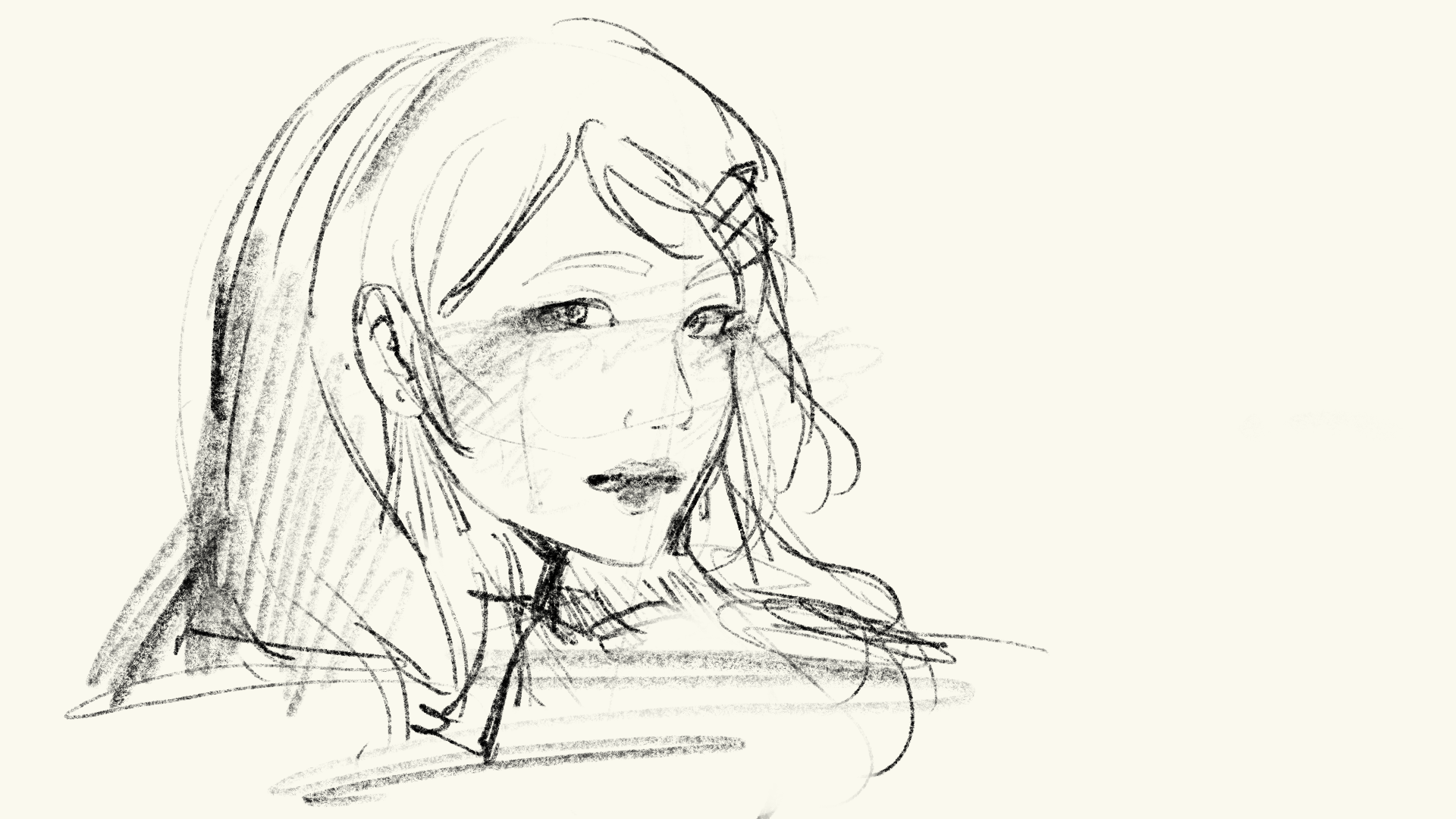
fig 4. ending 4 – you stay true to your ai values, ousting a fellow artist you used to look up to
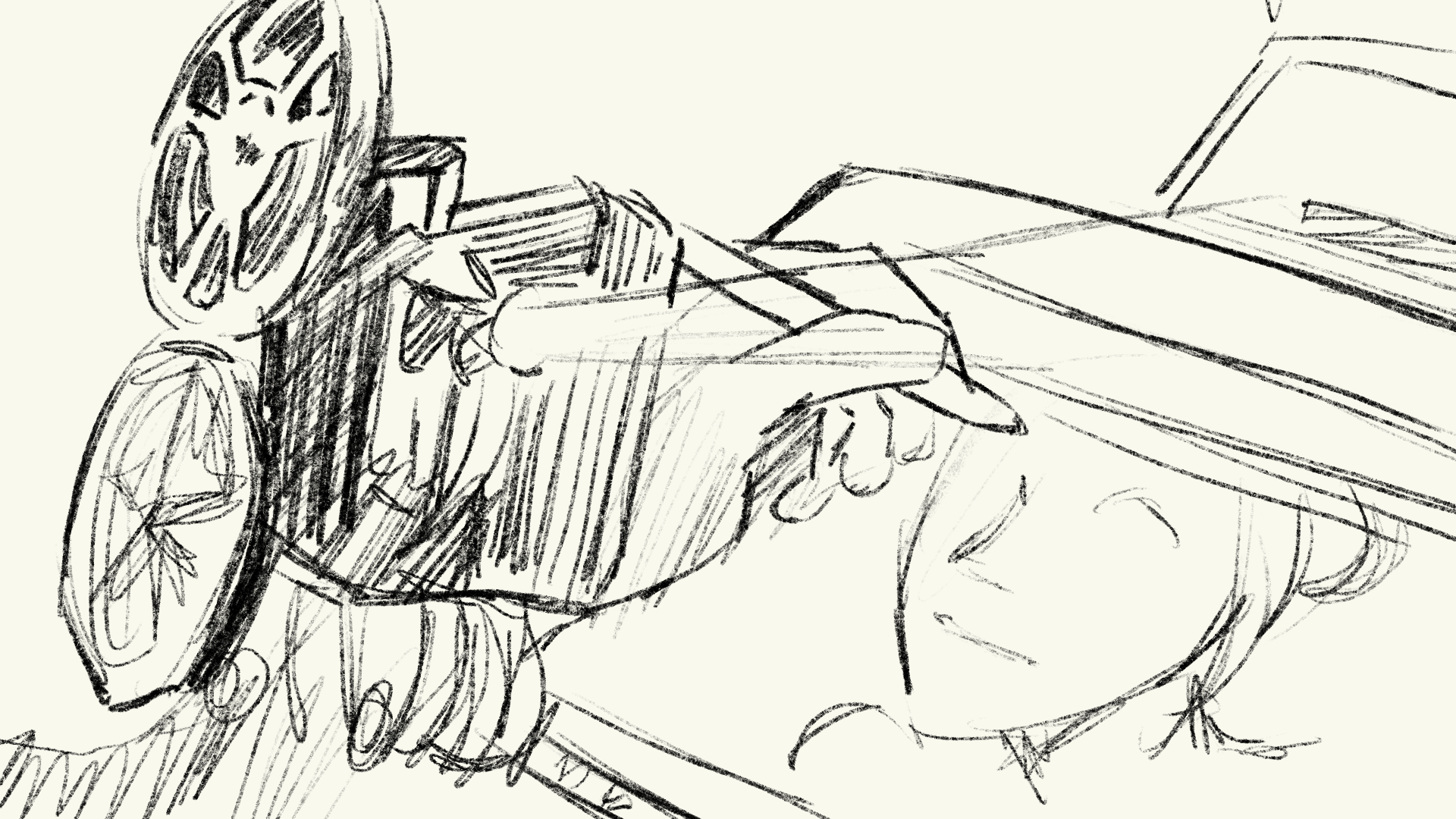
fig 5. ending 5 – you convince bill to let you use ai as a tool. ethically. but what is ethical?
Choice Maps
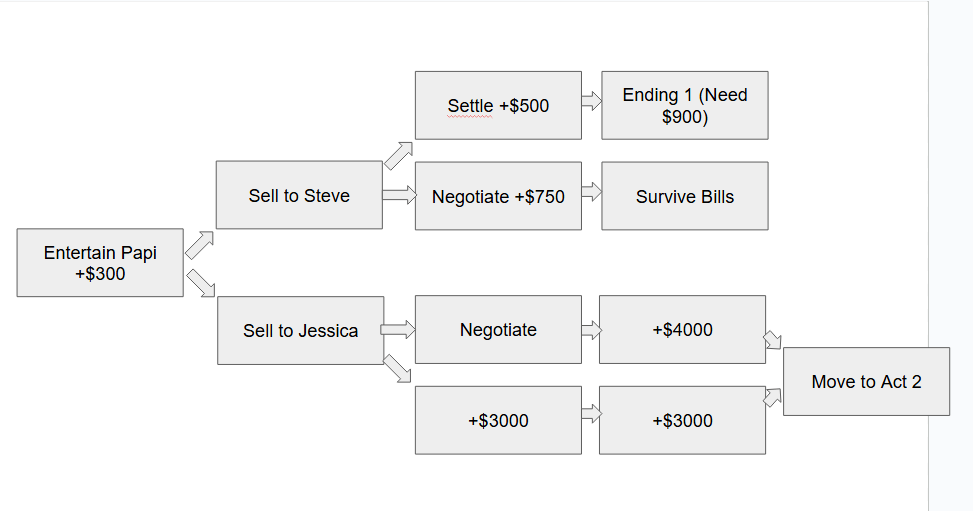
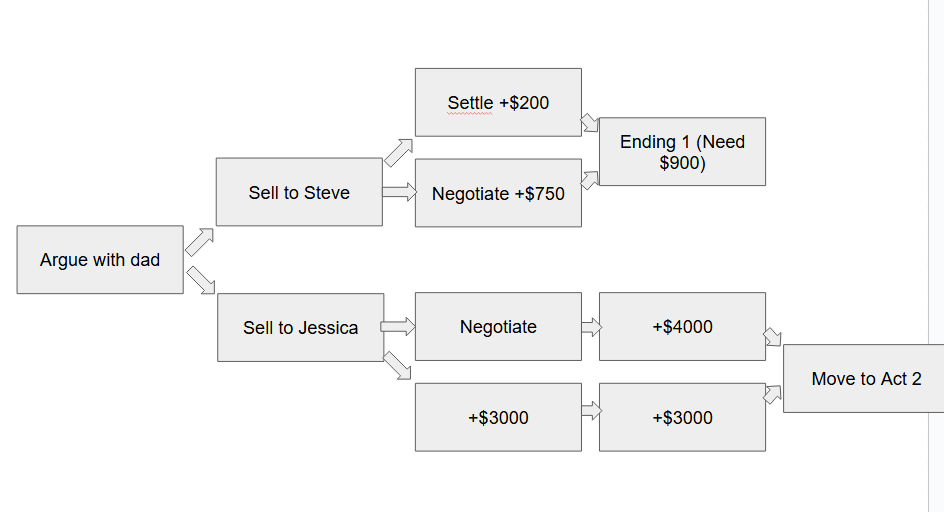
fig 6. act 1 choices
In act 1, your choices shape both the story and how much money you have by the end. Deciding whether to entertain Papi or argue with your dad changes your starting point—either getting some extra cash or starting off with tension and less support. From there, selling to Steve or Jessica becomes a key moment in terms of if you’re able to pay your bills the following night.
These choices aren’t just about money—they show how small decisions and relationships affect survival as a struggling artist. By the end of act 1, players see how quickly things can fall apart depending on what they prioritize. Many testers said they felt real stress over bills and regret over past choices, which shows that the system worked to make those decisions feel meaningful.

fig 8. act 2 choices
In act 2, you go home, where you can make choices about paying your bills, grocery shopping / eating or skipping on food to save money. I wanted these choices to be made based on your current financial situation. For example, maybe you don’t want to eat, because you don’t have enough money, or maybe you only buy what you can instead of bulk meals, because you want to save on costs in the current moment. After your nightmare, you’re able to either stay up (lose 1 health) or go back to sleep, in which you oversleep the next morning and have to either order an Uber ($50) or run (and stink).

fig 9. act 3 choices
In act 3, you get to make the big choices that impact most of your endings. For example, you can overwork by accident and reach ending 2, or if you survive 3 work days, you get to see Natsuke (someone you look up to) use AI. After your conversation, you get to decide what to do about her AI usage.
Game Design
Target Audience
The target audience for my game primarily consists of AI users and adult players, as the narrative explores mature themes and language. More specifically, the game is designed to resonate with college students and recent graduates navigating post-academic uncertainty. Drawing from concepts of empathetic design and player identification, the narrative situates the player in the emotionally fraught experience of a new graduate struggling to find stability in career and finances. Through environmental storytelling and narrative agency, players are encouraged to internalize the tension between personal aspirations and external pressures.
A central emotional pillar of the game is the recurring motif of familial disappointment—particularly the fear of letting one’s parents down and confronting patterns of parental financial control. These narrative beats are framed to evoke reflective empathy, inviting players not only to relate to the protagonist’s anxiety and self-doubt but also to critically examine the social and emotional systems that perpetuate them.
Ludonarrative Design
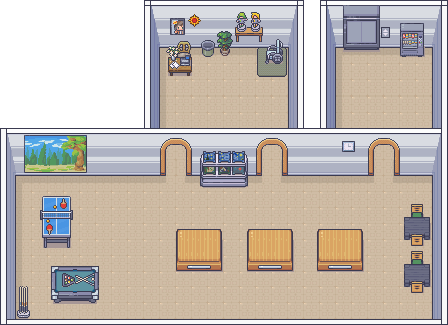

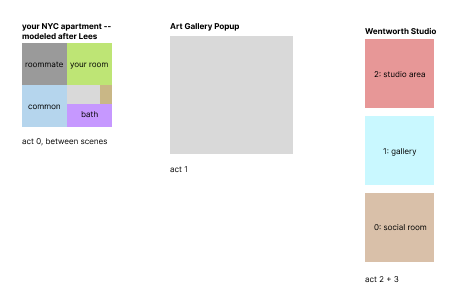
fig 10. some current maps (basement / social room) and apartment vs. the original brainstorm of map space
The game’s mechanics are designed to create ludonarrative coherence, where the player’s actions and the story’s emotional tone reinforce each other. Every gameplay system reflects the protagonist’s struggle with career anxiety, financial instability, and identity in a world where art and authenticity are blurred by AI creation.
The player’s daily routine—deciding whether to pay bills, buy groceries, or stay late at work—serves as an interactive reflection of economic pressure and burnout. These choices generate procedural storytelling, where survival decisions communicate the same feelings of tension and uncertainty that define the narrative. Each small act of budgeting or self-sacrifice becomes a moral and emotional statement, rather than a simple gameplay task.
The core mechanic of viewing and judging artworks—deciding whether they were made by humans or AI—embodies the game’s thematic conflict between authenticity and automation. This system uses cognitive dissonance and player agency to question how we define creativity and self-worth in an era of machine intelligence. Interactions with both real and AI artists deepen this tension, creating a subtle commentary on validation, exploitation, and the commodification of art.
Finally, the ability to explore the studio, home, and gallery provides environmental storytelling that reinforces the protagonist’s isolation and internal state. Each space evolves with the player’s decisions, visually manifesting the consequences of overwork, neglect, or artistic integrity.
History Versions of Game:
Tiny Playable Prototype (1o/16)
Players: This one consisted of Butch, Lucas, and a student in class. All male and college-aged.
- The student in class suggested that people can change their mind about AI art, giving an example of their friends who went from anti-AI art to generating it themselves.
- CHANGE: I added the ability for you to change select your opinion as the game progresses
- Butch suggested I add history log & keep the tone consistent.
- CHANGE: Added a history
- Lucas didn’t really feel empathetic since he felt like $200 was a lot of money (as a non-artist)
- CHANGE: Decreased your initial amount demand and added some dialogue about how $200 / 20 hours is $5 per hour in this economy
Alex (10/19)
Player: Alex, a college-aged student. Alex is not an artist, but does not like AI art.

fig 11. state of game when Alex played (no artist names, bid was way too high, no art)
- Alex wished the characters had more depth (just named artist)
- CHANGE: Created 3 archetypes (tech enthusiast, fraud, and business)
- Alex wished there were more artists to interact with and not just AI-artists
- CHANGE: Added Felicity, a real artist, as a character
Christina W. (10/22)
Player: Christina is a lecturer who uses AI often. She can relate to artists and game developers as someone who has worked in the field. Christina has first-hand experience in the art industry.
- Christina kept pressing the wrong keys
- CHANGE: Added some onboarding, ran out of time for the rest 🙁
- Wishes there were more choices for Landon as it felt like she was just going through it (bored)
- CHANGE: Added an option to leave early if you’re not interesting in how the AI works
- Said most artists are more introverted than how I was writing them
- CHANGE: Pushed Felicity and Stella more introverted as Stella is one of the AI-artists pretending to be a real artist, though she gets mad at you if you accuse her
Julia Vu (10/24)
Player: Julia is a college-aged student who uses AI for productivity. As a poet, she does not like using AI for creative outlets.
- Julia’s main feedback during this playtest was that she wanted you to feel more like a starving artist
- CHANGE: Added a money system, which ended up as a big success! In a later (unofficial) playtest, Lucas said it felt SO satisfying to get money (including the sound)
- Julia thinks the Wandering Man should have a name
- Change: Named him Steve
- Julia thinks adding more audio or sensory descriptions would help bring the game together. A big to-do for polishing the game.
- Change: Added more environmental art and polish (added background art, game assets)
- Change: Added sounds and more descriptive language via narrator (added phone call sound for when you call Dad)
Krystal (10/29)
Player: Krystal is a college-aged student who identifies as an artist herself.
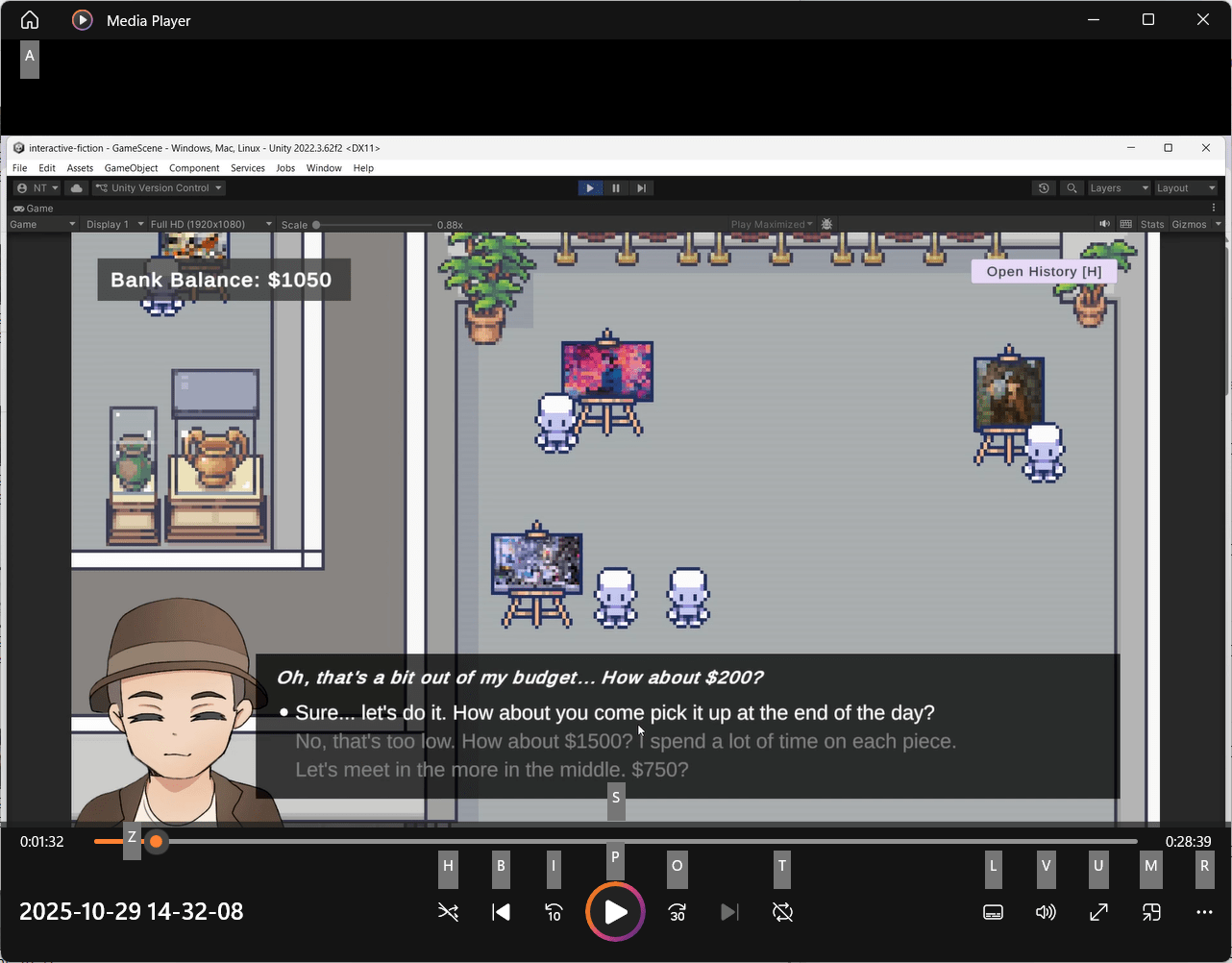
fig 12. Krystal’s playtest ran for 28 minutes
- Krystal didn’t seem too into it as she missed out on a lot of dialogue and kept skipping many lines. She suggested some things that were already mentioned (student loans, why some people were named ???)
- CHANGE: Added some more audio cues and background music to make the game more interesting.
- CHANGE: Added a nightmare / memory with your dad not paying for your college to reemphasize it
- Krystal didn’t feel like she had to sell to Steve at all because she had $1050 at the start
- CHANGE: Now you start with either $300 or $0 depending on your first choice
- Krystal didn’t like how Jessica felt “sus.” She suggested I make Jessica start off with her introduction.
- CHANGE: Made Jessica introduce herself first.
Jess (10/29)
Player: Jess is a college-aged student who has an AI start up about generating IF games with 3D art.
- Wished I had blip noises like Lucas
- CHANGE: I think blips would be weird for people, so I added more audio cues + background music.
- Wished the mini characters had art
- CHANGE: Added character art to each one
- Really loved the art!
Vanna (10/29)
Player: Vanna is a college-aged student who is not an artist and does not like AI at all. She avoids using it in even productive work.
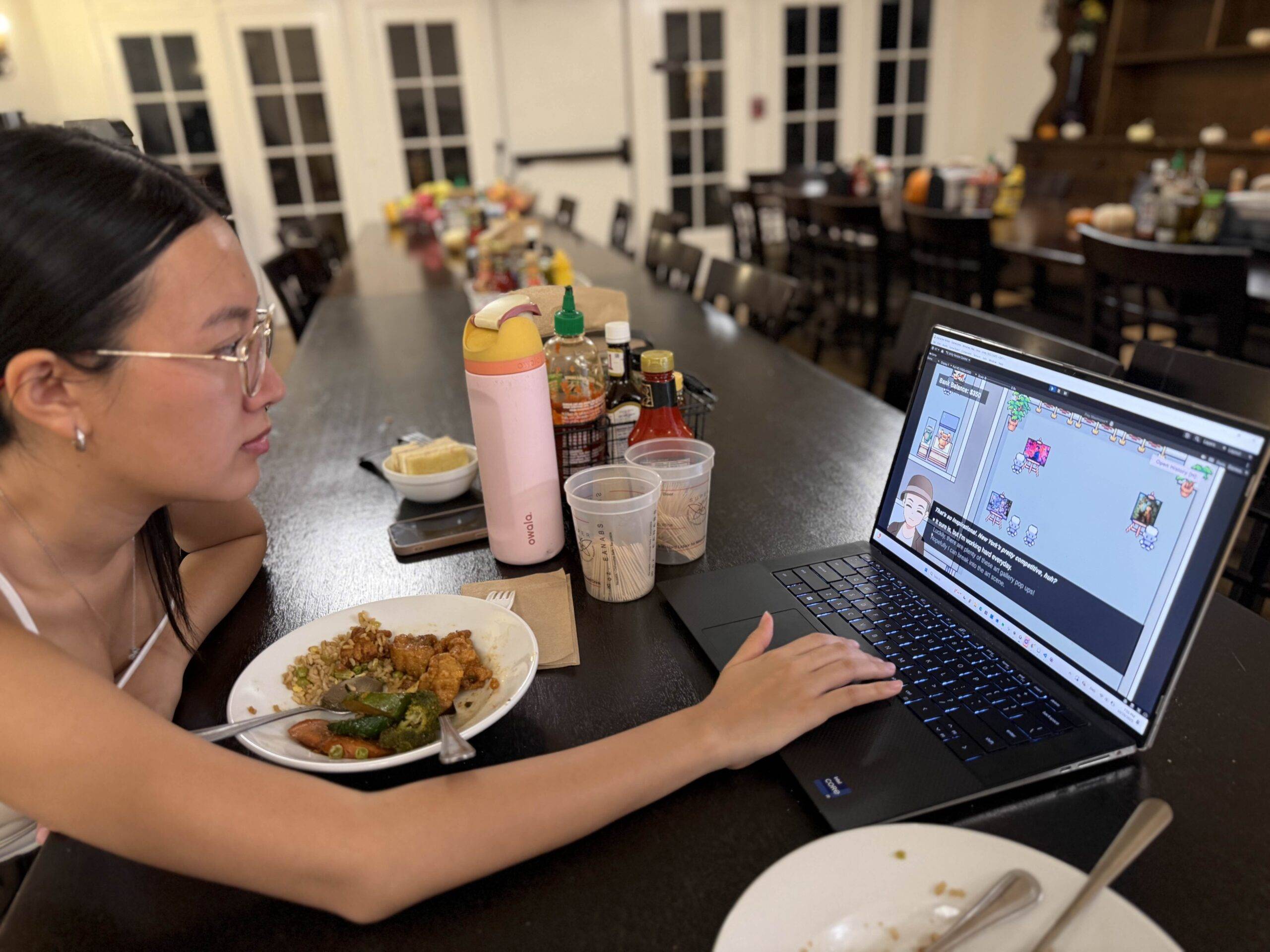
Link to Download Video Clip: IMG_4721
- In the clip which I couldn’t figure out how to embed, Vanna gets fooled by NewGen, thinking he is a real artist (LOL)
- She shows clear shock & genuinely felt bad for the artist during the game
- She also felt betrayed by Stella, thinking her art was real too.
- Takeaway: For people who don’t use AI much, it shows that the average person might not know what is AI and what is real anymore
- The main takeaway here was that act 1 was very polished and didn’t need much change. She thought act 2 was also solid and that Bill’s story was super sad.
Final Playtests: Julia
https://www.youtube.com/watch?v=9c9WbluHJik
0:56: “oh no”
1:30 Julia is distraught that she lost all of her money to bills
13:20 Julia is shocked and realized that she could have sold the painting later
15:50 “babe I’m broke” → sells for $200 because she’s just looking for any money
16:56 sad face “im a failure”
17:30 wants to run away from man in dream
17:50 mad that newgen is laughing at her “what are YOU laughing about”
18:44 happy she feels confident as an artist
29:25 gasps that someone stole his wife’s style
30:00 lots of gasps
Takeaways:
- Felt really sad losing money and gaining money
- Felt like they were the artist (“Yay I’m confident!”)
- Adding the flashbacks, dreams, and music was a hitch! Julia felt lots of emotion and actually read through everything.
- Fixed some minor typos + a bug with the elevator
- Fixed some node change bugs
Final Playtest: Alex (part 1 and part 2)
https://youtu.be/ydsB6tWyPV0?si=pu4EIp2sxSEXTvSv
0:43 “my dad’s kinda a meanie”
0:59 “this is so sad. I’m like a starving artist”
1:14 “yea i work my ass off…holy my money”
8:57: “my dad hates me”
9:09: “im not gonna cry, im just invested in the story”
4:40 Alex had hesitation when choosing to use AI if it meant that his work would be done quicker.
5:15 Alex felt visible shock that his action have consequences because he skipped 1 meal and lost everything.
10:15 Alex realized that he would need more meals just in case of something happening to him just like his last playthrough.
10:25 Alex feels betrayal as his role model, in game, is using AI to do her work faster and more efficiently.
10:50 Alex looks and sounds like he has been betrayed by the one he looks up to. He understands that art can take a physical toll on someone but realizes that taking a shortcut will be the sunset on human creativity.
11:05 Bargaining Alex is going through the 5 stages of grief.
11:30 Alex wants the person to keep their job but take accountability for using AI
Takeaways:
- CHANGE: Fixed some minor typos + a bug with rerouting you during sleep
- CHANGE: Reworded the ending choices to be more clear about your stance on the ethics
Reflecting on Game Experience
Empathy
I designed the game hoping to illicit two main things (1) empathy towards the artist and Bill’s wife (also an artist who was wronged by AI), and (2) make you reflect on AI. Overall, looking at the playtests, I believe I accomplished these goals. For example, in the playtest with Vanna, a college student who rarely uses AI, she was shocked about AI and what it could generate. She was also easily fooled by the artists, making her reflect on AI usage in the current day. Afterwards, we had a long conversation about “ethical” AI usage. In Julia’s playtest, she showed a range of emotions, from feeling sad she lost all her money to denial when she realized she lowballed herself (she wanted to go back and replay to get the $3000/$4000). She made a lot of gasps and “aws” during Bill’s backstory, showing that she felt angry and sad towards someone’s hard work and style being stolen. Alex, a more stoic person on the other hand, made less expressive sounds, but was able to also empathize with the player, especially when it came to money. He ended on two endings, one where he fainted and the other where he choses to let you use AI as a tool. He was upset when he overworked himself and also felt hesitation towards making some choices about ethics.
Narrative
My goal for the narrative was to capture the emotional experience of a young artist struggling with financial instability, self-worth, and authenticity in the age of AI. I wanted players to feel the same exhaustion, doubt, and pressure that come from trying to survive as a creative under both economic and familial expectations. Based on my playtests, I think I accomplished this. Players often expressed real emotional reactions—sadness, guilt, frustration, or empathy—especially during moments involving money loss, burnout, or betrayal by AI artists.
The theme of authenticity versus artificiality came through strongly, particularly when players had to decide whether an artwork was AI-generated or real. Many reported feeling conflicted, which was exactly my intention: to make players reflect on the ethics and emotions behind AI art. The inclusion of flashbacks, dreams, and family interactions helped ground the story, and several players mentioned feeling personally connected to the protagonist’s situation.
Overall, I believe the narrative successfully created empathy and self-reflection through its design. It didn’t just tell a story about anxiety and art—it made players feel it through their own decisions and consequences.
Short Reflection
This game was quite a challenge to create in just about two weeks. With three acts, multiple mechanics, and layers of story and presentation to balance, it sometimes felt like sprinting a marathon. Between writing dialogue, designing gameplay systems, composing or sourcing sound effects, and building the visual atmosphere, there were countless moments where I wondered if I had bitten off more than I could chew. And maybe I did — given the number of all-nighters that went into stitching everything together.
From the start, I knew I wanted to make something that wasn’t just a game to play, but one to feel. I wanted the mechanics, art, and tone to work in unison to tell a story — to make the player stop and reflect on their choices, their emotions, and perhaps even themselves. Every design decision, from the pacing of the dialogue to the color palette of the environments, was made to emphasize that emotional core.
The development process was an exercise in rapid problem-solving and creative compromise. Not every feature I imagined made it into the final build. Some ideas were cut for time; others evolved into something completely different once tested in context. But every limitation became an opportunity to focus on what mattered most — the heart of the experience.
Technically, it was a crash course in managing scope. I had to juggle writing branching dialogue in Yarn Spinner, implementing game logic in Unity, and polishing small interactions that might last only a few seconds on screen but needed to feel right. There were moments of frustration — bugs that refused to die, scenes that didn’t quite land, or last-minute design changes that rippled through everything else. But there were also moments of joy — when a mechanic finally clicked, or a line of dialogue sounded just right after the tenth rewrite. In the future, I would lower my scope a bit.
I hope that, despite its brevity, this game resonates with you in some way. Whether it sparks anger, sadness, empathy, or even discomfort — those reactions mean it succeeded in making you feel.


This is a game about artists, and it is also an excellent work of art in itself. Your lively and humorous text, exquisite drawings, and perfectly fitting soundtrack combine to create a chemical reaction, forming a “light” style that I really like. While playing, I thought of The Moon and Sixpence, and about the conflicts I had with my family when I tried to apply for a master’s in “game design.” This is indeed “the empathy machine.”
If you plan to make it your P4, I think you could streamline the mechanics a bit. The current money and stamina systems do simulate an artist’s life, but I often had to restart because I accidentally chose wrong, and these choices don’t seem closely related to values. Try to streamline the choices, letting the key choices “stake on values,” and it might create an even better experience!
Aww thank you.
Your line comment “This is indeed “the empathy machine.”” made me really happy 🥹🥹🥹
I think this game is so, so impressive visually and the mechanics are super advanced. The art and sets for the game are amazing, and I really liked being able to see different art as well. There was a ton to do and a lot of interesting interactions – would love to see more of it!
One technical thing I would suggest improving is being able to close the art with the space key as well after the dialogue is over. I would also consider adding checkpoints to make it easier to explore different endings.
I think it would’ve also been interesting to see the art I (the player) created, and also maybe some sort of time tracker, since I think if we had to sink hours into the game somehow to do the art, people would be more tempted to take the unethical options.