You’re Gone Background
You’re Gone, an HTML5 game authored and developed by Madison Rye Progress, is a Kinetic Novel that traces a husband’s grief following his wife’s passing, told wholly through the unique medium of text messages he continues to send to her phone. There are two versions of this game, in which players embody a coyote — or a white man — mourning the loss of his wife, a cat — or a Chinese woman, should you decide to abandon the furry feeling of anthropomorphic grief. I played both beginning to end — few differences exist beyond the rhetorical substitutions of “cat” for “Chinese” and “coyote” for “white”, and so on. In rare instances in the non-furry version, certain verbiage slipped through the cracks unchanged, resulting in narrative slips in which our human protagonist sprouts a tail, or inexplicably has a badger staffing the bar.


Images: View the differences between the furry version and the non-furry version.
Target Audience:
The target audience for this game indubitably includes furries, given the fact that there are two versions of this game — one in which the player is a coyote married to a cat; the other in which the player is a white man married into a Chinese family. However, beyond this surface-level demographic, You’re Gone speaks to anyone who has experienced the undiscriminating and disorienting aftermath of loss and grief. The game successfully draws empathy towards those who have experienced loss in their lives before (and evokes a light feeling of sadness and loss), through an immersive SMS user interface, realistic texts (that I could envision sending), and the hauntingly subtle time stamps reflecting moments of indecision or desperation. This is a game for those who have failed to move on, for those who have, and for those who are still trying.
Affordances of a Kinetic Novel:
By using the kinetic novel structure of a single predetermined narrative, You’re Gone fundamentally shapes how it communicates about grief by trapping the player into a cycle of hopelessness, leaving no other option but to send texts that they know will never be responded to. This structure was a beautiful design choice for the game as it models the husband’s emotional dependence on his wife, forcing players to similarly become dependent on sending these texts — and only when the husband begins to recover, the player, too, gain release, ending the game at the same moment that the husband learns to let go. As a result, this choice paradoxically removes player autonomy to better immerse them into the character they are playing — one who, for all intents and purposes, has no emotional autonomy.
Evocative Stories:
Much of the poignancy of You’re Gone stems from the realism of its fictional experience. Loss is a universal and painfully familiar piece of the human experience, thereby allowing the game to draw a significant portion of its emotional punch from players’ existing memories, experiences, and associations with loss and grief. The medium of a text message thread — a ubiquitous space where countless players have talked about their day, vented their frustrations, and expressed vulnerability and love — You’re Gone weaponizes a mundane and familiar social architecture into an evocative space of alienation and isolation. Aesthetically, this allowed for the game to feel much more real, even when it was told through the lens of anthropomorphized animals.

Image: You’re Gone is modeled after an SMS chat thread, with time stamps, dates, and everything.
Enacting Stories:
In You’re Gone, players occupy a unique position of being both passive viewers, unable to alter the unfolding story, but also active participants, forced to send each message for the game to progress. By making players actively adopt the role of the grieving husband, pressing send on every text message to his deceased wife, players become more immersed in the game’s play space (the SMS thread). Aesthetically, this design option allows players to better experience the rhythm of grief as they pause between sending messages, re-read their past messages, and reflect on their current experience.
Embedded Stories:
As the protagonist shares pieces of his daily life, vents his frustrations, and reminisces on inside jokes throughout his text thread with his deceased wife, the player gleans more and more insight about the cause of her death (cancer), what she was like, and the dynamics between her, her family, and her husband. The game invites players to actively engage in the active process of hypothesizing about narrative developments from what they have read throughout the texts. Aesthetically, this narrative choice contributes to the overall feeling of disorientation as players feel fragmented — piecing together parts of the story with each text.

Image: The protagonist reveals pieces of information through texts that the player then has to piece together.
Emergent Stories:
You’re Gone offers no branching narrative or choice-making game mechanics, so the way in which it utilizes emergent storytelling is quite different from games like The Sims, in which players have much more autonomy and control. However, from the game’s minimal sharing of concrete details (such as what exactly was shared in the wife’s document), there is a level of ambiguity and interpretability that allows players to fill in their own story of why things happened and how the story resolved, thereby creating an emergent story and unique experience for each player. Aesthetically, this also mimics grief — people deal with it in unique ways, just as people will experience this game in completely different ways.
Takeaways:
After playing this game, I would be thrilled if I could similarly wield the level of realism that You’re Gone succeeded in doing. As I mentioned earlier, the texts, interface, and interactions are all eerily realistic and reminiscent of real interactions a grieving person may have. In whatever narrative I write, I hope to also tap into this viscerally human experience and make people feel truly connected to my narrative.
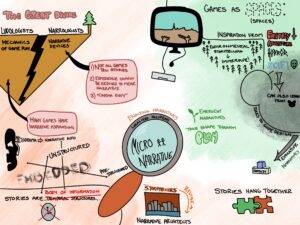
Sketchnote: