Background
I decided to play Hollow Knight, a Metroidvania action and adventure game available on PC, console, and the Nintendo Switch. Developed by Team Cherry, the game follows a young knight who journeys through the underground ruined kingdom of Hallownest. During his adventure, the young knight tries to unveil the city’s secrets but is met with powerful foes, creating intense and challenging combat alongside the atmospheric narrative. Due to the modesty of the combat, Hollow Knight should be accessible to players of all ages.
Thesis
In this post, I will explain how Hollow Knight’s dark ambience and familiar architecture evoke a grand sense of mystery, giving the player a great appreciation and excitement for the forgotten history of Hallownest.
Analysis
At the beginning of the young knight’s trek through Hallownest, he encounters a giant stone egg, alien in appearance, which its guardian describes as “lying in the corpse of an ancient kingdom.” The egg is illuminated by a cool blue and black backdrop, evoking this sense that the ancient kingdom, although forgotten, is still a place of souls.
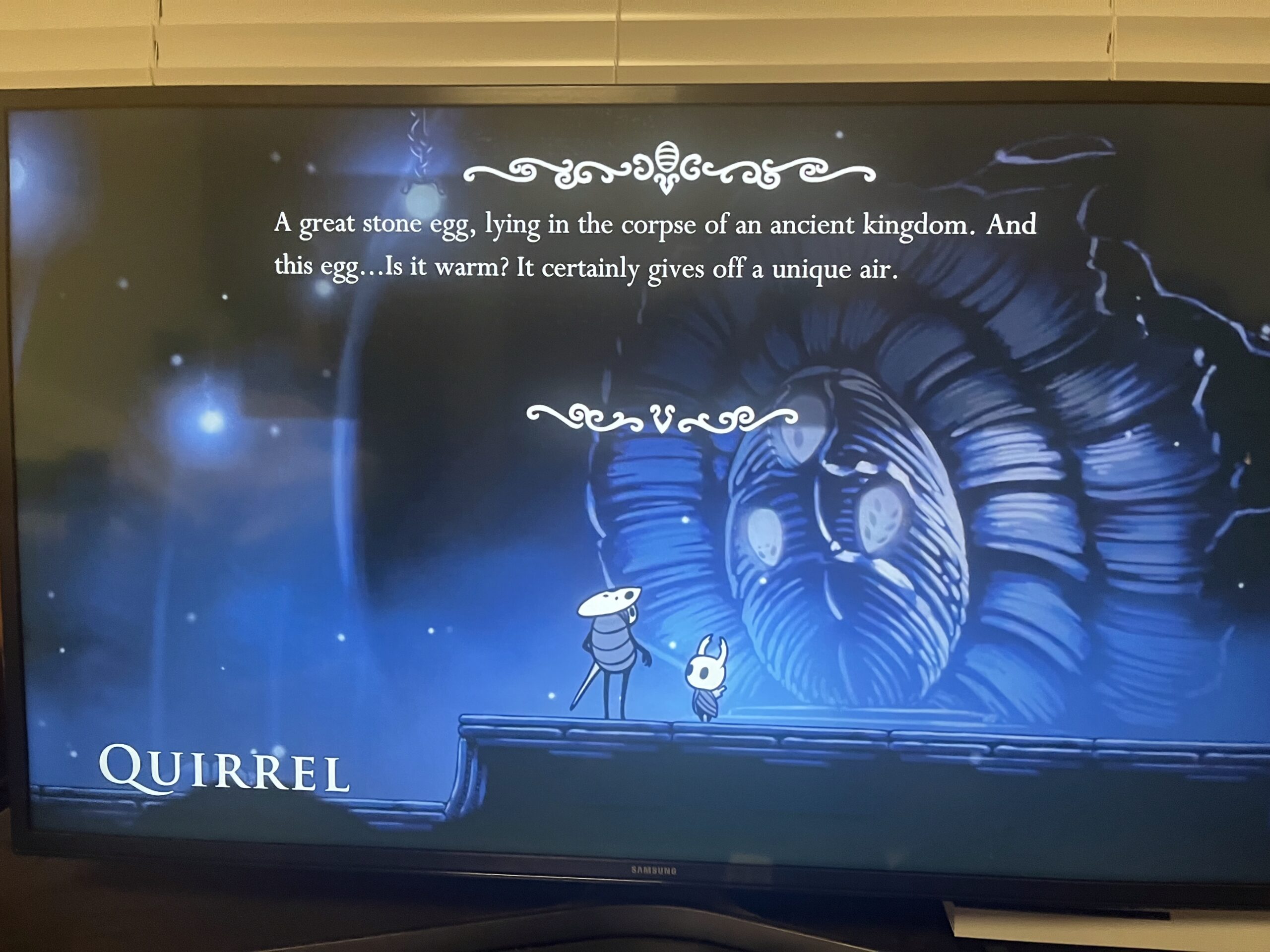
This scene exemplifies environmental storytelling, which Henry Jenkins defines in his article, “Game Design as Narrative Architecture.” Environmental storytelling is a strategy for unfolding a narrative through lighting, colors, and placement. This scene’s dark color palette reinforces the kingdom’s sense of forgottenness. However, the ethereal lighting and central placement of the massive egg enables the narrative to communicate this underlying spiritual essence. While the dialogue helps to clarify this theme, the environment is enough to create this picture.
The juxtaposition between emptiness and spirit is what drew me into the game and promoted my curiosity for the mysteries of Hallownest. As the young knight continues to explore Hallownest, the same dark color palette and ethereal lighting continue to evoke a mysterious tone that invites the player to uncover the kingdom’s fascinating history.
Another notable aspect of Hollow Knight’s design is its architecture. Namely, Hollow Knight incorporates architectural allusion. In his essay, “The Role of Architecture in Video Games,” Ernest Adams notes that allusion borrows real-life architectural styles that help to evoke the emotions that these styles suggest. The scene below borrows Victorian styles in the lamp post, rails, and bell, as well as other European styles for the columns and tunnel entrance, indicating wealth, intelligence, and elitism.

Although allusion is usually intended to give the player a sense of groundedness, it has the opposite effect in this case. The current Hallownest is full of alien foes, and while some exhibit intelligence, it is jarring to see such familiar, grand, elitist architecture alongside these beings. This contradiction enhances the narrative’s mystery, further garnering the player’s interest in Hallownest’s history.
Jenkins would describe this use of allusion as an instance of Hollow Knight’s embedded narrative, which imprints clues of the kingdom’s history into its environment and architecture. As a result, the player is likely excited to learn how Hallownest transformed from this elite kingdom into an alien world.
Conclusion
In just a couple hours of play, Hollow Knight demonstrates how a game can communicate narrative not through exposition, but through the subtle power of environment and design. The dark ambience, ethereal lighting, and alien-yet-familiar architecture immerse the player in a kingdom both haunted and lively. By embedding history into its world through visual storytelling and architectural allusion, Hollow Knight invites players to explore not only its physical spaces but its forgotten past. This mystery-driven approach is what makes the early experience of Hollow Knight so compelling and a testament to the worldbuilding potential of game design itself.
Ethics
Hollow Knight was effective in portraying bodies benevolently, mainly because it opted for abstract character designs that avoided familiar ideas of race and gender. Characters are usually bugs or spirits and are, as the name of the game suggests, hollow. This inhuman character designs, in conjunction with the theme of hollowness, allow the player to freely project their own meaning onto these bodies. If Hollow Knight had instead chosen to design its characters with familiar races, genders, or body types, it would be difficult to avoid biases. For example, if a player identifies patterns in the movements or abilities of characters with particular appearances, it could perpetuate stereotypes in a way that is unintended by the designers. Ultimately, Hollow Knight’s abstract characters serve as examples of inclusive game design.