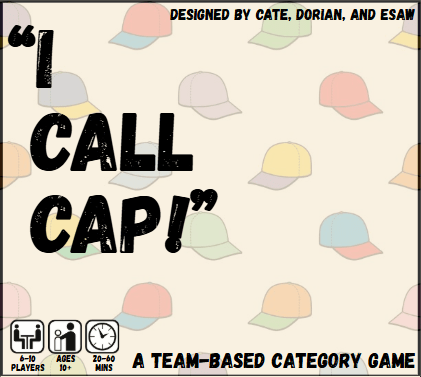
“I Call Cap!” – Esaw Adhana, Dorian Gulley, Cate Celio
Artist’s Statement
Our intention in creating “I Call Cap!” was to create an engaging and inclusive category-naming game with a very-competitive edge. By keeping our categories broad, we were able to create a game where (we believe) any player feels like they can contribute to their team’s success without needing any niche knowledge. We put all players on a roughly equal playing field, and the betting aspect encourages players to put faith in their team rather than play passively. Also, by requiring teams to have to name items in a row, one after another, we ensure that collaboration isn’t just advantageous — it’s imperative. Still though, after playtesting, we acknowledged that there is a lot of pressure for one player to name something and nobody wants to be dead weight for a round, thus we allow players to skip their turn, slightly slowing down their team, but allowing the game to progress and their team to potentially succeed. Overall, “I Call Cap!” creates a high-energy competitive atmosphere where teams — whether they are composed of strangers or friends who have known each other for years — can succeed together.
Concept Map

Initial Decisions About Formal Elements and Values
In the initial stages of designing our game, we really liked the idea of some competitive betting/challenging system, which we think is well-summarized by the name itself, “I Call Cap!” Inspired by games such as “BS”/”Liar’s Bar” (games where you can call your opponent out for lying), we wanted to include this mechanic somehow in our game, settling on the betting style where the ‘ante’ (the number of things to name) gets higher and higher. We especially like that during betting, nobody except for the ring leaders knows the category, which creates this mild dynamic of suspense/terror as the rest of the players can only watch as the bet rises and rises. Also, with regards to dynamics, our game was a bit more intense/unforgiving where an individual player had to name something or their team would effectively lose, but we ultimately decided to slightly ease this by allowing skips to help remove that “I failed my team. It’s all my fault. I’m bad.” feeling since that wasn’t something we wanted to encourage. One of the most challenging/finicky things that we encountered was trying to settle on categories. With the three of us, we were able to come up with many unique categories, but then, as we thought about it (as well as through playtesting), we realized that even if the rules were well-defined, it was ideal to have airtight categories with minimal interpretation/haziness. For example, we scrapped “How many colors can you name?” because we realized players would/did get into the habit of saying “Light green,” “Dark blue,” etc., and even if they didn’t, it was unclear if “Sunshine yellow” or “Lime green” were valid (and we wanted to minimize arguments during rounds). We were satisfied with the 40 categories we settled upon, but we also acknowledged that allowing for some creativity was partially what made the game fun (particularly when someone names something that you hadn’t thought of before!). Ultimately, our game, based on the number of required players as well as the unavoidable limitation of the number of cards/categories, isn’t something that one would play every weekend, and might be more of a 1–2-time play, but we are confident that we created a genuinely fun player experience. We create an aesthetic of challenge but also fellowship. Teams need to rely on each other to succeed, and even though the concept is relatively simple, players very quickly get “into” it. “You guys are on to something…” was one piece of feedback we got during our playtesting and was pretty representative of the general feedback we received, namely that our game is more than a gimmick — “I Call Cap” is something that people could see themselves playing (and possibly purchasing) — no cap.
Testing and Iteration History
For the first iteration of our game during class, we already had a basic infrastructure set up. We had the idea that we wanted players to bet for their teams to see how many items in a trivia category they would name. Our first playtest had tons of different categories, where team leaders would publicly grab cards, bet, and then team members could all name items as fast as they could, as soon as they thought of an item. The testing went well, we had multiple players tell us they had fun and felt engaged. We got the feedback that the 30 seconds was a good timeline, and they felt that all players had many opportunities to participate. However, we did notice some issues that we corrected for the next iteration.
First, we found that when team members had the entire betting period to think of items in a category, it was less spontaneous. We also found that team leaders could get visual cues from their team about what they thought they should bet. Since this took away the suspense of betting, we decided that cards should be secret. Further, we found that team members were naming items so quickly that we were unable to hear, count, or determine if something was repeated or not in a category. From there, we decided that team members must name items in a specific order, going down a line. We also found that some categories were too open-ended or allowed for answers that were not as fair. For example, a “movie titles” category allowed for Star Wars 1, Star Wars 2, Star Wars 3, etc. When playtesting these changes, the game once again went well, and we got positive feedback about its level of fun. Our main feedback that we received was around the ability to dispute answers that the other team named. Here is a

Thus, the next iteration of our game for the next playtest refined the scoring and counting system. We wanted a balance between ensuring that all named items were said in good faith, the rhythm of the game was not compromised, and scores were adjusted fairly. While refining categories limited the number of answers in disputes, we had a few instances where players would call out answers they didn’t like in the middle of naming, and arguments would eat into their limited time. From this, we decided that players could call out completely erroneous answers but leave questionable answers for debate at the end. In tandem, to ensure that a win or loss did not always depend on disputes at the end, we encouraged teams to continue naming until the end of the 30 seconds, rather than stopping once hitting their goal. We also allowed one skip per team per round to allow teams a chance to allow the round to continue longer.
The next round was our final playtest. The players were engaged and almost completed an entire game at the time. They told us it was fun, and that their “hearts were racing.” Since one team started to take a clear lead at the end, the playtesters suggested that we add more variety or randomness to allow teams to make a comeback. They were excited by the idea of point multipliers on certain cards, which we had discussed prior, so we implemented them into our final card design. We also got the feedback that the game could be stressful due to the combination of a time crunch and fear of letting your team down. Due to this, we changed to allowing unlimited skips, while still enforcing the players to go down the line, so that all players have the opportunity to participate. Finally, we refined some rules so that it was clearer to players. Our testers ran into issues where team leaders were signaling answers to other team members, and we decided that gesturing, as long as nothing was said aloud, was alright to allow the team to advance.
Important Links
Here is the link to our final prototype containing rules, our card designs, our box design, and image credits: Final Prototype
Here is the link to our final playtest video: Final Playtest Video
Extra Credit
When designing cards, we made sure to round edges in order to match the game’s playful vibe and to prevent paper cuts. We also used Cardstock to make the cards easier to handle and shuffle.