Secret Hitler and Active/Passive Play
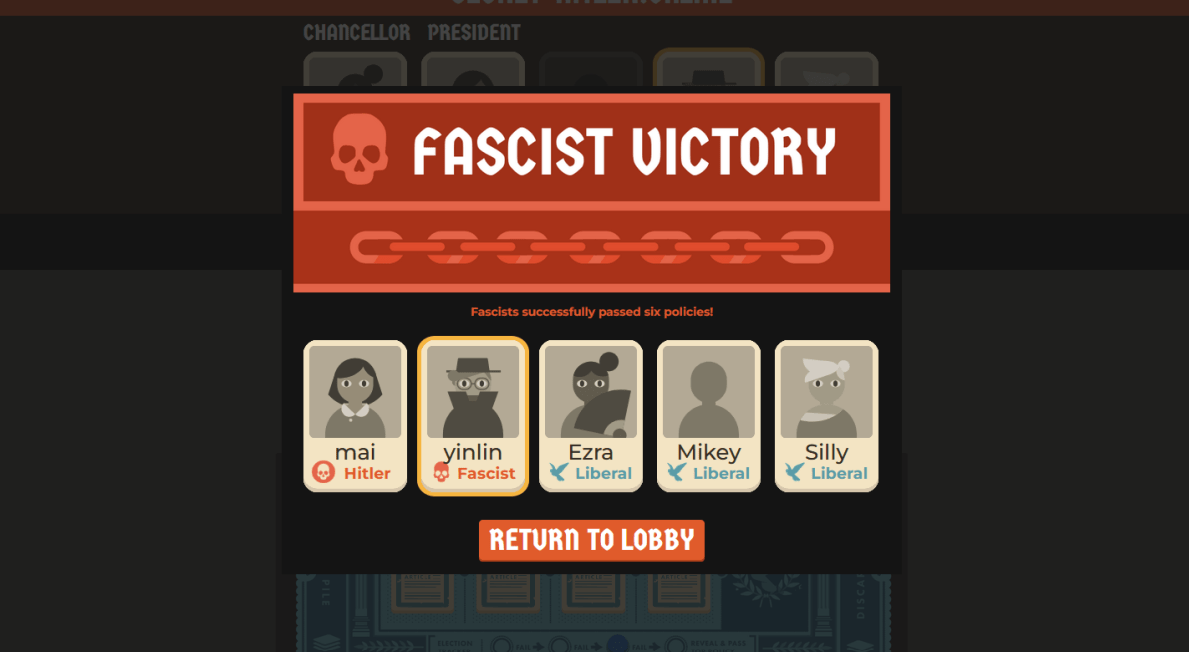
Secret Hitler is a social deception board game created by Max Temkin, Mike Boxleiter, and Tommy Maranges, who make up the publishing company Goat, Wolf, & Cabbage LLC. It’s meant to be played by groups of 5-10 people, with an age range of teens and up. Players take on roles as members of the fascist or liberal parties of a Weimar Republic-era Germany, with each side trying to pass a number of their own policies or get the Hitler player elected Chancellor (if you’re a fascist) or successfully root out “Hitler” (if you’re a liberal). While there are ways to eliminate players, the core of Secret Hitler, unlike deception games like Among Us and Mafia, does not involve voting on players to eliminate each round. Killing Hitler is great, but simply keeping Hitler and the fascists out of power also creates a winning scenario.
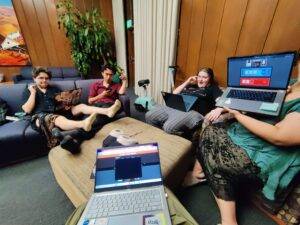
Secret Hitler facilitates a social dynamic that really forces me to be conscious of the initiative I take within a group trying to achieve a goal. In this case, the goal is to root out Hitler. Whether I was a liberal and actually trying to find Hitler or a fascist and just pretending to go along with it, I was constantly thinking about and calibrating the things I said and did, wondering whether I should be acting more independently of everyone else, trying to lead the group discussion, or lying low and going with the flow.
The point, partially, is to avoid suspicion. Since the game is structured so that roles are hidden from everyone except for fascist players (or Hitler, if you’re playing in a smaller group. With larger parties, Hitler is unaware of who their fascist supporters are.), all players are encouraged to behave in a way that keeps them out of scrutiny (for the most part). The primary group decision making mechanic involves the voting in of Chancellors, a simple process that ends up becoming the longest part of the game due to the discussions that precede each vote. While everyone casts their votes individually, it’s not uncommon for players to want to reach some kind of group consensus about whether the candidate is suspicious or not before proceeding with the election. These discussions are lengthened considerably in the late game, when electing Hitler as Chancellor leads to an instant loss for the liberal team.

In my first few sessions, I noticed that this mechanic, combined with my desire to avoid obstructing the liberal party’s goals and avoid suspicion, pushed me towards taking on a more passive role in the group. I observed others more than I accused people, and when I did, I wasn’t super committed to my ideas. Often, I would find myself asking “so are we voting yes or no?”, seeking to do what everyone else had decided instead of voting the way I felt. In my mind, I felt that this was a good strategy for blending in.
Secret Hitler doesn’t only encourage players to choose passive and conformist playstyles, though. The other reasons why I ended up doing so when I first began playing was because I didn’t trust my own judgments—of my other players, and my observational skills— and because I wasn’t familiar enough with the other players to feel comfortable engaging more. Especially in such a confrontational, conflict-prone context, because even if it’s just play, the rounds of Secret Hitler that I played could get heated. The more I played, though, and with people I was closer friends with, I found that I trusted my intuition more, or at least felt more secure in knowing that even if I was wrong it wouldn’t be the end of the world if I still insisted. Participating more actively meant that I would inevitably stand out more, and get accused more, but I became more comfortable with fielding accusations as well.
These social dynamics occur outside of the game too. When I’m new to a social setting, I feel less comfortable being confrontational and distinct. I dissent more, talk louder, get more opinionated when I’m in familiar settings. What Secret Hitler does is bring those social behaviors to the forefront of my mind by turning them into the game’s strategy. Trying to win the game meant I was constantly taking note of and cataloguing my social participation, causing me to notice much more about my behavior and how I presented myself, as well as the reactions I would get. Knowing this also meant that I could consciously decide how I wanted to play a certain round, whether I felt like blending in on purpose or draw attention. When I played as a fascist, I would sometimes act suspiciously on purpose, so that scrutiny would be taken off of the Hitler player.
ETHICS
While part of the fun of Secret Hitler is the interplayer conflict, there are ethical implications in creating a game that is built to facilitate accusations and arguments between players. As with many deception games, the implication is that it’s up to the group playing to mediate the intensity of the game, but that also means that it’s possible for groups to fail to do this. Without safety bars, what happens when conflicts that happen in the game become too serious, and turn into conflicts outside the game?
Additionally, Secret Hitler specifically calls into question the ethics of utilizing the metaphor of fascism and Nazi Germany as its theme. The game does want players to experience and understand (on a very abstracted and simplified level) the ways in which fascists can fly under the radar and create division in a party, but this concept is mostly lost under the rest of the gameplay. It’s much too abstracted, and the pace of the game doesn’t leave any room for thoughtful reflection. Even with that in mind, the invocation of these names and the histories attached to them in a party game can come across as insensitive and trivializing the real-world ramifications of the Nazis. Though the game makes quite clear its stance as anti-Nazi, the invitation to play within its historical set dressing—assume the “Hitler” role, even—can feel disrespectful. Fascism, Hitler, etc: these are terms that the average Secret Hitler player is going to be very familiar with, as this theme has not only connotations of evil but also brings to mind the political and bureaucratic. It makes sense to use these as a shorthand for the game’s mechanics and vibes, then, even if it may not be the most ethical. Could Secret Hitler be reskinned, its mechanics reexplained within the context of a different world? Would it be worth what could be potentially gained or lost from the game?