Dys4ia, developed by Anna Anthropy, is a game developed for Mac and Windows platforms, that tells the autobiographical story of Anthropy’s journey on hormone replacement therapy (HRT). The game’s primary target audience is really Anthropy herself; she calls it a journal game. It is a form of feminist self-expression, or, in her words, “documenting the emotional experience of transitioning”. The game serves as a powerful tool of expression, blending game design techniques of puzzle design, as well as queer theory, through platforming queer perspectives, and a focus on reclaiming the body and the erotic.
The design of the puzzles reflects the emotional experience of a shifting body and experience during HRT. Throughout the game, the player is challenged to pass through a brick wall. The first time, the player’s shape doesn’t fit through the wall, but it does fit in. The second time, after the player has started HRT, the player can barely walk up to the wall, because their shape is so awkward. Before the third and final time, there’s a minigame in which the player plays a version of pong, breaking the wall to make room for themselves. In the third and final version, the player is still a constantly shifting shape, but can finally fit through.

[the first brick wall puzzle. Though it seems like you can almost fit through, you always get stuck]

[the second brick wall puzzle. The player’s shape is increasingly strange and unable to fit in]

[the third brick wall puzzle. The player is constantly changing, but can finally fit through]
Several other puzzles also highlight the experience of being trans in the form of representing emotional struggles physically. The choice to represent these experiences as physical challenges, in which the player can win or lose, makes vivid the social pressures of being trans in a social world. It is not only an internal experience, but also a deeply interactive and potentially alienating experience.

[having to defend against rude comments. Literally being on the defense and taking damage]
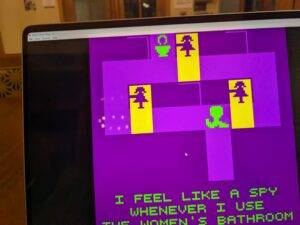
[navigating an unsafe videogame environment, where you can lose, is not unlike navigating an unsafe physical environment, in which trans women are especially vulnerable to violence]
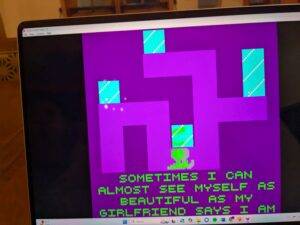
[each mirror has a slightly different reflection. Self-image as fluid, contextual, and potentially damaging]
The game also makes use of queer and feminist theory by speaking candidly about the body, the erotic, and the power structures that constrain them. Several of the puzzles in the game talk about Anthropy’s relationship with her chest hair, chest size, and nipple sensitivity. These candid conversations destigmatize the body and permit it to be celebrated. She is able to, both through HRT and the artistic expression of this game, reclaim ownership and joy in her body.

[trans joy at no longer having to shave her chest]

[trans joy with her growing chest and less sensitive nipples]
Lastly, the game makes use of queer time by employing a non-linear menu and encouraging non-linear experience. The game does not force the player to progress directly along a single path. Instead, they may replay the events in any order. This highlights how the experience of transition is an ongoing process that repeats in non-linear ways. This queering of time allows players to sit with moments that impacted them emotionally, or reexperience episodes in new ways, trying new things. This is especially helpful for people who are seeking comfort, experience anxiety, or who get distracted easily. This helps make the game not only more artistically representative of Anthropy’s transition, but more inclusive.
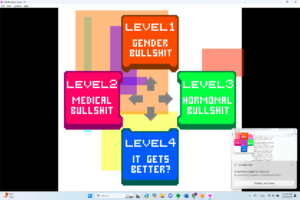
In conclusion, Anthropy integrates elements of puzzle design into queer theory, destigmatizing bodies, confusion, and non-linear progress. One thing I really admire from her approach is her use of game as journal. Though games are inherently interactive, it is easy to overlook that the process of creating a game is itself an interactive, therapeutic process. This philosophy can be used to remind ourselves that creation is play, and that that playfulness is itself political, regardless of who the game is made for and whether it ever releases.