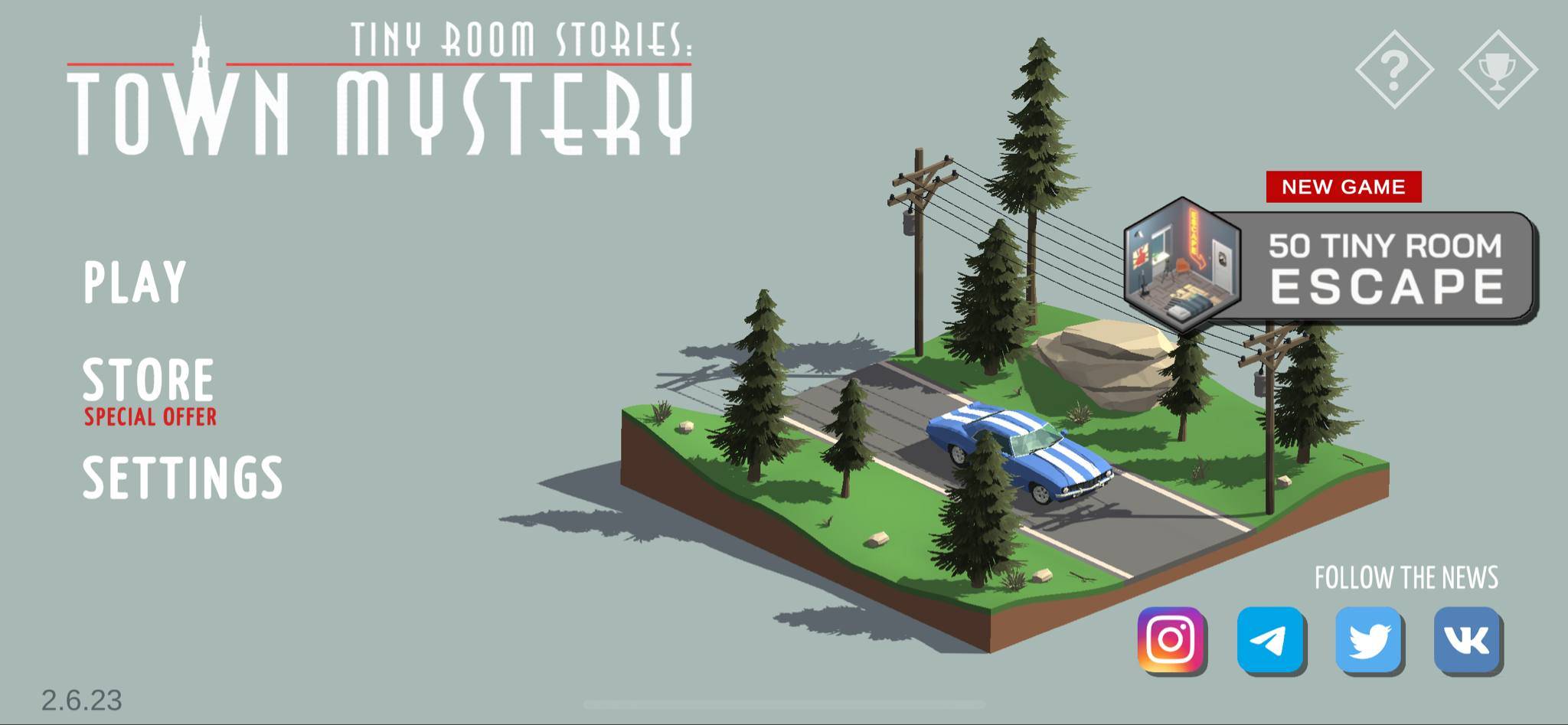
For this critical play analysis, I played Tiny Room Story: Town Mystery by Kiary Games Ltd on my iPhone (also available on Android). This single-player puzzle adventure game combines escape-room mechanics with detective storytelling. You play as a private investigator returning to your hometown after receiving a letter from your missing father. When you arrive, the entire town is abandoned, and you must solve environmental puzzles to uncover what happened. The game’s intuitive touch-based interactions and modular room-based design make it approachable while still offering rich layers of mystery and challenge.

Figure 1: Story Set Up
At its core, Tiny Room Story uses clear but clever mechanics: tap to interact, drag to rotate the room, collect items, and solve puzzles to unlock new areas (Figure 2 & 3). Each room is small but filled with visual clues. The player must observe, manipulate, and sometimes revisit these environments to progress. These mechanics not only serve the gamer’s experience, but also the storytelling experience. Every interaction with the room reveals a new narrative layer either through a found document or environmental context.


Figure 2 & 3: Room Hint and Puzzle
The narrative is embedded directly into the puzzle progression. Rather than rely heavily on dialogue or cutscenes, the game tells its story through the structure and contents of its environments (Figure 4). This environmental storytelling is reinforced by the game’s formal elements: the objective (solving central mystery), boundaries (each level is a self-contained space), and rules (interact, rotate, observe). The pacing of the story is tied to how quickly the player solves each room, making narrative and mechanics interdependent.
The sense of place is crucial. The town’s eerie emptiness, coupled with the realistic details of each room, creates a strong atmosphere of unease and curiosity. The architecture isn’t just a backdrop, but rather a storytelling device (Figure 4). The player doesn’t just read or hear what happened, they can see it in the half-eaten meals left on tables, dusty workplaces, and locked doors that suggest hidden elements. This architectural design echoes game studies concepts of spatial narrative, where space itself becomes a vehicle for plot progression.

Figure 4: Abandoned office with abandoned food
If I were to improve Tiny Room Story: Town Mystery, I would expand the variety of interaction mechanics to deepen immersion. While the rotate-and-tap system works well, introducing light locomotion (even if it’s limited to room transitions) or branching puzzle paths could make exploration feel less linear and more investigative. Additionally, adding more character-driven story elements, like flashbacks or voice recordings, could add emotional weight to the otherwise solitary mystery. This would shift the aesthetic slightly from pure challenge and discovery toward narrative and fantasy, which would give players a more layered emotional experience. These additions would complement the strong environmental design while enriching the story’s depth and the player’s sense of agency.
From an accessibility standpoint, Tiny Room Story: Town Mystery presents some limitations. It relies heavily on visual cues, small touch targets, and intricate spatial puzzles that require rotating 3D environments. This design can be challenging for players with visual impairments or motor difficulties. There are no in-game settings to adjust contrast, text size, or enable screen reader compatibility (at least that I could find in app itself / online). As a result, the game unintentionally excludes players who rely on adaptive technologies or require alternative inputs. Including option accessibility modes, like visual assistance or alternative navigation methods, would greatly improve this game’s inclusivity.