


Brought to you by Team 13: Lorenzo Ahn, Karina Li, Luke McFall, Faith Zhang
Artist’s Statement
Common Thread was created to bring strangers, friends, and families closer together by breaking down verbal barriers and inviting them to dive into each other’s minds. We wanted to explore how expression and collaboration can facilitate connection, not through perfect communication, but through the messy, creative ways people interpret and build on one another’s ideas.
In this game, players work together to uncover a secret word, using only sketches inspired by their individual clues. Without the ability to explain or clarify their drawings, they must rely on whatever fragments they can piece together, often leading to wild guesses, hilarious misinterpretations, and moments of unexpected understanding.
At its core, Common Thread is about imperfect collaboration. It’s a playful reminder that even shared confusion and collective imagination can bring people closer together. All it takes is a few people, a few scraps of paper, and a little creativity.
Concept Model
During our individual brainstorms, many of us gravitated toward deduction and communication-based games. We drew inspiration from games like Mao, Telephone, Wavelength, and Heads Up, all of which emphasize hidden information, subtle signaling, and interpreting limited clues.

We were especially interested in how players infer meaning and collaborate without relying on explicit communication and wanted to center our game experience around the tension and excitement of deducing hidden information. This led us to focus our concept map on interactions that revolve around gradual understanding and “aha!” moments:

Initial Decisions and Values
During our first project meeting, we had very similar ideas for what our game should be. As we narrowed down our ideas into a select few, we noticed common traits among our ideas and found ways to combine them all into 3 core game elements. From these 3 mechanics, our first game idea was born.
- Drawing: The first major commonality that our ideas had was team based drawing. We all agreed that a group of people with varying artistic abilities working together to create artwork has a lot of potential for organic and fun gameplay moments. We designed 2 ways to facilitate this. Everyone working together on the same drawing or a chain-of-events style drawing where people draw individual pictures that only make sense in the context of the group’s drawings.
- Social Deception: We were really excited about the idea of the group working together to create a masterpiece while a few imposters were trying to ruin the drawing without being detected. The first major challenge with this was finding a balanced way to create an unbalanced flow of information. It was very difficult to design mechanics where information could be withheld from the whole group so that a spy could “blend in” while still having the group work toward a common goal. We decided to start with a spyfall-like design where players take turns adding details to a drawing while the spy would try to evade detection and try to guess what the group was drawing,
- Fast paced gameplay: A big goal of our game was to have fast and snappy gameplay. We initially thought that a turn based game would be the easiest way to incorporate our “spy”, but we all agreed that waiting around for your turn is incredibly boring so we decided to involve a timer element to speed up gameplay. Another way we came up with to create a sense of urgency in our game was to have everyone be doing something all the time. In the case of drawing, everyone starts with a piece of paper and gets a set amount of time to draw before they pass their drawing to the next person. As they pass the drawing, they would also receive the drawing that someone else started. This design showed a lot of promise in terms of fast gameplay, but significantly changed the mechanic of the spy.
Formal Elements
Players
Originally, we designed the game for a small to medium-sized group around 5-8 players. Players are either part of the main collaborative drawing team or secretly assigned the role of a spy, whose goal is to subtly throw off the main team and guess the secret word before the main drawing team does.
Objectives
For the majority of players, the objective is to successfully guess the secret word based on their drawing interpretations of the individual clues they received. For the spy, the objective is to correctly guess the secret word before being discovered. Players gain satisfaction from either successfully deducing the secret word or catching the spy in action.
Procedures
In our initial idea, each player begins with a blank sheet of paper. Working under a timer, players draw based on their assigned clue, then pass their drawing to the next person. The next player uses the previous drawing as inspiration while also incorporating their own clue, trying to piece together the growing artwork. This cycle repeats for several rounds, encouraging quick thinking and layered creativity, similar to the game Garctic Phone. Meanwhile, the spy, who receives no clue, must still add to the drawings and blend in without revealing their lack of information.
Rules
- Each player, except the spy, gets a clue word related to the secret word. For instance if the secret word is “whale”, clues might be “mammal”, “ocean”, “blue”, “wet”, and “big”. The spy receives a blank card.
- Players draw in sequence, each having a set time (e.g. 30 seconds) to add to a drawing before passing it along.
- After the chain reaches the last player, the group reveals all their drawings and works together to guess the secret word and identify the spy.
- If the group correctly identifies the spy or guesses the secret word, they win. If the spy correctly guesses the word first and avoids detection, they win.
Resources
The main resources are paper, drawing utensils, and the target word provided at the start. Time is also an essential resource to the game, helping to add urgency to the players’ drawing choices.
Conflict
The conflict centers on deducing the secret word while identifying the spy. Players must collaborate to interpret the drawings, but remain wary of deception. The spy must blend in convincingly without giving away their ignorance, thus creating tension between cooperation and opposition.
Boundaries
The physical boundary is the immediate play space, such as a table where players sit together and carry out all activities like drawing, guessing, and accusing.
Outcome
The game ends when the team wins by correctly deducing the secret word and identifying the spy, or when the spy wins by either guessing the secret word first or avoiding detection.
Playtesting and Iterations
Playtest #1
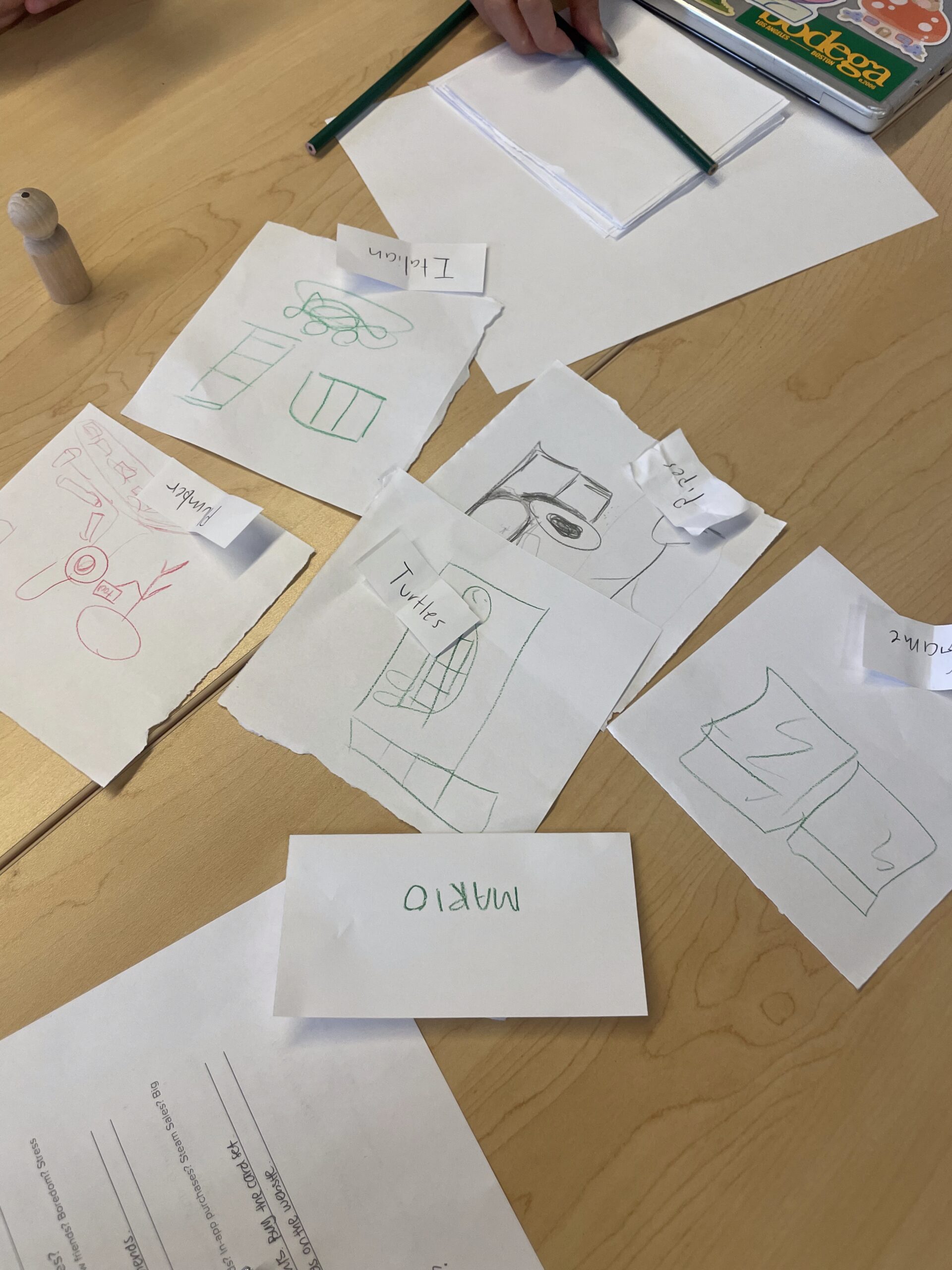
We conducted our first playtest during lecture with 6 students. At this stage, we wanted to explore different variables, such as whether to include the spy mechanic and whether players should draw sequentially or simultaneously. For this playtest, we tested sequential drawing without a spy. We gave everyone in the group a trait word. Then players took turns drawing their word in order. The word they were trying to draw was Mario.
This playtest was very revealing about what would make our game fun from this point forward. For starters, the chain of events drawing style was confusing for players because the trait words didn’t connect clearly enough to influence the next drawing. When we mentioned the idea of everyone drawing their own drawing but at the same time, they all agreed that simultaneous drawing would improve the gameplay experience.
Playtest #2
Our next iteration was also played in lecture. This time, we tested simultaneous drawing with a spy. All players got a trait word except for the spy, and everyone had 30 seconds to draw their trait. Once drawing time was done, players would reveal their drawing and have to guess what the target word was. If the spy guessed the word first they won, if the players guessed the spy first they won.
Playtesters immediately liked this version significantly more than the first. There was less confusion about the rules and objectives of the game. As the game progressed, players had very positive reactions to the game and our mechanics that we layed out. We noticed that the timer element created a sense of excitement and urgency as well as made the game move very fast. Once it was discussion time, players were able to guess the word, however they did it with only 3/6 of the drawings. This revealed a flaw in our game design where some trait words gave significantly more information about the target word then others. Another flaw was the spy drawing was almost completely ignored because it didn’t fit in with the other words. However, all playtesters agreed that simultaneous drawing was more fun.

Playtest #3
Our third iteration was in section, where we removed the spy element all together. Since the spy role felt awkward during gameplay, we wanted to see if it was necessary at all. All players got trait words and drew their traits simultaneously. Once drawing time was over, players would show their drawings and try to figure out the target word.
The version was the simplest form of our game yet and it really showed with the instruction process. There was very little confusion or misunderstanding of the rules of the game. The target word that players got was “Hamilton” and drawing time was set to 30 seconds. Players were able to guess the word pretty quickly, but had a lot of fun doing so. The next round, the target word was “Balloon Animal”, and players had a much harder time guessing the word. This led to the discovery that when players were given nouns as traits, it was significantly easier to guess the target word. On the other hand, when players were given adjectives, it was a lot harder. Overall, the play testers really liked this version of the game and really enjoyed the team work it fostered.

Playtest #4
We felt like we were approaching our final version of the game, but we wanted to see if a team versus team style of game would make it even better. We conducted this playtest with 8 students in class – 4 on each team. Each team got the same target word and same traits. They had 30 seconds to draw and then they had to try to guess the word. Whichever team guessed the word first, won.
Explaining the game to the playtesters went just as smooth as playtest 3, however, because there were twice the number of people, the set up took much longer. Once gameplay did start, we realized that this was almost an entirely different game than before. While playtester really enjoyed the added competitiveness to the game, there were several new nuances that we would have to think about as developers for this version to work. One issue, for example, was that one team would start listening to the guesses of the other to try to learn a trait word instead of discussing it with their own team. Besides player behavior, there were also double the people in the game which complicated setup and play more than we liked. Players also suggested adding a formal process for making guesses, such as ringing a bell to bring everyone’s attention back together. This would allow opposing teams to stay connected and still gain information by hearing each other’s guesses, rather than the game splitting into two completely separate groups.

Playtest #5
For our final playtest, we tested with 6 students. We realized from the previous playtest that the team mechanics added more complexity to the game than needed for the players to have fun, so we decided to implement only the most essential mechanics for our final iteration. No teams, no roles, no turns. Just the pure joy of drawing, squabbling, and guessing.
This time, the instructions were far simpler to comprehend than in the previous tests, as players did not really need to ask us for further clarification. This allowed us to be more clear about core rules such as players not being being to validate or reveal their trait word. We were worried that without spies or additional mechanics to incite conflict there would be less tension. However, we noticed that discussions still got heated. Part of this is due to better adherence to the rules by the players as they weren’t validating their traits, leading to fun misinterpretations and lively disagreements. Between rounds, testers brought in more players and wanted to keep playing, aiming to work their way up to harder difficulty levels. One potential improvement is to address repeatability, as once we get through the pre-packaged clues, the game could get repetitive. Our solution is to add blank cards for custom secret words and clue words that the players could come up with, opening up the door for inside jokes and repeatability.

Final Playtest Video
Print-n-Play
Final Designs
Box Design


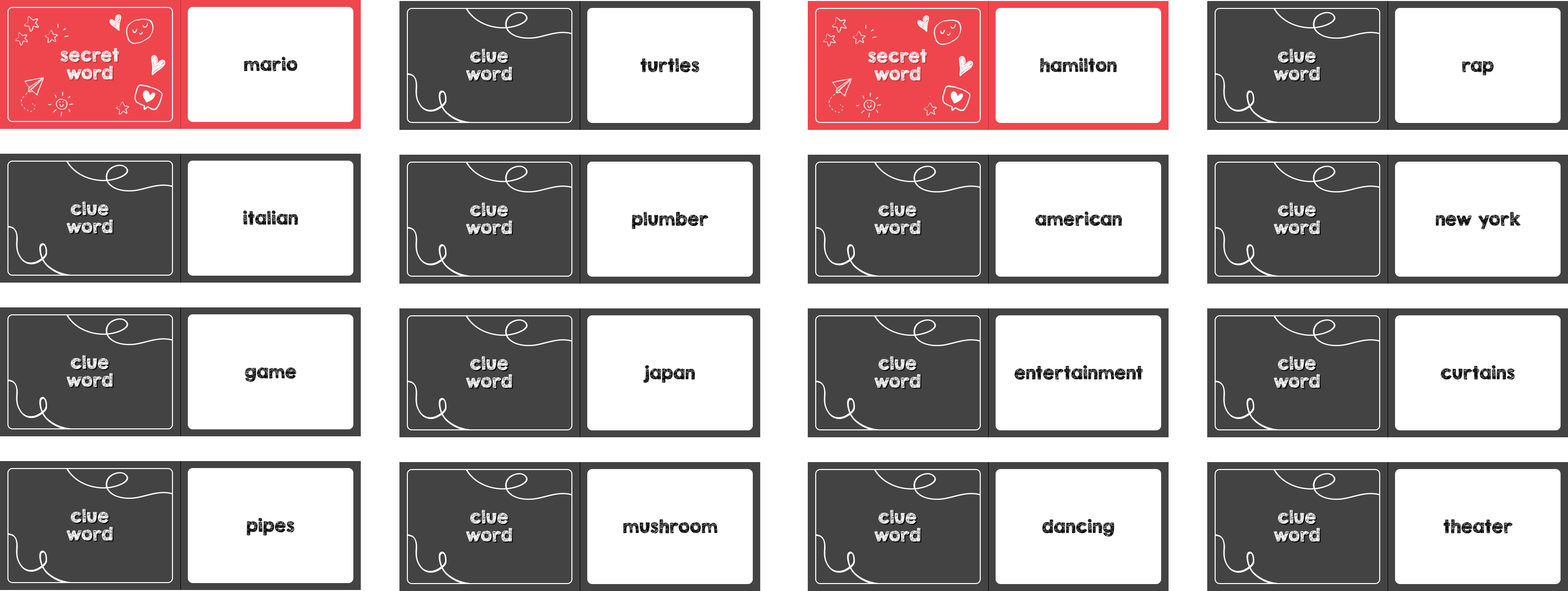
Card Design

Rulesheet


