

LINK TO GAME: https://madifan.itch.io/maries-phone
Please play before read!!
Overview
Marie’s Phone begins after the death of the protagonist’s grandmother. At her mother’s request, the protagonist travels to her grandmother’s home to help with funeral logistics — including the practical task of going through her phone to find photos, contacts, and bank details.
As players explore the phone’s apps — photos, notes, and messages — they gradually uncover fragments of the grandmother’s life. What starts as a functional search turns into an emotional journey. The player’s inner reflections shift in tone as they piece together memories and routines, revealing unspoken emotional distance and longing for connection within the family.
Over time, the phone transforms from a tool of efficiency into a vessel of memory. The more players engage with the grandmother’s traces, the more layered their understanding becomes, leading to one of several reflective endings that impact the protagonist’s relationship with their mother.
This game explores how we often come to know the deceased better after their death. We often take family relationships for granted while prioritizing “greatness” in other parts of life. Marie’s Phone urges players to slow down, reflect on the chance that they still have to get to know their loved ones better, and take advantage of those while they still have it. On the other hand, this game also explores the contradictory emotions that accompany loss—players should feel complex feelings of the weight of handling someone’s belongings, the bittersweetness of discovering small details about a person after they’re gone, and the way grief and administrative tasks uncomfortably coexist
How did this game come to be?
The idea began with a simple question: What would people think of me if they looked through my phone after I died? I imagined someone decades in the future scrolling through messages, notes, and photos from my twenties. This thought opened up questions about how our digital traces shape memory and how technology mediates the way we’re remembered.
At first, the project was rooted in technological curiosity, exploring the intersection of death, data, and digital afterlives. But as I continued developing the concept, my focus shifted toward the emotional dimension of remembrance. I became more interested in how our perceptions of the deceased evolve when we encounter their belongings—especially ordinary, personal traces like notes, photos, and unfinished messages. The project grew into an exploration of how grief, memory, and discovery intertwine, and how confronting what’s left behind can create an urgency to connect with our loved ones while we still can. I was really curious how a project that leverages embedded storytelling (while still being mainly text based) can help land a message that can feel overdone, especially when this mode of embedded storytelling feels close to how one might deal with death of a family member in real life.
Branching Choice Map
The game branches based on three factors:
- Emotion points, which increases by one for each purple tagged passage in the phase where the player explores the grandma’s phone. This metric stands for how much the protagonist comes to learn about the deeper emotions of grandma in ways that they didn’t before.
- Reflection points, which increase by one for each blue tagged passage in the phone exploration phase. This metric stands for how much the protagonist reflects about grandma as a person, independent of learning new things about her.
- Choices in the talking to mom phase. Players get off the phone after finding the information the task list asks for and talk to the protagonist’s mom. If their emotion and reflection points are insufficient, they would be directly channeled to the bad ending. If they have sufficient points, the protagonist would come to tell the mom about the grandma’s secret hobby. Depending on how the protagonist interacts with the mom here, the player will arrive at the emotional or medium ending.
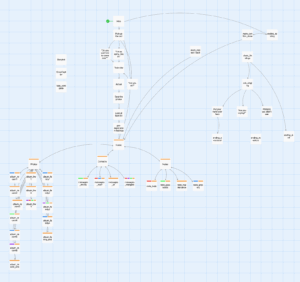
Map for which passage gives what points:
| Artifact | Reflection | Emotion | Task |
|---|---|---|---|
| album_recent_1 | 1 | ||
| album_recent_4 | Hobby artifact, Picture of her | ||
| album_recent_5 | 1 | ||
| album_recent_6 | 1 | ||
| album_hw_3 | 1 | Hobby artifact | |
| album_family1 | 1 | ||
| album_family_3 | 1 | Photo of her | |
| album_family_4 | 1 | ||
| messages_mom | 1 | ||
| messages_margaret | 1 | Call list | |
| messages_mrchu | Call list | ||
| note_grocery | 1 | ||
| note_passwords | Finance |
Choice map for talking to mom:
| Passage | Choice | Empathy |
| Mom_confirm_done | Of course I did! | -1 |
| Yes, I’m sure | +1 | |
| Ask_singing | Hold hand | +1 |
| Pretend you didn’t see | -1 |
Historic Versions of Marie’s Phone
In total, the game went through 5 iterations and 9 playtests. I will go through each iteration and highlight key design changes and supporting evidence.
Version 1 – Paper Prototype (10/13 Playtest #1)
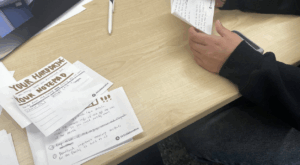
Playtesting with Luna
Playtester information:
Luna: 20s, personally relates to the theme a lot from personal experience with hispanic family culture that doesn’t talk deeply about emotions.
The first paper prototype introduced the concept of a player exploring their deceased grandmother’s belongings to uncover who she was in life. The core tension at this stage was between privacy and grief — the player both intruded on and memorialized the deceased. My first playtester Luna connected strongly with the theme: “like, I’m Hispanic, and they don’t talk about sh*t. Except when they’re drunk…And then they tell you everything. And, like, oftentimes you’re like, didn’t need to know that. But, like, that’s the price you pay, right?…I think that there’s something interesting [about] the different ways that people handle family communication.” (15:10). Luna did not want their recording shared online, so I will link the transcript to this playtest here.
However, she observed that the prototype was “trying to do two things at once”(19:26) and advised me to focus on one emotional throughline. She also pointed out that the feelings were more important than the literal ending.
Mechanically, the interface was confusing: the prototype used both a hard drive and notebook inventory. Luna suggested consolidating this.
Changes: Based on this, I made the game explicitly about emotional distance and reconnection within families, setting aside the privacy angle. I wanted to center the outcome of the game on attitude and behavioral change, which had a clearer success metric with the family centric theme: I could interview players about their thoughts on connecting with family after the play test. After deciding the theme to focus on, I began developing the idea that player choices would mirror how people navigate grief and communication after death. I also merged the two inventories into one and planned new dialogue scenes with the mother to anchor the emotional transformation.
Version 2 – Figjam Flowchart Prototype (10/19–10/22 Playtests #2–4)
Playtester Information
Brian: 20s, personally relates to this topic as 2nd generation immigrant who has loose connection with grandparents due to language barrier and geography.
Krystal: 20s, personally relates to this topic as 2nd generation immigrant who has loose connection with grandparents due to language barrier and geography.
Luna: 20s, personally relates to the theme a lot from personal experience with hispanic family culture that doesn’t talk deeply about emotions.
The Figjam version was the first digital prototype, showing branching storylines and choices around reconciling with the mother. Players now browsed through Grandma’s phone to piece together her life, with different endings depending on how much they explored. The narrative structure was made up of branches of linear storytelling with an open exploration section for when players go through Marie’s phone. Choices that players make lead them to the corresponding ending, which is a relatively linear flow to allow more controlled dialogues for setting the emotions.
Brian found the concept emotionally powerful: “This is quite relatable… regret about not spending enough time with family” (0:00). He appreciated the phone interface: “It feels more natural than having this experience done purely in dialogue” (1:41).
However, players consistently found the writing too heavy-handed. They wanted the emotional resolution to feel more subtle and realistic to cultural norms in real life. Krystal felt the characters were “very generic”(0:17) and struggled to connect Grandma’s sadness with her life: “She’s going to watercolor classes, she seems really independent… why is she sad?” (1:24). She also pointed out the need to clarify the family’s cultural context and text styles.
Changes: In response, I grounded the family in an Asian immigrant background to explain the distant communication style and rewrote the prose to be more understated. I expanded the phone content to enhance the evocative and enacting narratives: I added neutral details like grocery lists and casual notes to make the phone feel more like a realistic device. By adding more content for the player to explore, I am allowing the player to uncover more information about the grandma and grow invested in grandma’s character (i.e. I leaned in to the enacting narrative more). Having content that don’t necessarily add to the emotional part of the narrative also balances the pace of the game—the player is not constantly contributing to the progression towards the end of the game. To slow pacing and make exploration feel more intentional, I started designing one-by-one reveal mechanisms for photos and conversations.
Version 3 – Early Twine Prototype (10/19 Playtests #5–6)
Brian: 20s, personally relates to this topic as 2nd generation immigrant who has loose connection with grandparents due to language barrier and geography.
Lucas: 20s, personally relates to this topic. Doesn’t identify as close with family or extended family.
By Version 3, the game transitioned into Twine with full interactivity. The branching system was functional, exploration felt intuitive, and the tone became subtler. He also appreciated the new exploration content, which “painted more context and characterization.” However, Lucas (~21) found the cause of death (a car crash) too jarring and suggested something more common and relatable: “if it was like an illness it would’ve been more narratively fulfilling.(0:06) He and others noted occasional confusion between the narrator and protagonist voices and asked for more clarity in dialogue attribution.
Players also wanted stronger emotional continuity between exploration and the ending. Lucas said, “Transition between phone exploration and emotional ending needs to be explored more” and pointed out that the protagonist’s “language ability” in Chinese wasn’t clear.
Changes: I changed the cause of death to a heart attack to make the story more grounded, added clearer speaker labels, and rewrote sections to distinguish internal reflection from narration. I also began testing “forced pacing” for albums to slow player progression and emphasize reflection. These updates deepened the emotional realism and made the gameplay feel more cohesive and believable.
Version 3.5 – Twine Expansion (10/19 Playtest #7)
Playtester:
Butch: ~20s, is close to immediate family but not super close to extended family.
Version 3.5 introduced the first rewritten ending since version 2. It attempts to write the emotional ending through a moment of physical connection between protagonist and mother. They described the new ending as “the strongest scene that evokes the most emotional response”(3:53). Interaction with Grandma’s phone brought on more of a sense of pity rather than sadness, but interacting with the mom is “where the cracks where the player can feel sad, remorseful, or wistful that their mom is guarded, and that is how they didn’t get to know their grandma” (4:58). For this reason, Butch wanted more interaction with the mom, more emphasis on the ending to really help players bring the learning back into real world relationships.
Butch also noted that requiring the players to “do more digging, getting a bit more labor on the player will make it more satisfying when they find something” (0:07). Right now, the exploration phase is full of findings that contribute towards an emotional moment, which can feel normalized when squeezed together.
Something that Butch liked was how the narrator had different reaction to the same piece of evidence based on what they’ve already seen. Butch revisited the same phone links multiple time to try to get different narrations. Sometimes they were able to, but in other times the narrator didn’t have more to say.
Changes: I expanded the conversation sequences with Mom and began using subtle cues to mark completed exploration areas. These changes emphasized intergenerational understanding and made the player’s learning feel more directly applicable to their own relationships, advancing the game’s empathy goal. I also added more content in the phone exploration phase that are “red herring content” to make discoveries in grandma’s phone more satisfying
Version 4 – Completed Endings + Notebook Reflections (10/29-31 Playtest #8-9)
Playtesters:
Christina: ~50s, feels like they grew apart from mother as they grew older so relates to the theme a lot.
Luna: ~25, personal connection to topic listed above
This version added the full branching structure: three endings (emotional, medium, and bad) and reflective notebook pages for each. Christina responded strongly to the emotional side of this update: “This [ending] almost made me cry, I really feel it myself. My mom and I have grown apart as I’ve gotten older and all my grandparents are gone…I feel like how to I push through the barrier that’s between us, how do I reach out to my mom again, it’s hard”(0:16). When Christina left the playtest, they noted “Now I’m going to have to call my mom” (4:31).
Christina also appreciated the nuanced portrayal of the mother’s emotional awkwardness and found that it conveyed a believable sense of inherited emotional restraint.—“She’s not very good at being supportive… each generation maybe does a little bit better than the last one, but it’s not like they will magically be perfectly emotionally well balanced person” (1:48).
Still, they wanted the bad ending to hit harder, mentioning that the bad ending should reinforce that the player is upholding the wall. They also noted confusion about who “Margaret” was and wanted more explicit reflection on Grandma’s Chinese notes and passwords.
The last major feedback from this iteration was that the notebook content didn’t feel very distinguished from the phone exploration. In fact, Luna was confused about why it was a different phase if it was conveying the same information.
Changes: I clarified character identities in how I mention character names, revised the bad ending to make the player’s role in emotional distance more visible through player choices, and made player choice a bigger factor in deciding the ending to give more sense of agency. The narrative structure is still mainly linear across sections for controlled storytelling, but the ending section is slightly more branched now based on how the player interacts with the mom. In response to the comment about the notebook, I condensed some of the content into the notes app of the phone and removed the notebook section entirely. Now, I only have the phone exploration and talk to mom phase of the games. This way, the interaction with mom also has a bigger role in the game, which matches previous playtesters’ feedback of wanting more interaction with mom (Butch).
Version 5 – Final Prototype
Across versions, Marie’s Phone evolved from a superficial exploration of grief that feels too generic to be related to into something that successfully evokes the desired empathy goals in players, as seen in quotes in the last few iterations.
By the final version, players were often leaving playtests reflecting on their own families. The game now successfully achieves its core goal: prompting introspection about emotional distance and reminding players to reach out while they still can.
Here is a quote from the final playtest with Luna on the project’s emotional success:
“I felt like I learned something, and I had something to take away from it, but yes…What I love about pieces that sit with mundaneity is that it is the bulk of our lives, and we need to treasure that, because it’s very easy for us to get caught up in the humdrum of, like pursuing careers, pursuing dreams, and then we sort of leave people behind that we’ve cared about. And I feel like your story does an excellent job of talking about what happens when you leave someone behind in that rush of trying to become great. So I feel like there’s something serene and deeply heartfelt about having a bit of a reckoning with that. And so I appreciate that this piece does that for me. It helps me feel in that way.” (47:52) Luna did not want their recording shared online, so I will link the transcript to this playtest here.
Reflection
During this reflection, I had many moments where I felt paralyzed by the space of possibility for what I could do. There are so many branches, so many metrics, and so many ways the narrative could go. I learned to really narrow things down in a low fidelity form early on and not be afraid to try a structure out. A specific example is when I was revising the ending: I was very conflicted on how to balance the metrics accumulated throughout the game to create a fair ending branch. However, the better approach for me ended up being just tracing through the story again to really follow the narrative. I realized it was ok to not be incredibly meticulous with calculating metrics for the scope of this project.
If I were to do an IF again, I would definitely be more robust in my initial writing to avoid decision paralysis in twine. I now have a better idea of how passages branch and link to each other, so I will also be able to make the writing closer to what twine would require.


I really liked the whole game and I thought the concept was very creative and well-executed. My favorite part of the game was definitely looking through the phone – the way the information about the family and grandmother is discovered is super creative and made me feel immersed in the experience. I also think the phone is such a great idea because so much of our lives is on there now, and you really can learn so much about people and what they care about by looking through them.
I also thought the part about the grandma getting singing lessons, the teacher encouraging the grandma to invite her family, and the chat between the mom and grandma where the mom is too busy to go really really sad.
I would’ve loved to see some of the artifacts on the phone visualized, such as the images in her camera roll. I think also with more time if the exploring phone part could be on an actual phone and players could click around it that could be amazing.